Greater Seoul index at 78.2, non-metropolitan at 60.6
Seoul falls below 100 for first time in three months
Middle East war, government regulations and rising interest rates weigh on sentiment
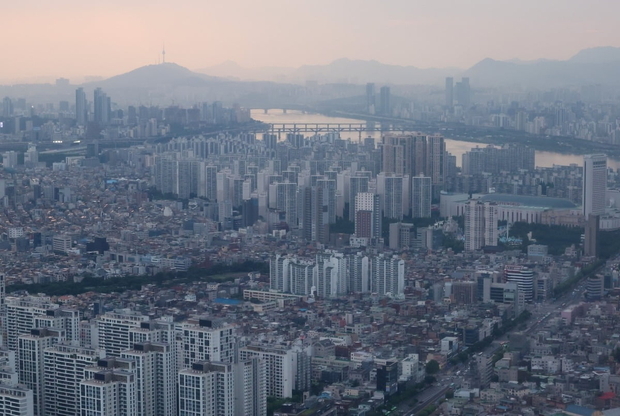
Seoul's Housing Business Survey Index slipped below 100 for the first time in three months since January (107.3), entering a downward phase. Ulsan recorded the steepest decline nationwide, plunging 41.2 points.
The Korea Housing Institute said Tuesday that its Housing Business Survey Index (HBSI) for April fell to 63.7, down 25.3 points from the previous month, based on a survey of housing developers. A reading above the baseline of 100 indicates that more developers expect business conditions to improve than to worsen.
In the greater Seoul area, the index dropped 16.7 points to 78.2. By region, Gyeonggi Province fell 23.1 points to 76.9, Incheon dropped 14.8 points to 70.0 and Seoul declined 12.2 points to 87.8.
An institute official attributed the decline to "external uncertainty stemming from the fallout of the Middle East war, concerns over an economic slowdown, rising construction costs driven by higher oil prices, and fears of weakening demand amid a recent uptick in interest rates," adding that the government's announced plans to tighten property holding taxes also weighed on sentiment.
The greater Seoul area index stood at 78.2, down 16.7 points, while the non-metropolitan index fell 27.1 points to 60.6. Metropolitan cities as a group dropped 33.3 points to 62.6, and provincial areas fell 22.4 points to 59.1.
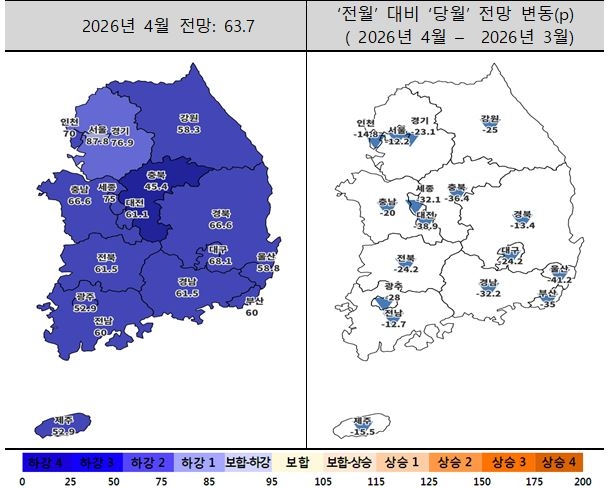
Among metropolitan cities, Ulsan posted the largest drop at 41.2 points (100.0 to 58.8), followed by Daejeon at 38.9 points (100.0 to 61.1), Busan at 35.0 points (95.0 to 60.0), Sejong at 32.1 points (107.1 to 75.0), Gwangju at 28.0 points (80.9 to 52.9) and Daegu at 24.2 points (92.3 to 68.1). In provincial areas, North Chungcheong Province led declines at 36.4 points (81.8 to 45.4), followed by South Gyeongsang Province at 32.2 points (93.7 to 61.5), Gangwon Province at 25.0 points (83.3 to 58.3), North Jeolla Province at 24.2 points (85.7 to 61.5), South Chungcheong Province at 20.0 points (86.6 to 66.6), Jeju at 15.5 points (68.4 to 52.9), North Gyeongsang Province at 13.4 points (80.0 to 66.6) and South Jeolla Province at 12.7 points (72.7 to 60.0).
Sejong, Daejeon and Ulsan saw especially sharp declines due to a base effect and broader concerns about market stagnation. "Unsold units after completion surpassed 30,000 as of February, with 86 percent concentrated in regional areas," an institute official said. "Concerns over delayed capital recovery and deteriorating project viability are significantly dampening sentiment among regional developers."
The nationwide financing index for April fell 16.7 points from the previous month to 66.1, while the materials supply index dropped 17.0 points to 79.6. "The upper end of commercial bank mortgage rates has exceeded 7 percent, increasing the financing burden on buyers and tightening funding conditions for developers as well," the official said, adding that prolonged conflict driving up oil prices, a high exchange rate and raw materials price instability were also reflected in the figures.
hope@heraldcorp.com