South Korea's stock market triggered sidecar circuit breakers 101 times this year — nearly once every two trading days
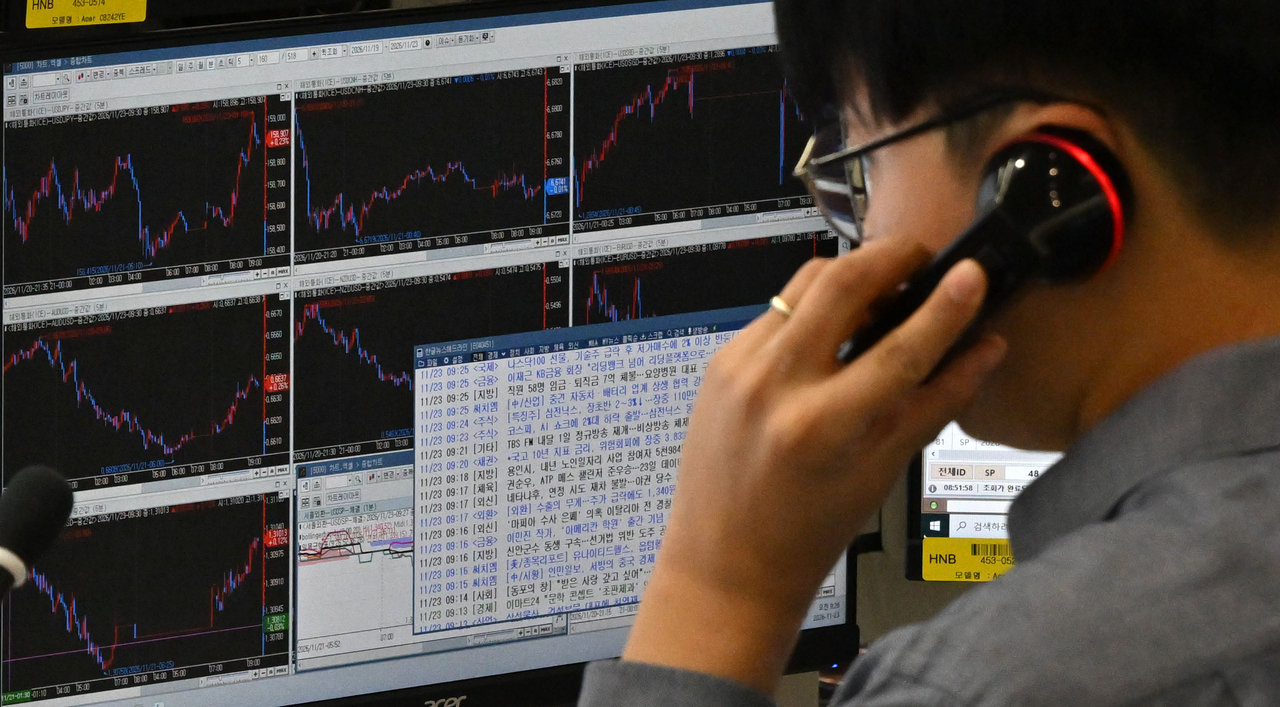
Volatility has been the defining theme of South Korea's stock market this year. Sidecar circuit breakers — temporary halts on program trading designed to cushion sharp price swings — have been triggered more than 100 times so far in 2026, more than double the count recorded during the 2008 global financial crisis. The KOSPI 200 Volatility Index, or VKOSPI, widely known as the "fear gauge," has averaged nearly 60 this year, more than twice last year's level.
Korea Exchange data show sidecars were triggered a combined 101 times across the Kospi and Kosdaq markets through Tuesday — 61 times on the Kospi and 40 times on Kosdaq.
With roughly 219 trading days logged through Tuesday, the trigger count is approaching half the total number of sessions. The figure does not mean sidecars fired on half of all trading days — both markets sometimes triggered on the same day — but it underscores just how extreme price swings have been this year.
The 101 triggers set an all-time high since the current sidecar regime took effect in 2002. Even during the 2008 global financial crisis, when world markets were in turmoil, the combined trigger count across both markets reached only 45. This year's total is roughly 2.2 times that figure.
On the Kospi alone, the 61 triggers this year already surpass the cumulative total of 60 recorded over the entire 24-year period from 2002 through last year.
Breaking down this year's Kospi triggers, 29 were buy-side sidecars and 32 were sell-side. On Kosdaq, 22 were buy-side and 18 were sell-side. Combined across both markets, buy-side triggers numbered 51 and sell-side 50 — a near-even split that reflects extreme volatility in both directions.
A sidecar is a safeguard that temporarily suspends program trading when market volatility spikes. Once triggered, program buy or sell orders are frozen for five minutes before the halt automatically lifts.
On the Kospi, a sidecar fires when KOSPI 200 futures prices move 5 percent or more above or below the reference price for at least one continuous minute. On Kosdaq, both the Kosdaq 150 futures price and the Kosdaq 150 index must simultaneously move by 6 percent and 3 percent, respectively, for one uninterrupted minute.
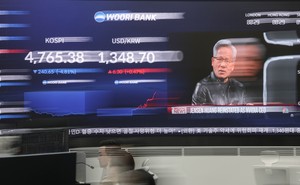
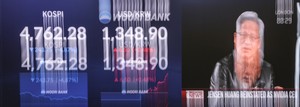
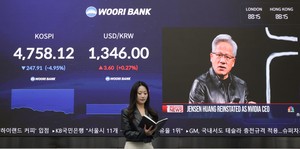
The frequent triggers reflect a year of violent swings in both directions. The Kospi fell 5.21 percent on Friday and dropped another 3.31 percent on Monday. Then on Tuesday, news of Nvidia CEO Jensen Huang's return sharply lifted investor sentiment, sending the index surging 6.32 percent to close at 5,006.03 — a single-day rebound.
That rally triggered a buy-side sidecar on the Kospi at 9:06 a.m. Tuesday, followed by a buy-side sidecar on Kosdaq at 9:28 a.m. The rapid succession of sharp declines and rebounds within just a few days forced repeated temporary halts on program trading across both markets.
The surge in volatility is equally visible in the fear gauge. Korea Exchange data show the VKOSPI averaged 59.1 from Jan. 2 through Tuesday — about 2.45 times the full-year average of 24.08 recorded last year, a year-on-year increase of roughly 145 percent.
The VKOSPI measures how much the market expects share prices to move, based on KOSPI 200 options pricing. It rises not only when share prices fall but also when sharp gains fuel expectations of wider swings ahead.
What makes this year unusual is that the fear gauge has remained elevated for months rather than spiking briefly. When the Kospi surged past the 9,000 mark in June amid wild swings, the VKOSPI climbed above 90. On June 29, it hit 96.94 at the close — the highest closing level since Korea Exchange began officially publishing the index in 2009.
The VKOSPI gradually retreated after that peak as volatility appeared to ease, but it has climbed again more recently as uncertainty over the AI industry and concerns about further US interest rate hikes have come back into focus.
The VKOSPI closed Tuesday at 58.45, up 4.69 percent from the previous session. While well below its year-to-date high, it still comfortably exceeds double last year's full-year average.
"Volatility is the No. 1 thing to monitor in the stock market right now," said Lee Kyung-su, a researcher at Hana Securities, adding that the current turbulence is distinctive in that it is a "stock-only shock." Lee said the key risk lies in the cycle of a reverse-monetary-policy market during a period of interest rate hikes, noting that share prices tend to form a bottom somewhere between a reverse-monetary-policy phase and a reverse-earnings phase.
However, Lee said current share price levels can already be seen as having priced in the relevant issues, and that investors need a strategy of watching volatility indicators closely to gauge when a true bottom arrives. Lee added that growing media attention to the government's stock market stabilization fund also reinforces confidence that volatility may be near its peak.
Nov. 25, 2026