"The road to Shu is harder than climbing to the blue sky."
The line comes from "Hard Road to Shu," a yuefu poem by the Tang dynasty poet Li Bai. The region around present-day Sichuan province is a vast basin ringed by mountains — in ancient times, one of the most inaccessible corners of the Chinese heartland. It was absorbed into China in 316 B.C., when Qin general Sima Cuo recognized the fertile Bashu region's enormous economic value and strategic geography and persuaded King Huiwen to launch a campaign of conquest. The victory freed Qin from chronic food shortages and opened a new avenue of attack against its great rival, Chu. A shift in thinking and a willingness to take risks changed the course of history.
SpaceX completed the largest initial public offering in history on Friday (New York time). Shares opened at $150, about 10 percent above the $135 offering price, and closed at $160.95, a gain of 19 percent on the day. The debate that once swirled around the offering price has now shifted to whether the stock is fairly valued at current levels. Some market observers have likened valuing SpaceX less to conventional stock analysis and more to the prediction markets that have surged in popularity in the United States.
The target prices on offer so far span a wide range: Oppenheimer has set a target of $195, while Morningstar puts fair value at $63 — implying either a nearly 50 percent gain from the offering price or a roughly 50 percent decline. Because SpaceX is still unprofitable, expectations rather than earnings will drive the stock. The market will eventually form a clearer view, but for now no one can predict the right number with confidence. In the face of that uncertainty, a solid grasp of where the company actually stands today is the most useful starting point.
AI the main drag on profits; spacecraft and Starlink show clear strength
SpaceX operates three main business segments: spacecraft, Starlink connectivity and AI. Based on 2025 figures, Starlink is the largest by revenue at $11.39 billion and also generates $4.42 billion in operating profit. The spacecraft segment is also in the red. The AI segment posts the smallest revenue at $3.2 billion and the largest operating loss at $6.36 billion.
Because the company as a whole is unprofitable, a price-to-earnings ratio could not be used to set the offering price. Instead, bankers applied a price-to-sales ratio — a metric more commonly used for early-stage companies. Based on 2025 revenue of $18.7 billion, the PSR at the offering price works out to 94 times. Determining where value lies requires first identifying where revenue growth will be fastest.
In its prospectus, SpaceX broke down its total addressable market by segment: $370 billion for spacecraft, $870 billion for Starlink and $26.46 trillion for AI.
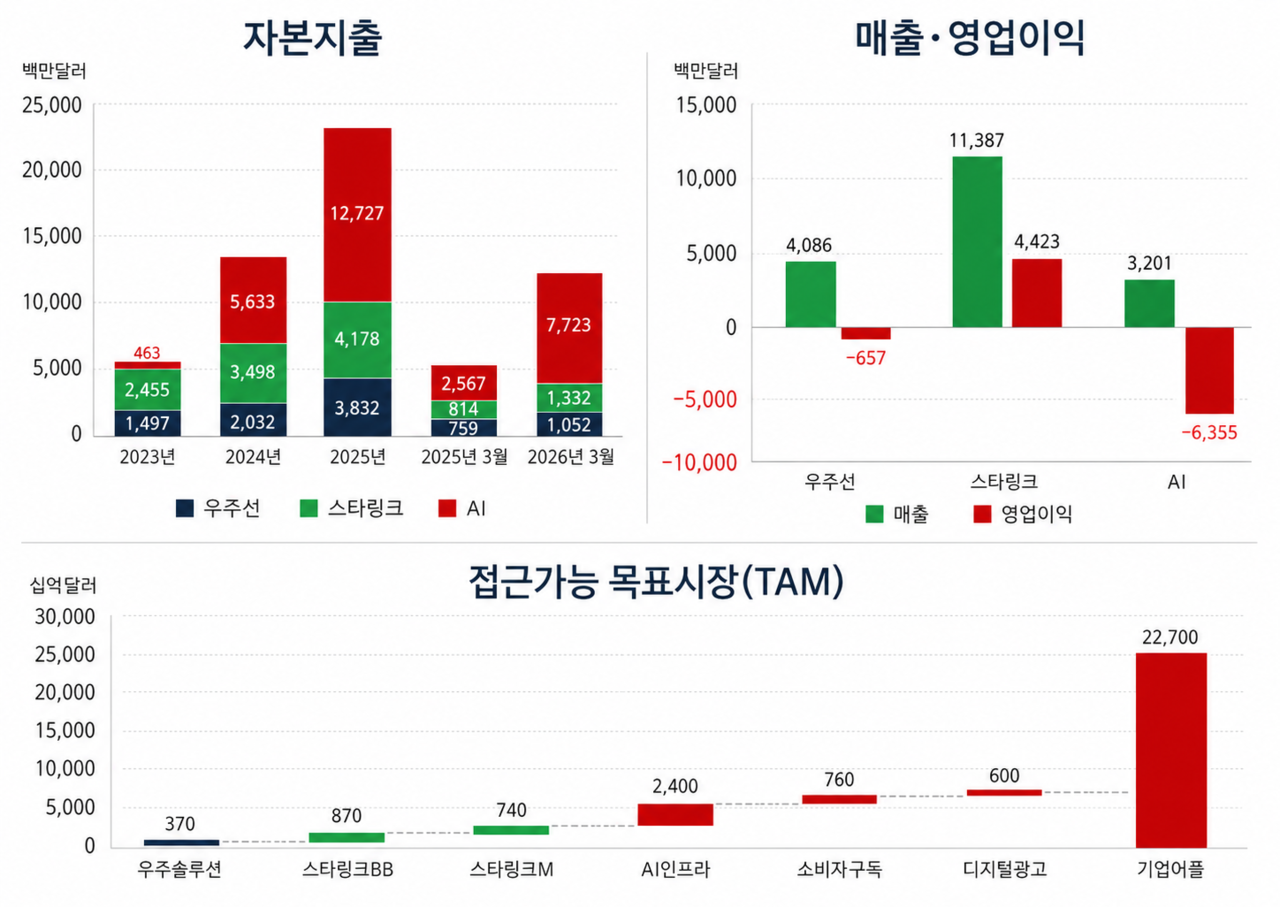
SpaceX key financials and total addressable market by segment
SpaceX's competitive position in the spacecraft and Starlink segments is overwhelming, and there is a credible case that those two divisions could eventually generate hundreds of billions of dollars in annual revenue. Starlink's operating margin already stands at roughly 40 percent.
Under a highly optimistic scenario, if SpaceX captures half of the combined $1.24 trillion TAM for those two segments, the arithmetic yields roughly $240 billion in operating profit. Apply a price-to-earnings multiple of just 10 times, and the implied enterprise value approaches $2.4 trillion.
The problem lies in the loss-making segments.
In the spacecraft division, development costs for the Starship super-heavy launch vehicle are currently the main drag on profitability. SpaceX's track record gives reasonable grounds for confidence that Starship will ultimately succeed — and if it does, the company could generate new revenue streams from building AI data centers in orbit.
The deeper concern is the AI segment.
Goldman Sachs, the lead underwriter, projected in its institutional research that SpaceX's total revenue would reach $474 billion by 2030, with AI segment revenue growing nearly 100-fold — from $3.2 billion in 2025 to $322 billion in 2030. That would represent the steepest and largest increase of any of the three divisions.
SpaceX recently signed chip-leasing contracts with Anthropic and Google worth a combined $26 billion a year — a result significant enough to drive the company's overall revenue growth this year, but not yet clearly profitable on its own. AI data center operations are capital-intensive, carrying heavy costs for power, cooling, GPU procurement and depreciation. Last year, SpaceX's capital expenditure for the AI segment totaled $12.73 billion, dwarfing the $3.83 billion spent on spacecraft and $4.18 billion on Starlink.
Fierce competition in AI investment raises prospect of additional share issuances
The AI segment's capital expenditure last year more than doubled from $5.63 billion in 2024. This year, SpaceX spent $7.72 billion on AI in the first quarter alone — a pace that implies more than $30 billion for the full year. The IPO raised up to $86 billion including the overallotment option, but a substantial portion of those proceeds will likely need to flow into the AI segment. SpaceX has not disclosed how it plans to allocate the offering proceeds across specific uses.
Competition among hyperscalers in the AI data center market is fierce. Improving profitability will require stronger competitiveness across the broader ecosystem — semiconductors, power generation and beyond. That context helps explain why Elon Musk has signaled his intention to enter the semiconductor and power generation businesses. Doing so will require enormous capital, and internal cash flow alone seems unlikely to cover the bill in the near term. That is why talk of additional share issuances has already begun.
Tesla, too, raised capital through multiple secondary offerings after its listing. Musk holds supervoting rights at SpaceX, so additional issuances would be unlikely to dilute his control. That makes supply-and-demand dynamics a critical variable for the SpaceX share price.
Index inclusion effects and latent selling pressure both warrant close attention
By the same token, investors should watch carefully how SpaceX is incorporated into major indexes and how passive fund flows develop. At the offering price, SpaceX's market cap of roughly $1.77 trillion places it among the top seven companies globally by total market capitalization — but the shares issued in the IPO represent only 4 to 5 percent of that total. Index inclusion and the resulting passive inflows are generally calculated on the basis of float-adjusted market cap rather than total market cap. On that measure, SpaceX ranks closer to 25th to 30th among large US stocks — meaning the passive money that flows in will reflect a 25th-place weighting, not a seventh-place one.
The Nasdaq-100 and Russell 1000 relaxed their eligibility criteria to allow SpaceX to be added to their indexes quickly. The S&P 500, however — the largest index of all — has decided to maintain strict standards on minimum trading history, liquidity and profitability. SpaceX is expected to need at least a year before it can qualify for S&P 500 inclusion.
Convertible preferred shares represent another potential headwind. The outstanding balance of convertible preferred shares, which stood at $38.8 billion at the end of 2025, fell to $7 billion in the first quarter of this year, suggesting a large portion has already been converted into common stock. When those converted shares become freely tradable will depend on lock-up conditions and how index providers treat them. The existing investor shares converted from preferred stock represent a potential overhang that could weigh on supply-and-demand dynamics going forward. Even as passive funds flow in gradually, sequential selling by existing investors could limit upward momentum in the stock price.
Twenty-three global investment banks — including Goldman Sachs, Morgan Stanley, BofA Securities, Citigroup and JPMorgan — served as joint bookrunners for the offering. Because of conflicts of interest inherent in the underwriting role, those banks were unable to publish independent investment opinions during the listing process, meaning many of the institutions that examined SpaceX most closely have yet to release formal research. Now that the IPO is complete, they are expected to begin issuing recommendations — and those reports will be worth waiting for.
Ultimately, a company is shaped by its CEO. Elon Musk's greatest strength is his willingness to take on challenges, and investing requires the courage to embrace optimism. Uncertainty in the AI segment is a genuine concern, but the spacecraft and Starlink divisions offer a more straightforward positive case. How the SpaceX share price evolves from here could ripple through global capital markets. Whether or not one invests directly, SpaceX is a company that anyone with an interest in capital markets would do well to watch closely.
kyhong@heraldcorp.com