
Hospital becomes first in South Korea to reach 8,000 kidney transplants; 15-year graft survival rate stands at 80.1%
Asan Medical Center continues to set records in kidney transplantation, achieving world-class outcomes in both patient survival and quality of life.
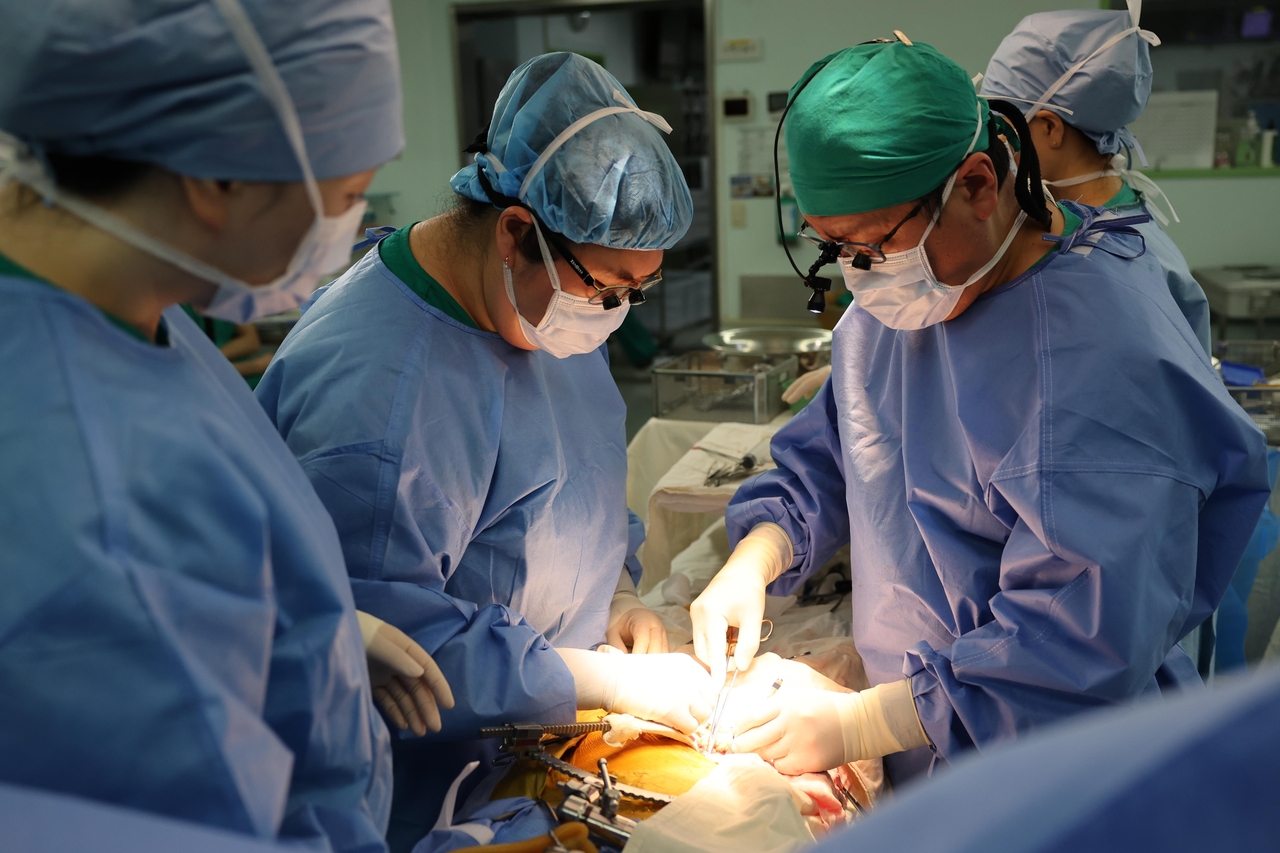
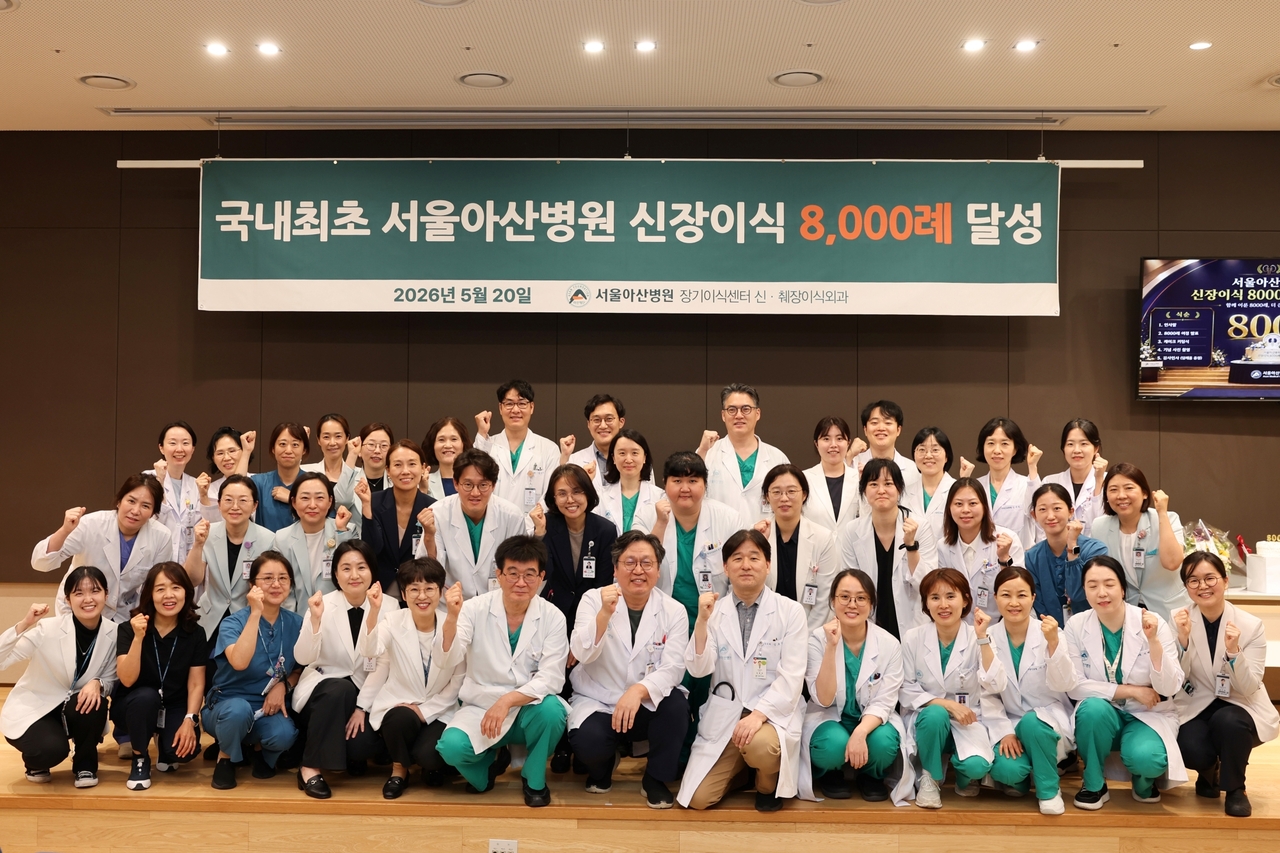
The hospital recently performed its 8,000th kidney transplant — a national first — successfully transplanting a wife's kidney into her husband, a man in his 50s battling stage-5 chronic kidney disease. Kidney transplantation is the only treatment option for patients with end-stage renal failure who would otherwise require lifelong dialysis. Over the past 35 years, Asan Medical Center has given 8,000 such patients the chance at long-term survival and a high quality of life through transplantation.
The kidney transplant team at Asan Medical Center's organ transplant center performed the milestone procedure on May 20, transplanting a kidney donated by the wife of patient Shin, a 58-year-old man with chronic renal failure.
Since performing its first brain-dead donor kidney transplant in 1990, the hospital has carried out 6,312 living-donor transplants and 1,688 brain-dead donor transplants. Over the past five years, it has handled one in every five kidney transplants performed in South Korea and conducts more than twice as many transplants annually as other major medical institutions.
Equally notable as the volume of procedures is the hospital's high survival rate. Asan Medical Center's graft survival rate — the proportion of transplanted kidneys functioning well enough that patients do not require dialysis or re-transplantation — stands at 98.5 percent at one year, 95 percent at five years and 88.5 percent at 10 years, all world-class figures. The 15-year survival rate reaches 80.1 percent, demonstrating the program's long-term safety.
Asan Medical Center in particular treats a disproportionately high share of high-risk patients. When a donor and recipient have incompatible blood types, or when a crossmatch test used to assess tissue compatibility returns a positive result, the recipient's body may reject the transplanted organ.
Building on desensitization technology — which effectively removes problematic antibodies targeting the donor kidney — the hospital performed its first successful blood-type-incompatible kidney transplant in 2009 and has since carried out 1,315 such procedures, the most of any institution in South Korea.
Blood-type-incompatible kidney transplants have become routine, now accounting for about 20.3 percent of all living-donor kidney transplants at Asan Medical Center. The five-year graft survival rate for blood-type-incompatible transplants is 94.1 percent, comparable to the 93.5 percent rate for compatible transplants. The patient who received the 8,000th kidney transplant was also a blood-type-incompatible case.
The five-year graft survival rate for immunologically high-risk patients — including those with a positive crossmatch — is 93 percent, close to the 93.9 percent rate for standard-risk patients, further demonstrating the program's strong outcomes.
Meanwhile, an aging population has significantly shifted the age profile of kidney transplant recipients. The median recipient age was 36 in the 1990s and rose to 52 between 2020 and 2025. Patients in their 50s now account for the largest share of recipients at 31.9 percent, and the proportion of recipients aged 60 and older has risen sharply compared with the past — a trend attributed to Asan Medical Center's efforts to expand transplantation to older patients.
Asan Medical Center has also been at the forefront of improving patient quality of life by actively adopting robotic kidney transplantation. The hospital has performed more than 200 robotic kidney transplants — the most in Asia — and has demonstrated outcomes comparable to those of open surgery.
Kidney transplantation is a highly complex procedure requiring precise microsurgical anastomosis techniques. Robotic surgery offers up to 10 times the visual magnification of open surgery and enables precise movements through the robot's articulating instruments. While open kidney transplantation requires an incision of about 20 centimeters, the robotic approach needs only a roughly 6-centimeter incision for the kidney and three small holes of about 1 centimeter around the navel. The smaller incisions reduce the risk of surgical site infection and hernia and generally allow for faster recovery.
Kim Young-hoon, the Asan Medical Center professor of kidney and pancreas transplant surgery who led the 8,000th transplant, said the milestone was made possible by the hospital's systematic multidisciplinary approach. "Behind achieving 8,000 kidney transplants — a first in South Korea — is Asan Medical Center's unique, structured multidisciplinary system," he said. "From preoperative evaluation through surgery, postoperative care and long-term follow-up, all medical staff across kidney and pancreas transplant surgery, nephrology, infectious disease, laboratory medicine, the operating room, intensive care unit, wards and the organ transplant center work in close collaboration to improve patients' long-term prognosis."
He added that the high long-term graft survival rates serve as an important indicator that kidney transplantation can be performed safely even in immunologically high-risk and elderly patients. "The kidney transplant team at Asan Medical Center will continue to do its utmost to ensure that patients with chronic renal failure can enjoy long-term survival and a high quality of life," he said.
kty@heraldcorp.com





