Euisun Chung visits dedicated EV plant backed by 2 trillion won ($1.33 billion) investment as Genesis flagship electric SUV nears production launch
![Hyundai Motor Group Chairman Euisun Chung inspects vehicle components with employees at Hyundai Motor's Pune factory in India earlier this year. [Hyundai Motor Group]](https://wimg.heraldcorp.com/news/cms/2026/06/01/news-p.v1.20260114.41e46405054a478986b6eae50279f976_P1.jpeg)
Hyundai Motor Group Chairman Euisun Chung recently visited Hyundai Motor's dedicated electric vehicle factory in Ulsan to review production readiness, industry sources confirmed. The visit is widely seen as a final pre-launch inspection of the new facility, with mass production of the Genesis large electric SUV GV90 expected to begin imminently.
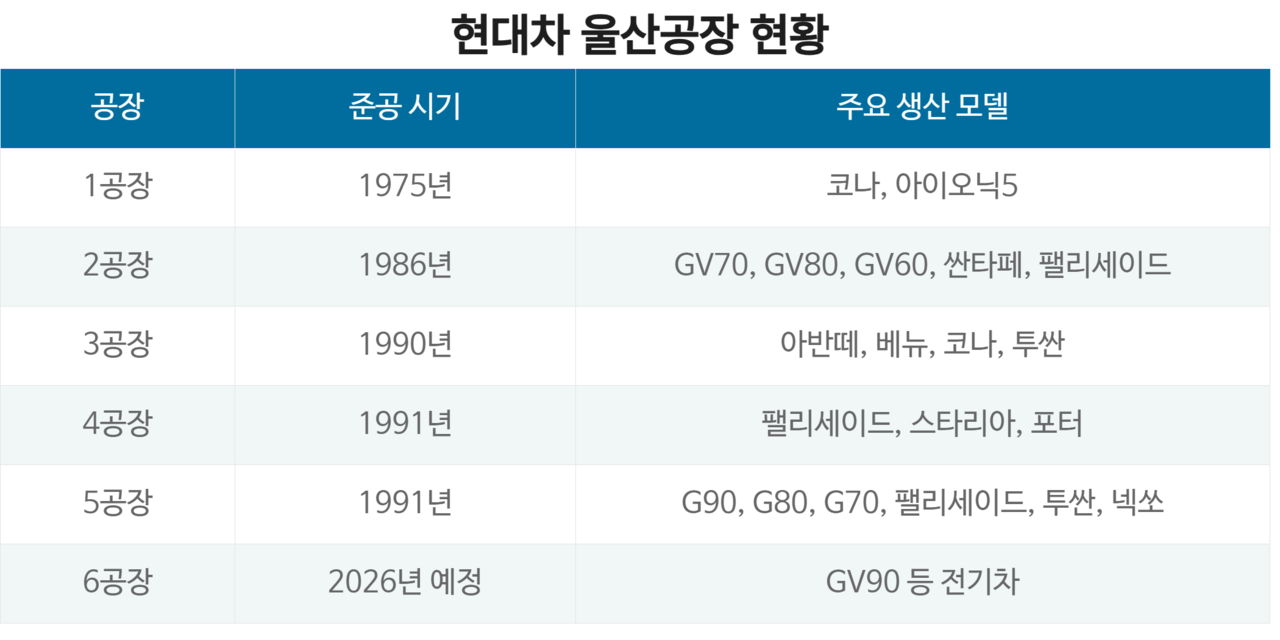
Chung toured the EV-only plant — known internally as Plant 6 — at the Ulsan complex late last month, examining equipment installation and mass-production preparations, sources said Sunday. The factory, completed at the end of last year, is on the verge of beginning full operation. With the GV90 — Genesis's first flagship electric vehicle — widely expected to enter mass production around September, the chairman's visit is read as a final on-site check before the launch.
The Ulsan EV factory is the first new domestic passenger-vehicle plant Hyundai Motor has built in roughly 29 years, since its Asan factory in South Chungcheong Province opened in 1996. Situated within the existing Ulsan complex, the pure-EV production facility is regarded as a key symbol of South Korea's shift to an electrified manufacturing base. Hyundai Motor invested approximately 2 trillion won ($1.33 billion) in the plant, securing annual production capacity of around 200,000 electric vehicles on a site spanning 548,000 square meters.
The existing Ulsan complex runs a mixed-production system, building both internal combustion engine vehicles and electrified models on the same lines. The new factory, by contrast, was designed from the ground up exclusively for electric vehicle production, with processes and equipment built around battery installation structures and high-voltage component systems to stably mass-produce vehicles on EV-dedicated platforms.
The GV90 is the frontrunner to be the first model off the new line. The large electric SUV is built on Hyundai Motor Group's next-generation EV platform and is expected to be the key model determining the factory's initial utilization rate. The company is also reviewing plans to produce hybrid or extended-range electric vehicles at the facility in addition to pure battery-electric models, sources said.
After the new factory begins operation, Hyundai Motor plans to start a full reconstruction of Plant 1 and one line of Plant 4 in Ulsan from September next year. Once construction begins, production of the Ioniq 5 and Kona — currently built at Plant 1 — along with the Porter from Plant 4's second line, is expected to be transferred to other facilities.
![An aerial view of Hyundai Motor's Ulsan factory complex. [Hyundai Motor]](https://wimg.heraldcorp.com/news/cms/2026/06/01/news-p.v1.20260403.acea8304e5b54ff78203d41a4535782c_P1.jpg)
Plants 2 through 5 are also expected to be slated for reconstruction in sequence, with industry observers suggesting Plant 2 could be next. Plant 2 currently handles production of mid- to large-size SUVs for both the Genesis and Hyundai brands, including the Palisade, GV70 and GV80 — all of which carry substantial order backlogs. Given that demand, industry watchers believe reconstruction of Plant 2 is more likely to be considered after Plants 1 and 4 are overhauled and the new EV factory reaches stable operation, rather than being launched immediately.
Hyundai Motor Group has announced plans to invest 125.2 trillion won ($83.3 billion) domestically from this year through 2030, and to expand exports of electrified vehicles from 690,000 units in 2024 to 1.76 million units by 2030.
"The Ulsan EV factory is not simply a plant for producing one electric vehicle model — it will serve as the benchmark for transforming Hyundai Motor's entire domestic production system," an industry official said. "Once GV90 mass production gets off to a stable start, reconstruction of aging lines and the introduction of next-generation electrified models should also accelerate."
kwater@heraldcorp.com