Agency cites transnational crime busts, economic safety net as key achievements
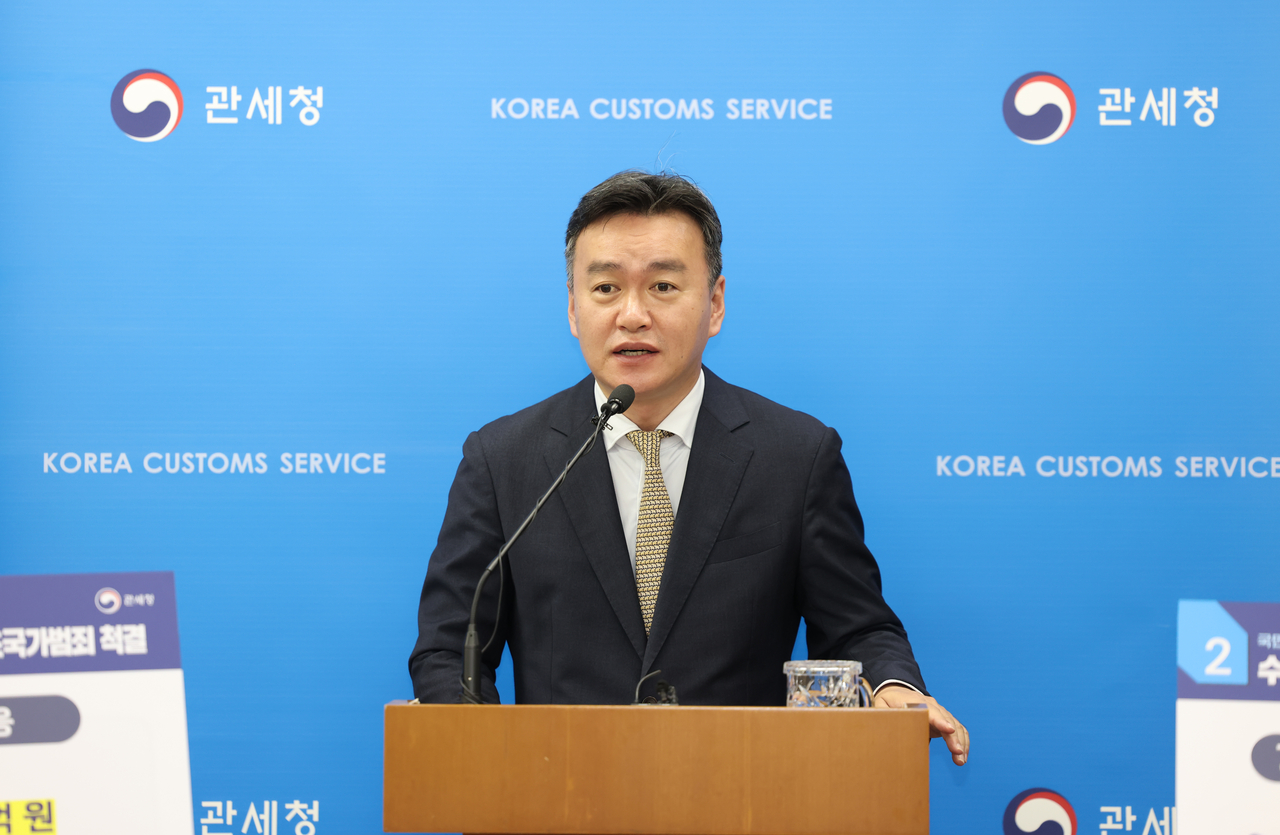
The Korea Customs Service announced its first-year achievements under the People's Sovereignty Government on Monday, highlighting record drug seizures, a crackdown on transnational crime and the construction of an economic safety net to protect exports and livelihoods through K-brand protection and the removal of overseas customs barriers.
Commissioner Lee Jong-wook held a press briefing at the Government Daejeon Complex on Monday to outline the visible results of customs administration over the first year of the Lee Jae Myung government and the agency's policy direction going forward.
The agency organized its achievements under two broad headings: combating transnational crimes — including drug and firearms smuggling, trade security violations and foreign exchange offenses — that threaten public safety, and building an economic safety net covering supply chain diversification, consumer price stability, K-brand protection and support for import-export businesses.
On drugs and firearms, the Korea Customs Service intercepted 1,181 cases involving 3,233 kilograms of narcotics at the border over the past year (June 2025 through April 2026), the highest level since the agency's founding. The figures represent a 22 percent increase in cases and a fourfold increase in weight compared with the same period a year earlier.
The agency expanded its use of advanced equipment, including millimeter-wave body scanners, and for the first time introduced a "second drug inspection line" — a system that goes beyond primary checks at airports and seaports by conducting additional X-ray screening and physical inspections at inland postal hub facilities.
The agency also recorded tangible results in blocking illegal firearms, seizing 17 illegal guns and 331 rounds of live ammunition over the past year. A joint task force formed with the Korean National Police Agency and the National Intelligence Service in September 2025 to prevent the distribution of homemade firearms confiscated three firearms, 338 imitation guns, 37 rounds of ammunition and 272 scopes.
On trade security, the agency conducted intensive enforcement against trade security crimes that undermine the international credibility of South Korean exports, uncovering 67 cases worth a combined 1.2 trillion won (approximately $798 million) — more than five times the value detected in the same period a year earlier. The crackdown focused on "disguised-origin re-exports," in which foreign-made aluminum cable was imported, fraudulently relabeled as domestic product and re-exported to the United States, with 949.4 billion won worth of such cases detected. The agency also targeted illegal exports of strategic materials — including drones and related components that could be used for military purposes — seizing approximately 258.1 billion won worth of violations.
On foreign exchange crimes, the agency's transnational crime task force, launched in November last year, uncovered 122 cases of foreign exchange offenses — including money laundering, price manipulation and illegal currency exchange — totaling 2.07 trillion won, more than four times the value recorded in the same period a year earlier. The agency focused particularly on new types of foreign exchange crimes that harm livelihoods: capital market manipulation, in which companies inflated export figures to overstate financial statements and artificially boost share prices or secure fraudulent listings, and public subsidy fraud, in which import prices were falsely declared at inflated values to embezzle government subsidies.
On the economic safety net, the agency's efforts spanned supply chain diversification, consumer price stability, K-brand protection and support for import-export businesses.
On supply chain diversification, the Korea Customs Service responded to global supply chain instability by establishing special provisions for certificates of origin and transport rules, diversifying crude oil import sources to include Canadian crude (up to 33 million barrels annually) and U.S. crude (16 million barrels). The agency also supported the domestic petrochemical industry by enabling Australian natural gas liquids to be used as a naphtha substitute through strategic tariff classification, facilitating the import of up to 2.5 million tons annually — roughly 10 percent of 2025 naphtha imports.
On consumer price stability, the agency worked to accelerate the distribution of goods subject to quota tariffs and root out unfair practices exploiting the system. It conducted 866 intensive on-site inspections of bonded zones, imposing fines on 243 occasions and seizing 292 tons of illegally stockpiled sugar. The agency also uncovered 10 companies (worth 462.4 billion won) that had abused quota tariff recommendations made under third-party names or falsely declared high import prices to evade corporate taxes and siphon capital overseas.
On K-brand protection, the agency conducted joint intellectual property enforcement operations with overseas customs authorities including Cambodia, encouraged customs registration of domestic and foreign intellectual property rights, and provided training on counterfeit identification. As a result, 143,000 counterfeit K-brand items were proactively intercepted at the border, and 13 intellectual property infringement cases worth 9.1 billion won were investigated and referred for prosecution. The agency also collected and provided real-time overseas customs and non-tariff barrier information, resolving 854.9 billion won worth of customs clearance difficulties in a timely manner.
One notable example involved an international classification dispute with Indian customs over telecommunications equipment components — where South Korea applied a 0 percent tariff and India applied 20 percent, with 800 billion won at stake. The agency successfully pressed South Korea's position through the World Customs Organization, preventing a large-scale tariff assessment.
On support for import-export businesses, the agency provided 1.2281 trillion won in tax relief related to the situation in the Middle East, easing the burden on companies by excluding from dutiable value the increases in freight and insurance costs incurred from using alternative shipping routes. The agency also extended 1.1511 trillion won in tax relief — a 31 percent increase from the same period a year earlier — to small and medium-sized enterprises facing business difficulties due to deteriorating external conditions, through measures such as payment deadline extensions and installment payment options.
As it enters its second year, the Korea Customs Service plans to tighten border surveillance and upgrade the economic safety net with a series of follow-up measures.
On transnational crime, the agency will designate drug smuggling as its top priority and expand the second drug inspection line by applying multiple-reading and multi-stage inspection systems across all entry channels — not just international mail, but also travelers, express cargo and general imports.
The agency also plans to build a monitoring system to fundamentally block the overseas leakage of core national technologies, including defense and industrial technology, and will establish a dedicated "virtual asset transaction analysis team" to combat new forms of foreign exchange crime exploiting virtual assets and foster a sound virtual asset market.
According to the Korea Customs Service, illicit funds exploited annually through illegal currency exchange — including voice phishing proceeds and gambling money — amount to 12.9 trillion won, of which an estimated 10 trillion won involves crimes using virtual assets.
On the economic safety net, the agency will identify additional measures to support supply chain diversification, including plans to shorten certificate-of-origin issuance times to facilitate imports of Malaysian crude oil. It will also provide tailored support for export items vulnerable to changes in the trade environment.
The agency will also move to ensure that quota tariffs deliver their intended price-stabilizing effect by thoroughly blocking unfair practices that exploit the system. It plans to build a real-time information-sharing system with quota tariff recommending agencies such as the Ministry of Agriculture, Food and Rural Affairs, and to secure authority to crack down on hoarding at the customs clearance stage through an amendment to the enforcement decree of the Price Stabilization Act.
The agency also said it will strengthen cooperation with private organizations such as the Trade-related Intellectual Property Protection Association to better protect South Korean import-export companies and K-brands.
"The Korea Customs Service will continue to focus all its capabilities on delivering tangible results that the public can feel," Commissioner Lee said. "We will hold the border firm so that not a single harmful item can gain a foothold in this country, and we will provide a solid foundation for our businesses to reach out across the world."
kwonhl@heraldcorp.com