Top-quintile homes cost 112.7 times the income of the bottom quintile; highest gap in 41 months as luxury prices surge; jeonse costs also soar, requiring 44 years of savings for low earners
Low-income households in Seoul would need to save every won of their earnings for more than 112 years to afford a top-tier apartment in the city, new data shows.
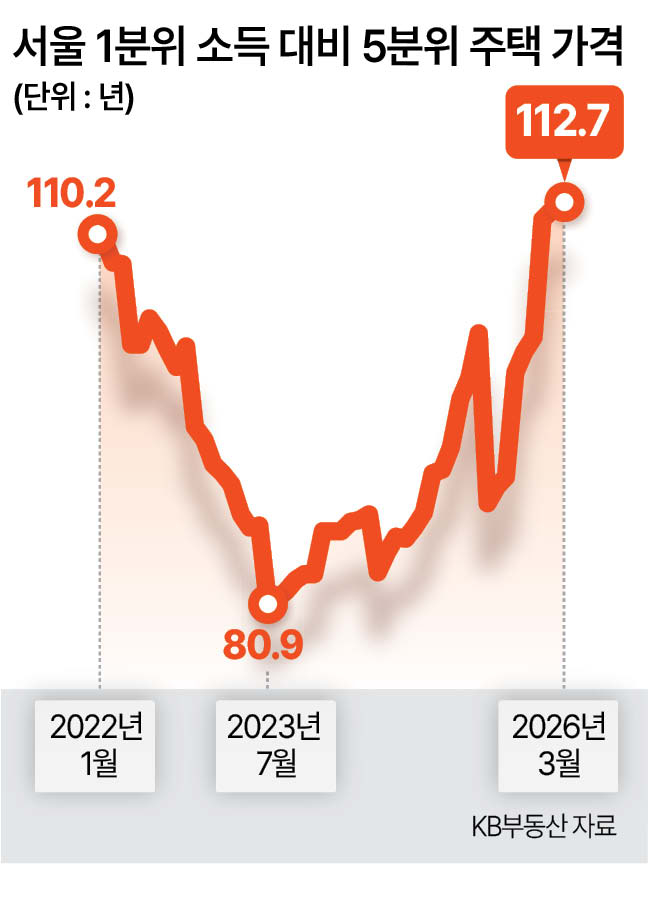
▶Bottom-quintile vs. top-quintile housing PIR approaches 113 again= According to KB Real Estate, the price-to-income ratio (PIR) — which divides a home's price by annual household income — for bottom-quintile (lowest 20 percent) households in Seoul against top-quintile (highest 20 percent) homes stood at 112.7 at the end of the first quarter, based on two-or-more-person urban households. The figure means a top-quintile apartment costs 112.7 times the annual income of a bottom-quintile household.
The PIR is widely regarded as a gauge of polarization in the real estate market. The reading was the highest in 41 months, since December 2021, when it reached 113.7. After peaking above 114 in 2021, the indicator fell to 80.9 in July 2023 before resuming an upward trend. It then jumped from 102.4 at the end of last year to 111.9 in January — a leap of 9.5 years in a single month.
The surge reflects a rapidly widening gap in housing prices within Seoul. The average sale price of a top-quintile apartment in Seoul stood at 3.439 billion won (approximately $2.29 million) this month, 6.6 times the 520.83 million won average for bottom-quintile homes.
Top-quintile apartment prices slipped 12.03 million won from the previous month's 3.451 billion won but remained 14 percent — or 441.8 million won — above the year-earlier level of 3.009 billion won. Bottom-quintile prices, by contrast, rose just 6 percent over the same period, from 490.44 million won to 520.83 million won.
In Apgujeong-dong, Gangnam-gu, a 182-square-meter unit at the Shinhyundai apartment complex sold for 11 billion won on April 29, setting a new record and jumping 1.4 billion won from the previous month's transaction of 9.6 billion won. Although prices had appeared to be adjusting ahead of a planned capital gains tax surcharge on multi-home owners, the swift return to record highs shows that high-end Gangnam properties are proving resilient to price declines.
Even for households buying within their own income bracket, affordability has worsened. As of the end of March, the PIR for bottom-quintile households against bottom-quintile homes stood at 8.7, up 0.7 years from 8.0 at the end of last year. The second quintile (8.6) and third quintile (10.5) each rose 0.2 years from the end of the previous year, indicating that middle-income earners are also finding it harder to buy homes.
The trend reflects not only a widening gap between luxury and mid-to-lower-priced homes but also a rapidly growing income divide. Seo Ji-hyeon, head of the household budget trends division at the Ministry of Statistics, said at the release of the first-quarter household survey that "the income of the top quintile rose because a higher share of its members work at large corporations, while income growth among workers at businesses with fewer than 300 employees was relatively low."
▶Jeonse prices also rise … harder for low-income households= Jeonse prices also climbed sharply in the first quarter, compounding the burden on low-income households. The jeonse price-to-income ratio (J-PIR) for bottom-quintile households against top-quintile homes reached 43.9 at the end of March — the highest since December 2022, when it stood at 45.1, and also a 41-month peak. The figure means a low-income household would need to save its entire income for nearly 44 years to afford a jeonse deposit on a top-tier home.
Even when low-income households seek a jeonse home within their own income bracket, they would need 5.7 years of unspent savings — the highest reading since June last year, when it was also 5.71. Analysts attribute the rise to a shortage of available listings that has driven both sale and jeonse prices sharply higher.
Households in the second quintile would need 5.1 years of savings, those in the third quintile 5.7 years, the fourth quintile 6.2 years, and the top quintile 6.6 years to secure a jeonse home matching their income level.
Seoul jeonse prices have surged recently amid a shortage of available listings. An 84-square-meter unit at Acro River Park in Seocho-gu set a new jeonse record for that floor plan on May 12, when a lease was signed at 2.4 billion won for a 13th-floor unit.
A 114-square-meter unit at Gongdeok Samsung Raemian 2-cha in Mapo-gu also set a new jeonse high on May 26, with an eighth-floor lease signed at 1 billion won.
hss@heraldcorp.com