South Korea's and Japan's top automakers face mounting earnings pressure as their unions take sharply divergent approaches — Toyota's labor side calls for productivity gains and AI readiness, while Hyundai Motor's union pushes for higher bonuses, shorter hours and new hires.
![As the global auto industry undergoes rapid structural change, unions at South Korea's and Japan's leading automakers are responding in starkly different ways. A Toyota logo at a Toyota Mobility showroom in Tokyo. [Reuters]](https://wimg.heraldcorp.com/news/cms/2026/06/01/rcv.YNA.20260518.PRU20260518295901009_P1.jpg)
As competition in the global auto industry shifts rapidly, the unions representing South Korea's and Japan's flagship automakers are taking starkly divergent approaches. Facing shared pressures — an aggressive push by Chinese automakers and Tesla, rising raw material costs, and the twin transitions to electrification and AI — Toyota's union has led with calls for productivity gains and operational reform. Hyundai Motor Co's union, meanwhile, has entered this year's wage talks demanding higher performance bonuses, bigger allowances and new hiring.
According to a report released Sunday by the Korea Employers Federation titled "Implications of Toyota's Labor-Management Relations," Toyota's labor and management held four joint council sessions this year to discuss corporate survival strategies amid the upheaval reshaping the auto industry.
At the first session, Toyota union chief Keisuke Kito said quality problems had caused frequent production stoppages and project delays, causing "great inconvenience to our customers and to the 5.5 million colleagues working in the automotive industry." He called on the union to "break free from the existing way of doing things and change on our own."
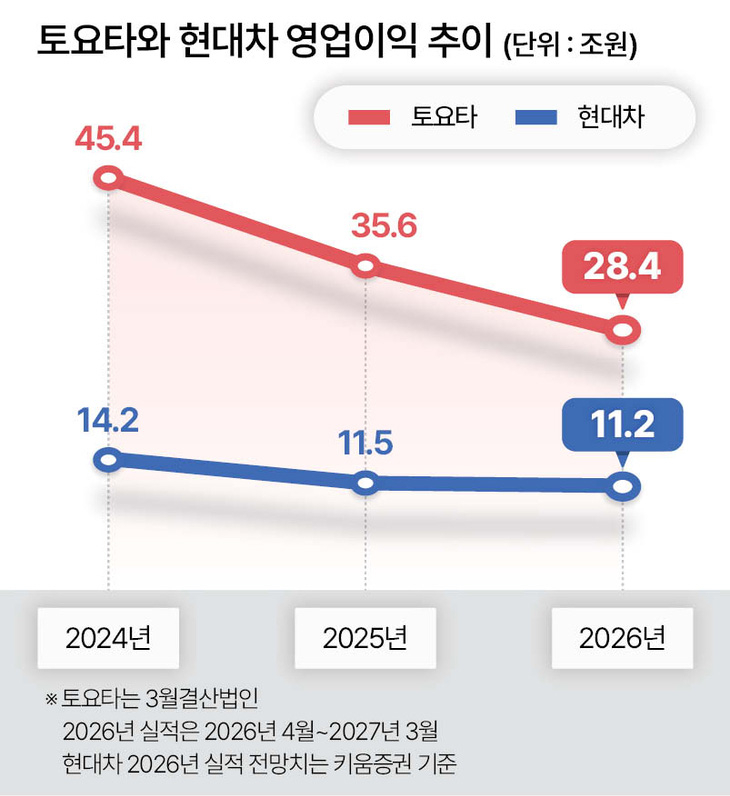
Toyota, long regarded as a profitability powerhouse, is under growing pressure on multiple fronts. Last year, sales rose 5.5 percent from the prior year to 50.6849 trillion yen (approximately $318 billion), but operating profit fell 21.5 percent to 3.7662 trillion yen. The company has since revised its operating profit outlook for this year down 20.3 percent from last year to 3 trillion yen.
Monthly sales declined for three consecutive months through April, partly due to disruptions in the Middle East, where exports plunged more than 90 percent. US tariffs, rising raw material prices, exchange rate swings, and the cost of electrification and software investment have added to the strain. A string of misconduct cases — including falsified certification tests for compact cars and diesel engines, manipulated crash tests, and a Prius recall — has also weighed on the company's quality reputation.
Rather than placing the blame solely on management, the union said delivering quality products to customers on time is the essence of corporate survival.
Productivity was a central theme throughout the sessions. At the fourth council meeting, Kito said the union was "resolved to fundamentally raise productivity, connect daily actions to concrete results, and build competitiveness for the future," adding that it had lacked the determination to "change on our own and decide for ourselves."
The Korea Employers Federation described this as a case of "Toyota's union declaring that, before making unconditional demands for profit distribution, it would improve inefficiencies in its own work practices to raise productivity and cut costs."
The union's stance on AI also stood out. Toyota union vice chairman Daiki Akiyama said workers should not treat AI merely as a tool, but should "confront it with the resolve to reinvent everything — asking what skills I can develop and what my added value is."
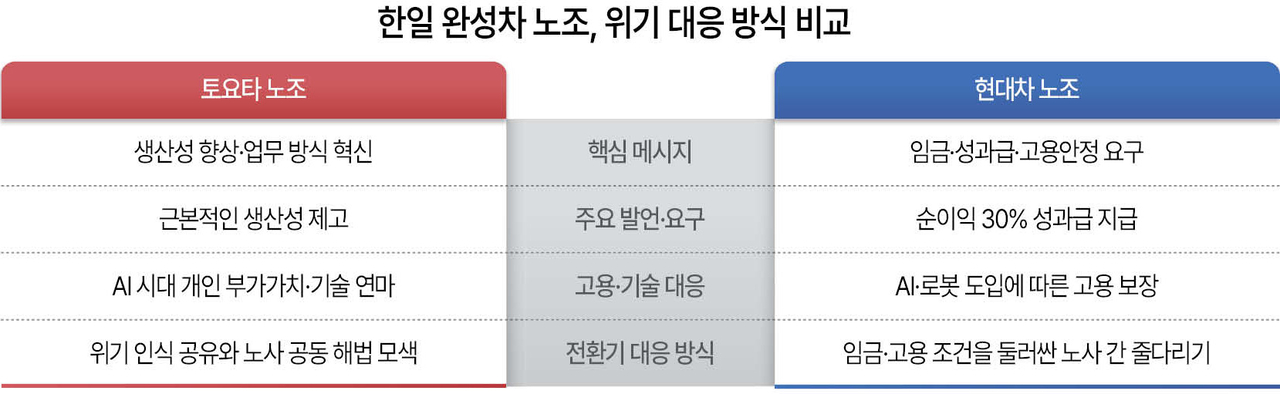
At Hyundai Motor, this year's wage negotiations have broadened into a wide-ranging standoff covering bonuses, pay structure, working hours and job security. The union is demanding a monthly base pay increase of 149,600 won (approximately $100), a performance bonus equal to 30 percent of last year's net profit, and an 800 percent increase in allowances. It has also called for a full monthly salary system, a four-and-a-half-day workweek, a retirement age extension tied to national pension eligibility, and new hiring.
Management has pushed back on the bonus and working-hours demands. Hyundai Motor says a significant expansion of allowances would be difficult given the ripple effects on affiliates and broader public perception, and that a four-and-a-half-day workweek could reduce annual production by roughly 160,000 vehicles. With the company also navigating the shift to electrification, factory restructuring and robot adoption, management says it cannot simultaneously accept new full-time hiring, a retirement age extension, shorter hours and higher fixed pay.
Hyundai Motor's global sales fell 3.9 percent in the January–April period from the same period last year. The earnings outlook is also challenging. Kiwoom Securities projects sales this year will rise 1.3 percent from last year to 188.741 trillion won, while operating profit is forecast to fall 2.2 percent to 11.21 trillion won. Even as sales slow, the company faces mounting pressure on profitability from the electrification transition, US tariffs, investment in new businesses and rising labor costs.
Future employment security has also emerged as a flashpoint. The union argues that existing members' jobs and working conditions must be protected as the company pivots to electrification, software-defined vehicles, AI and robotics. Management counters that it cannot guarantee job security without first securing competitiveness and profitability in new businesses. As Hyundai Motor Group expands its adoption of automation technologies including humanoid robots, the gap between labor and management over workforce redeployment and retraining is widening.
![Hyundai Motor Co's labor and management representatives at the opening session of this year's wage negotiations. [Provided by Hyundai Motor]](https://wimg.heraldcorp.com/news/cms/2026/06/01/rcv.YNA.20260506.PYH2026050607740005700_P1.jpg)
The Korea Employers Federation said South Korea's labor-management relations are too focused on short-term profit distribution, and that domestic unions "should learn from Toyota's union, which puts productivity first, rather than remaining trapped in a cycle of profit-sharing demands."
Lee Dong-geun, the federation's standing vice chairman, said labor groups in South Korea are increasingly "fighting for excessive profit distribution demands, such as paying out N percent of operating profit or net profit." He said it was highly instructive for Korean labor relations that "even the company with the most dominant sales and operating profit in the global auto industry has seen its union step forward — amid an unprecedented sense of crisis — to take the lead in thinking about and committing to a survival strategy."
kwater@heraldcorp.com