Ruling party says voters are rallying behind Lee government; opposition claims anger over misrule is driving turnout
Early voting for the June 3 local elections set a record for the highest turnout ever recorded in a South Korean local election, and political circles are scrambling to interpret what the numbers mean for the final vote. Both the ruling and opposition parties are claiming the surge as a sign of their own base mobilizing, and each is urging supporters to turn out on election day.
According to the National Election Commission, 10,498,411 of the 44,649,908 eligible voters cast early ballots on May 29 and 30, yielding a final early voting rate of 23.51 percent.
The prevailing view in political circles is that early voting tends to favor progressive candidates because younger voters — who lean liberal — make up a larger share of early voters. Since the early voting system was introduced, the Democratic Party of Korea has generally performed strongly in that segment.
Political commentator Park Chang-hwan said the high early turnout partly reflects a consolidation of progressive support. "I think the high early voting rate is influenced by the rallying of progressive supporters," he said. He added that North Jeolla Province saw an additional boost from a competitive dynamic with independent candidate Kim Kwan-young. "The 'catfish effect' of that rivalry likely pushed turnout even higher there," he said.
Shin Yul, a professor of political science and diplomacy at Myongji University, said media polls had shown People Power Party supporters in Seoul and Busan were far less inclined to vote early than their Democratic Party counterparts. "The high early voting rate can reasonably be interpreted as meaning that many more progressive voters joined in," he said.
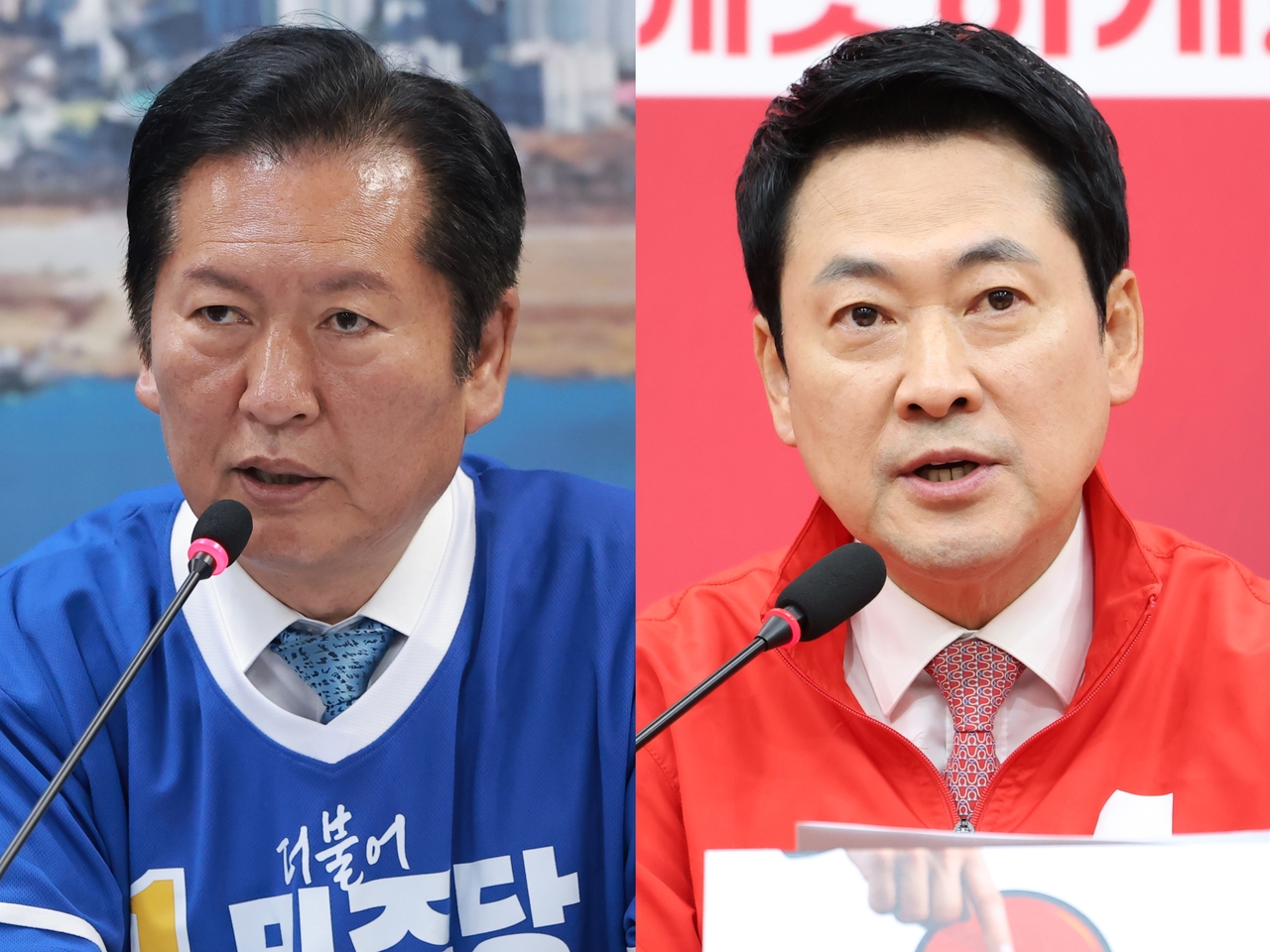
The parties themselves offered sharply different readings. Democratic Party leader Jung Chung-rae said he believed large numbers of voters who want to strengthen the Lee Jae-myung government had come out to the polls. "This is not a signal that is unfavorable to the Democratic Party," he said.
The People Power Party, by contrast, insisted that conservative voters were mobilizing in force. Secretary-General Jeong Hee-yong said voters angered by attempts to cancel President Lee's trial and by the frustration of homeownership aspirations were heading to the polls.
A senior People Power Party official argued that the early voting rate had risen only about 2 percentage points compared with the 2022 local elections, which the party won by a wide margin. "Back then, many progressive voters had given up on voting," the official said. "When you consider that, you can see that progressive consolidation this time around is not particularly large."
Whether the record early turnout will translate into high overall participation on June 3 remains an open question. Professor Shin cautioned that a high early voting rate does not necessarily mean a high final turnout. "Ultimately, you can view it as people who were going to vote anyway simply voting earlier," he said. He pointed to the 2022 local elections, when early voting hit what was then a record 20.62 percent, yet the final turnout was limited to 50.93 percent — the lowest election-day participation rate in any local election held since the early voting system was introduced.
Park, however, was more optimistic, saying the figures could be read as a sign that both camps are mobilizing strongly. "There is a possibility that the final turnout could approach 60 percent," he said.
thanks@heraldcorp.com