Bank of Korea cites market stabilization steps as cause of decline; cash deposits rise
By Kim Byeo-ri, The Herald Business
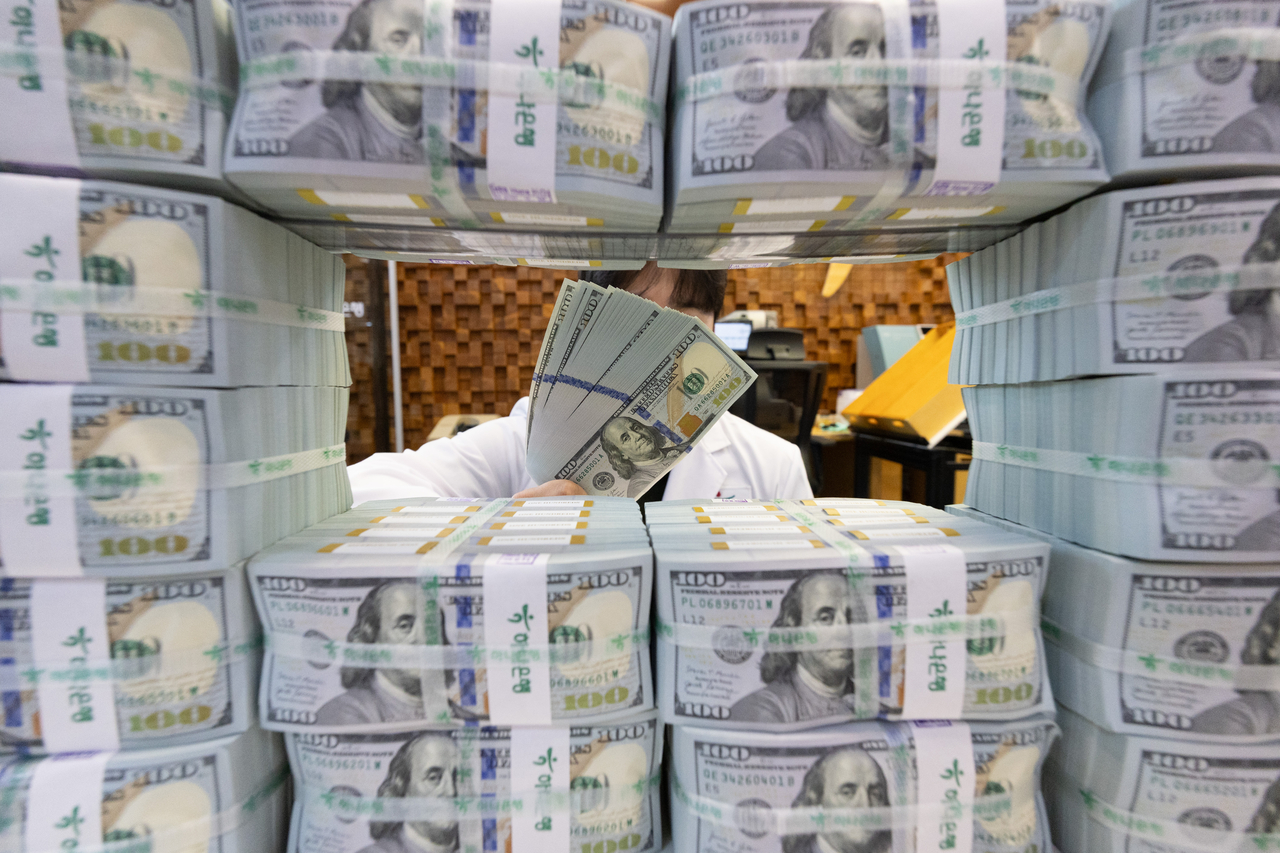
South Korea's foreign exchange reserves shrank by $880 million in May as authorities stepped in to stabilize the exchange rate. Cash holdings actually increased over the period, however, fueling speculation that the Bank of Korea was building up additional firepower for future currency intervention.
The Bank of Korea said Wednesday that the country's forex reserves totaled $426.99 billion at the end of May, down from $427.88 billion a month earlier.
The central bank attributed the decline primarily to market stabilization measures, including a foreign exchange swap arrangement with the National Pension Service. Under the arrangement, the pension fund procures dollars directly from the Bank of Korea rather than entering the open forex market, which helps put downward pressure on the won-dollar rate.
The monthly average won-dollar exchange rate in May stood at 1,491.3 won, nearly matching the 1,492.5 won recorded in March — immediately after the outbreak of the Iran war — and up 6.3 won from April's 1,485 won. Net selling of domestic shares by foreign investors pushed the rate higher. The exchange rate exceeded 1,500 won for 10 consecutive trading days at the end of May.
Forex reserves had risen in February following a new issuance of foreign exchange stabilization bonds, then fell in March as the Bank of Korea deployed market stabilization measures to defend against the high exchange rate. Reserves rebounded sharply in April on increased investment returns before declining again in May.
Breaking down the figures by asset type, cash deposits — the most liquid component — rose $2.59 billion from the previous month to $21.35 billion, even as overall reserves fell. The increase reflected the Bank of Korea converting a significant portion of its assets into cash during the month.
Securities holdings — including US government bonds, agency bonds and corporate bonds — fell $3.39 billion over the same period, from $384.07 billion to $380.68 billion. The decline suggests the central bank took partial profits on securities that had surged in April on higher investment returns, channeling the proceeds into cash deposits.
The shift is also seen as giving the Bank of Korea ample additional ammunition to intervene in the forex market, even as the won-dollar rate remains elevated.
Elsewhere, the country's Special Drawing Rights with the International Monetary Fund fell $30 million to $15.78 billion, while its IMF reserve position declined $60 million to $4.4 billion.
Based on end-April figures of $427.9 billion, South Korea ranked 12th globally in forex reserves. The country slipped out of the top 10 in February after Italy and France moved ahead of it. South Korea's reserves trail those of 11th-ranked Hong Kong, which holds $442.1 billion — $14.2 billion more.
kimstar@heraldcorp.com