
Democrats seen safely ahead in 9 regional races; PPP confident in 2; Seoul district mayor contests go down to the wire
With South Korea's June 3 local elections just one day away, both the ruling and opposition parties launched final all-out campaign pushes Tuesday, concentrating their firepower on the most competitive races.
Both party leaderships identified Seoul, Busan and South Gyeongsang Province as the top battlegrounds in the regional government head contests, while the fight over 25 Seoul district mayor seats — pitting the People Power Party's defense against the Democratic Party of Korea's bid to reclaim lost ground — drew its own share of attention.
Cho Seung-rae, the Democratic Party's secretary-general and overall campaign chief, said in an interview on CBS Radio's "Park Seong-tae's News Show" that six regional races — Seoul, Busan, Daegu, South Gyeongsang Province, Ulsan and North Jeolla Province — were too close to call. "Winning even one of them matters, so instead of predicting outcomes we're out there working hard," he said.
On the North Jeolla gubernatorial race, which has tightened after incumbent Gov. Kim Gwan-young entered as an independent candidate, Cho shrugged off the challenge. "There is no justification for running as an independent," he said, adding that even if Kim won, a by-election would have to follow.
The People Power Party, meanwhile, identified seven to eight competitive races. A senior party official told reporters Tuesday morning that Seoul, Busan, South Chungcheong Province, South Gyeongsang Province and Gangwon Province were in a dead heat, while Daejeon, Ulsan and North Chungcheong Province remained within reach "if our candidates keep pushing to the end." The party's internal polling reportedly showed Seoul and Busan moving within the margin of error in recent days.
Taken together, political analysts said the Democratic Party appeared to hold comfortable leads in nine regions: Incheon and Gyeonggi Province in the greater Seoul area; all four Chungcheong regions — Daejeon, Sejong, South Chungcheong Province and North Chungcheong Province; and South Jeolla Province, Gwangju, Gangwon Province and Jeju, with North Gyeongsang Province the sole exception.
The People Power Party, by contrast, considered only Daegu and North Gyeongsang Province safe, and planned to keep rallying conservative voters in contested areas until the last moment. PPP lawmaker Seong Il-jong pushed back on the Democratic Party's confident forecast for the Chungcheong region, appearing on MBC Radio's "Kim Jong-bae's Focus" to argue that the Democratic leadership's repeated visits to South Chungcheong Province were themselves proof that the party was struggling there.
In the Busan-Ulsan-South Gyeongsang (PK) region — the election's most fiercely contested zone — both sides expected the race to remain neck-and-neck through the final count.
Party leaders also chose battleground venues for their closing campaign rallies. Democratic Party overall campaign chair Jung Chung-rae was set to hold events in Gangwon Province and Yongin, Gyeonggi Province before wrapping up at Cheonggyecheon Plaza in Jung-gu, Seoul. Co-chair Han Byung-do planned to tour Iksan, Jeonju and Wanju in North Jeolla Province to stump for gubernatorial candidate Lee Won-taek.
On the PPP side, standing campaign chair Jang Dong-hyeok and co-chair Song Eon-seog were set to open in Seoul before fanning out to South Chungcheong Province and South Gyeongsang Province, respectively, for their final rallies.
Choi Chang-ryeol, a political science professor at Yongin University, said most voters had likely already made up their minds. "The broad 'insurrection judgment' frame is working in the ruling party's favor, making it a difficult election for candidate-centered appeals to gain traction," he said.
Still, Choi cautioned that the large number of competitive races meant many contests could be decided by razor-thin margins. "We could see results described as 'the people's exquisitely calibrated choice,'" he added.
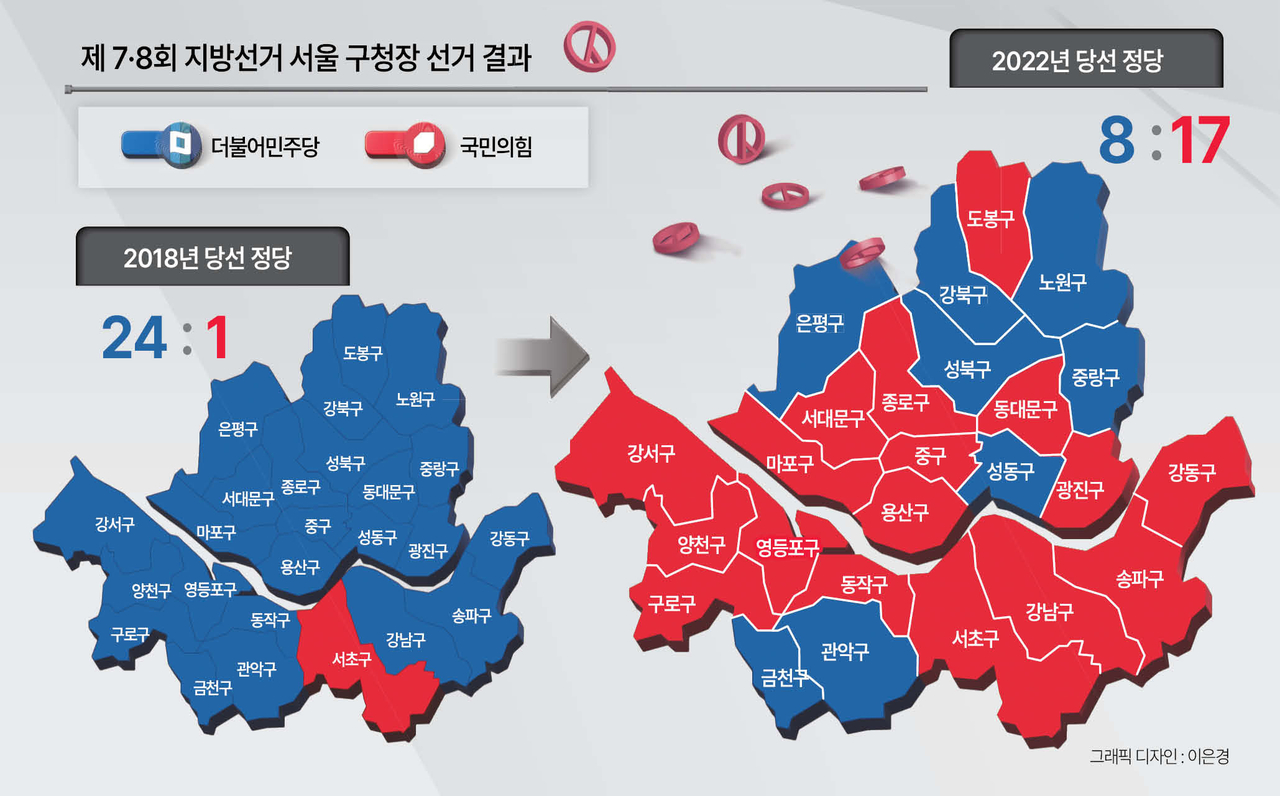
The outcomes of Seoul's 25 district mayor races are another closely watched subplot. In the June 1, 2022 local elections, the People Power Party swept 17 of those seats.
This time, analysts said the Democratic Party held the advantage, buoyed by high party approval ratings and the "martial law judgment" narrative. The party was targeting 19 to 20 seats — building on the eight districts where it already holds office and pushing into Dongdaemun and Dobong, as well as the Han River belt and Gangnam areas.
A senior official in the Democratic Party's Seoul mayoral campaign said the three Gangnam districts remained "very difficult terrain" for the party but expressed confidence that a strong showing in the Han River belt could produce meaningful results even in Gangnam. On former President Lee Myung-bak's recent endorsement of PPP candidate Oh Se-hoon, the official said the move would "actually hurt Oh among moderate Seoul voters."
The People Power Party, holding more incumbent district mayors than the Democrats, was building its defense around that advantage. The party was said to be counting on at least seven seats — the three Gangnam districts plus Yongsan, Gangdong, Yangcheon and Jung-gu — as a base from which to push further.
Particularly in areas sensitive to real estate values, such as the Han River belt, the party's strategy centered on leveraging the incumbent premium alongside deregulation pledges and reconstruction and redevelopment issues to blunt the Democratic wave.
A Seoul PPP city party official said: "With urban renewal projects becoming a major issue, we think the districts where we have sitting mayors are still very much in play."
By Yang Dae-geun, Park Byeong-guk and Joo So-hyun
bigroot@heraldcorp.com
cook@heraldcorp.com
addressh@heraldcorp.com





