
Local elections one day away as ruling and opposition parties make final appeals
Democratic Party calls vote a 'political judgment on insurrection forces'; PPP warns of rent, tax and interest 'triple bomb'
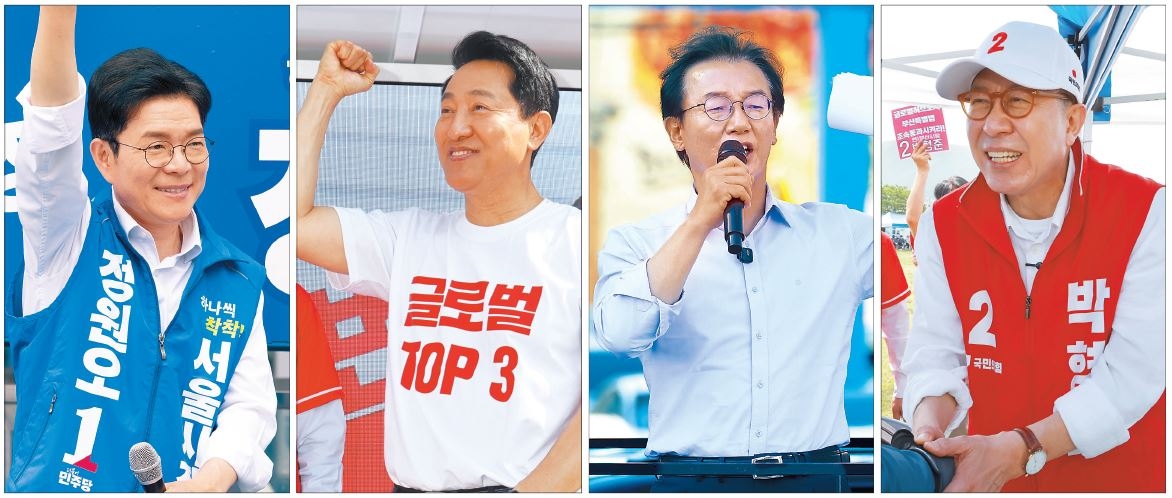
The June 3 local elections and National Assembly by-elections are one day away, with both contests expected to significantly shape local governance, the national political landscape and South Korea's course amid global uncertainty. Political parties on Tuesday signaled an all-out final push for votes. The Democratic Party of Korea is campaigning on "normalizing the state through judgment of insurrection forces," while the People Power Party is urging voters to "check the power monopoly of the Lee Jae Myung administration."
The elections mark the first nationwide vote since the Lee Jae Myung administration took office roughly a year ago. Voters will decide 16 metropolitan government heads and council seats, 227 basic local government heads and council seats, and 14 National Assembly by-election races simultaneously — results that analysts say could substantially redraw the country's political map.
The central dynamic of the elections is widely described as a "Lee Jae Myung versus anti-Lee Jae Myung" frame. Analysts broadly agree that debates over stabilizing or checking the president's administration have dominated the campaign, overshadowing regional pledges and local issues.
The Democratic Party has stressed the need to secure local power to support the Lee administration's governance. The PPP, by contrast, has pushed a "check the ruling party" message, arguing that unchecked dominance must be stopped. Democratic Party leaders visiting campaign sites have pledged to "detonate a budget bomb with the power of the ruling party," though the promise has drawn criticism as an overly rosy campaign pledge given that no specific funding figures have been disclosed.
The Democratic Party framed the elections early on as a "political judgment on insurrection forces" and a venue for completing the "liquidation of the insurrection" stemming from the Dec. 3 emergency martial law crisis. The party's strategy is to consolidate a three-pillar power base — legislature, administration and local government — by adding local power to its existing hold on the National Assembly and the executive branch.
Han Byung-do, co-chair of the party's joint standing election committee, said at a floor strategy meeting Tuesday that voters must "pass judgment on the incompetent and irresponsible local power that rode in on Yoon Suk Yeol's coattails four years ago and ruined their regions," adding that "the Lee Jae Myung administration must succeed."
Party leadership has been pushing fiscal campaign pledges under a ruling-party premium banner, working to spread a "government stability" message that candidates who will work in step with the Lee administration must be elected. The Democratic Party is targeting victories in at least nine of the 16 metropolitan government races. Cho Seung-rae, the party's overall campaign headquarters chief, said Monday that "six competitive districts and one trailing district remain in that classification." The party considers North Gyeongsang Province its trailing region; Seoul, Busan, Daegu, Ulsan, South Gyeongsang Province and North Jeolla Province are classified as competitive.
The PPP, the main opposition party, has countered the Democratic Party's "insurrection frame" by foregrounding its "check the administration" message. The party's calculation is to win over centrist voters by arguing that the Democratic Party has spent the entire year fixated on the martial law crisis and insurrection accountability while neglecting livelihoods and future growth engines.
The PPP has argued that a "triple bomb" of rising jeonse and monthly rent, higher taxes and heavier interest burdens has weighed on people's lives since the Lee administration took office, and is urging voters to use the local elections to stop it.
Jang Dong-hyeok, the PPP's standing election campaign committee chairman, issued a public appeal at the party's central headquarters in Yeouido, Seoul, on Tuesday, saying "the economic destruction and tyranny against livelihoods driven by Lee Jae Myung and the Democratic Party must now be stopped," and that "every vote cast for the People Power Party will be the force that revives our economy and protects our lives."
The PPP has classified eight districts as competitive: Seoul, Busan, Daejeon, Ulsan, Gangwon Province, South Chungcheong Province, North Chungcheong Province and South Gyeongsang Province. Daegu and North Gyeongsang Province are considered PPP-leaning.
Ha Sang-eung, a professor of political science and diplomacy at Sogang University, said the elections "started out as a race where the ruling party was seen as having a fairly large advantage," adding that "for the time being, the ruling party may not win by a large margin, but it is not a situation where the ruling party loses." He added that "whatever the outcome, the result is likely to favor the ruling party given the current situation." Ha identified the by-elections, rather than the metropolitan government races, as the key thing to watch. "What matters far more is how these results affect the leadership battles within the Democratic Party and the PPP," he said. "The National Assembly by-elections are more important to the parties than the local elections, because whoever becomes the next party leader will determine who controls candidate nominations for the 2028 general election."
rimsclub@heraldcorp.com





