Devices expected at Galaxy Unpacked on July 22; two models feature voice commands and real-time translation; Samsung-Google entry set to break Meta's dominance
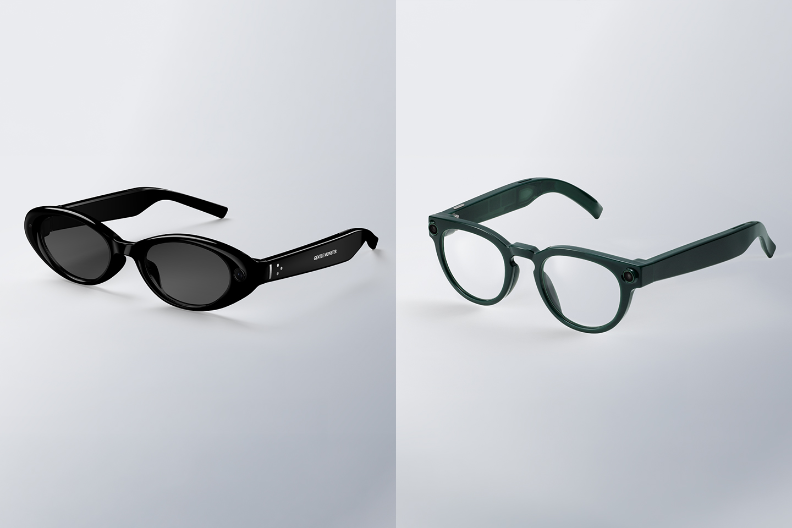
![Two AI glasses models developed jointly by Samsung and Google, unveiled at Google I/O 2026, and a concept image. [Provided by Samsung Electronics]](https://wimg.heraldcorp.com/news/cms/2026/06/02/news-p.v1.20260519.2b725ed65f7c4b78b3c3cbbada3f6736_P1.png)
A future where voice commands give you turn-by-turn directions without pulling out your phone — or where a restaurant menu translates itself the moment you look at it — is nearly here.
The AI glasses developed jointly by Samsung and Google are set to hit the market as early as next month. Their formal entry into a segment long dominated by Meta is expected to ignite a full-scale battle for early leadership in AI glasses, and could mark a turning point in the commercialization and mass adoption of devices widely seen as the next major platform after the smartphone.
Samsung Electronics plans to reveal detailed features and the physical design of the AI glasses at its Galaxy Unpacked product showcase, scheduled for July 22 in London, according to industry sources. The devices were first introduced May 19 at Google headquarters in Mountain View, California, during Google I/O 2026.
Industry watchers say Samsung and Google's years-long development effort has moved beyond completion into full commercialization. After detailed features are presented at next month's Unpacked event, the glasses are expected to go on sale and roll out sequentially across global markets.
The joint AI glasses come in two models, both running on Android XR, and are designed to work closely alongside Galaxy AI smartphones. They complement the phone's core AI functions, letting users access and act on information in real time without taking the device out of their pocket.
Neither model includes a display. Instead, each is equipped with built-in speakers, a camera and a microphone to read the user's surroundings and carry out voice-based commands — no complex touch input required. Users can invoke Google's Gemini AI, linked to their smartphone, to get turn-by-turn navigation to a destination without glancing at a screen. Finding a nearby café or placing a drink order is also possible by voice.
Translation capabilities have also been enhanced. The glasses support real-time voice translation that reflects the speaking style and vocal tone of the other person. They can also recognize text the user is looking at — such as a menu or a sign — and read a translation aloud.
The glasses can summarize incoming messages from a paired smartphone and read them to the user. Appointments can be added to a calendar by voice alone, with no additional input needed. A camera function lets users instantly capture whatever scene they are currently viewing.
The imminent arrival of Samsung and Google's AI glasses signals sweeping change for a market Meta has effectively owned. Meta held an 85.2 percent share of the AI glasses market last year, according to market research firm Omdia — a dominance that has kept the segment in an early, Meta-centric stage, given that its products have been in effect the only AI glasses offered by a major tech company.
With Samsung and Google set to ramp up sales in the second half of this year, the overall market is forecast to grow sharply. Omdia projects AI glasses shipments will surpass 15 million units this year, up from roughly 8.7 million last year, and reach 35 million by 2030.
Meanwhile, Apple's AI glasses launch has been pushed back again. According to technology outlets including PhoneArena, Apple has shifted the release of its first AI glasses from early next year to late next year, with the delay attributed to internal technical issues and component supply problems.
By Park Se-jung
sjpark@heraldcorp.com