Loss-only insurance deficit expands 15.6% from prior year; manual therapy payouts at 2.7 trillion won surpass cancer and cardiovascular claims at 2.6 trillion won; worsening loss ratio fuels premium hikes and disputes
![Insurance payouts for musculoskeletal conditions including manual therapy reached 2.7 trillion won (about $1.79 billion) last year, widening the deficit in South Korea's loss-only health insurance market. [Getty Images Bank]](https://wimg.heraldcorp.com/news/cms/2026/06/03/news-p.v1.20260603.8feca61f9ec74e2788b8f819ea9118cf_P1.png)
South Korea's loss-only health insurance market continued to grow last year, but its financial losses deepened. Premium revenue surpassed 18 trillion won, yet claim payouts grew even faster, pushing the loss ratio higher and raising concerns that policyholders could face a double blow of rising premiums and escalating disputes over claims.
According to the Financial Supervisory Service's preliminary report on 2025 loss-only insurance earnings, released Wednesday, the market posted a net underwriting loss of 1.87 trillion won last year — 250 billion won, or 15.6 percent, wider than the 1.62 trillion won deficit recorded the previous year. The figure represents premium revenue minus incurred losses and operating expenses.
The incurred loss ratio, the key profitability metric, rose 1.7 percentage points to 101 percent from 99.3 percent the year before. Given that the breakeven point sits at roughly 85 percent, the structural loss has become entrenched. By policy generation, third-generation (120.3 percent) and fourth-generation (115.1 percent) plans far exceeded 100 percent, while first-generation (102.3 percent) and second-generation (93.1 percent) plans fared relatively better, reflecting the accumulated effect of premium adjustments.
The market itself expanded. The number of active policies at year-end reached 36.22 million, up 260,000, or 0.7 percent, from a year earlier, and premium revenue grew 10 percent to 18 trillion won, an increase of 1.6 trillion won. But total claim payouts rose 11.4 percent to 17 trillion won, outpacing the premium increase — meaning insurers paid out money faster than they took it in.
![[Financial Supervisory Service]](https://wimg.heraldcorp.com/news/cms/2026/06/03/news-p.v1.20260603.535c5331bd754305b3c9f2f50cdece69_P1.png)
Non-reimbursed medical services were the primary driver of the widening deficit. Payouts for non-reimbursed treatments reached 9.7 trillion won last year, accounting for 57.1 percent of total claims. Payouts for musculoskeletal conditions such as manual therapy hit 2.7 trillion won, surpassing for the first time those for serious illnesses including cancer and cerebrovascular disease, which stood at 2.6 trillion won. Payouts for outpatient non-reimbursed injections — such as nutritional supplements — where overuse is a major concern, also reached 1 trillion won.
Emerging medical technologies also saw sharp increases. Payouts for robotic surgery jumped 72.4 percent in a single year, while prostatic urethral lift procedures rose 64.6 percent and high-intensity focused ultrasound treatments climbed 46 percent. Some high-cost procedures such as neuroplasty declined, but disputes over whether hospitalization was medically necessary persisted, accounting for roughly 20 percent of all loss-only insurance disputes last year.
The FSS said the deteriorating loss ratio will not only drive further premium increases but could also intensify consumer disputes as insurers tighten their claims review standards. The regulator said it would work to facilitate the transition to fifth-generation loss-only insurance policies to curb excessive medical use, and added it would launch immediate on-site investigations into improper claims review practices.
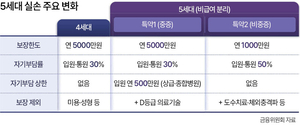
The fifth-generation loss-only insurance product raises the policyholder cost-sharing rate for non-serious, non-reimbursed treatments to 50 percent and reduces coverage for overuse-prone items such as manual therapy and non-reimbursed injections. It launched May 6. Premiums were set at roughly 30 percent below fourth-generation plans and more than 50 percent below first- and second-generation plans. The FSS plans to begin rolling out renewals and conversions for fourth-generation policyholders — whose plans were introduced in July 2021 — starting next month.
Starting in November, a "selective discount rider" and a "contract conversion discount" targeting first- and second-generation policyholders will also become available in succession, affecting a base of 40 million policyholders.
https://biz.heraldcorp.com/article/10731840
psj@heraldcorp.com