Ministry of Interior and Safety releases local government personnel statistics; total headcount stands at 313,924 as of end of 2025
Women accounted for 52 percent of all local government civil servants last year, and the number of female officials at Grade 5 or above surpassed 10,000 for the first time on record.
The Ministry of Interior and Safety released its annual "Local Government Civil Servant Personnel Statistics" on Tuesday, offering a comprehensive snapshot of public workforce conditions across the country.
The total number of local government civil servants stood at 313,924 as of the end of 2025, down 1,281, or 0.4 percent, from 315,205 in 2024.
The ministry attributed the slight decline to a 2,818-person increase in employees on leave — largely parental leave — which reduced the number of staff actually on the job.
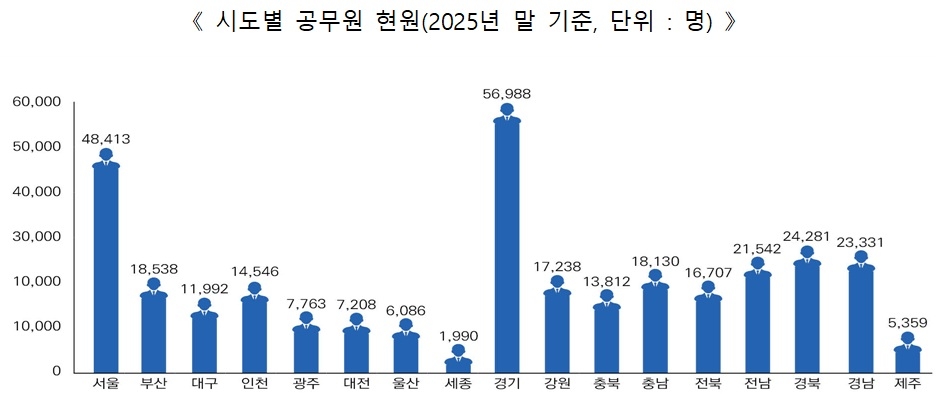
By region, Gyeonggi Province had the largest workforce at 56,988, followed by Seoul at 48,413 and North Gyeongsang Province at 24,281.
Among cities and counties, Changwon in South Gyeongsang Province had the most civil servants at 4,076, followed by Suwon in Gyeonggi Province at 3,802, Goyang at 3,456, Yongin at 3,409 and Cheongju in North Chungcheong Province at 3,331.
By job category, general-service officials numbered 312,057, followed by specialist-service officials at 929, designated-grade officials at 660 and political appointees at 278. Within the general-service category, administrative positions accounted for the largest share at 42.8 percent, followed by facilities positions at 12.8 percent and social welfare positions at 10.0 percent.
By rank, Grade 6 officials made up the largest share at 30.2 percent, or 91,571 people, while those at Grade 5 or above accounted for 8.3 percent of the total.
Women's representation showed particularly strong growth. Female civil servants numbered 163,328 — up 1,618 from 2024 — making up 52.0 percent of the total workforce. Among the 27,139 officials at Grade 5 or above, 10,518 were women, surpassing 10,000 for the first time since the statistics were first compiled.
The share of women in senior positions rose to 38.75 percent, up 4.02 percentage points from 34.73 percent in 2024, reflecting a broader trend of women advancing within the public sector.
Leave-taking showed a sharp upward trend. The number of officials on leave reached 33,948, up 2,818, or 9.1 percent, from 2024.
Parental leave was the most common reason, accounting for 24,266 people, or 71.5 percent of those on leave, followed by long-term medical care leave at 7,140 (21.0 percent) and family caregiving leave at 1,659 (4.9 percent).
The ministry said the figures suggest that family-friendly workplace culture is taking hold in the public sector, aided by government reforms such as expanded career recognition for parental leave.
New hires in 2025 totaled 16,243, down 2,529, or 13.5 percent, from 2024, continuing a downward trend that began in 2021.
The number of civil servants set to reach mandatory retirement age is projected to rise sharply — 4,550 in 2026, 7,837 in 2027 and 9,273 in 2028 — suggesting that new hiring will need to increase accordingly in the coming years.
The statistics are published annually in booklet form to support improvements to local government personnel systems and the development of foundational policy. The data are released each year on May 30 through the Ministry of Interior and Safety's website and the Ministry of Statistics.
Jin Myeong-gi, director general for local government innovation at the Ministry of Interior and Safety, said the annual data make clear that local governments must move beyond simple workforce management toward building sustainable long-term personnel strategies. "We will continue to pursue personnel policies that can respond swiftly to future administrative demands," he said.
thlee@heraldcorp.com