Government, public institutions and Samsung Heavy Industries join forces; vessel to be built in Korea and installed on-site
Korea Overseas Infrastructure & Urban Development Corporation among public institutions participating as financial investors
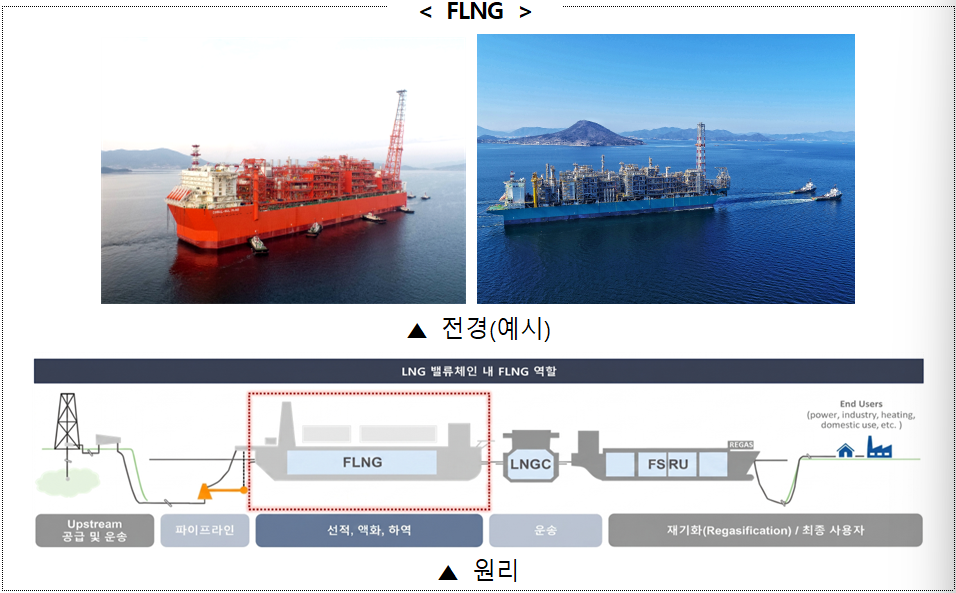
A "Team Korea" consortium of the government, public institutions and Samsung Heavy Industries has won a $2.8 billion (about 4 trillion won) contract to build the first floating liquefied natural gas offshore plant in Louisiana.
A floating liquefied natural gas facility, or FLNG, is a vessel equipped with natural gas liquefaction equipment. Built at a domestic shipyard and installed at the project site, it handles the full chain of liquefaction, storage and offloading of natural gas produced from a gas field.
The contract, signed June 1 local time, is structured around a fund managed by BlackRock — the world's largest asset manager — with the Korea Overseas Infrastructure & Urban Development Corporation (KIND), the Green Climate Fund and the Korea Ocean Business Corporation participating as financial investors. KIND is committing $70 million (about 100 billion won), the Green Climate Fund $30 million (about 45 billion won) and the Korea Ocean Business Corporation $50 million (about 75 billion won).
With this award, Samsung Heavy Industries will have secured 6 of the 10 FLNG orders placed worldwide, positioning the company to lead the market. Three of its FLNG units are already in operation, while three more are under construction.
The project will incorporate eco-friendly design technologies developed by Korean companies, including selective catalytic reduction — which converts nitrogen oxides in exhaust gas into nitrogen and water through a catalyst — and heat recovery steam generators that capture waste heat to produce steam and electricity, maximizing energy reuse.
Samsung Heavy Industries will install the plant roughly 74 kilometers off the coast of Louisiana, where it will produce approximately 4.4 million tons of LNG per year. Construction will take five years, followed by 25 years of operation.
The Ministry of Land, Infrastructure and Transport said the project is significant as an example of companies, three government ministries and two public institutions working in close coordination to win a major overseas infrastructure contract, and as a foundation for expanding Korea's footprint in the U.S. energy infrastructure market.
Because the project is an investment-development deal encompassing financing, construction and operations, it is expected to mark a turning point in shifting overseas construction from a traditional contract-based industry to a high-value-added, integrated one.
The fact that the plant will be manufactured and assembled in Korea before being installed on-site is also expected to generate a cascade of orders for small and mid-sized suppliers, contributing to regional economic activity.
The deal also suggests that participation in major overseas infrastructure projects can strengthen supply chain stability, not just win construction contracts.
With supply chain uncertainty growing amid the threat of a Hormuz Strait blockade, securing overseas infrastructure could meaningfully diversify import sources and reinforce transportation networks, analysts say.
The government said the outcome was the result of government ministries and public institutions "acting as partners to Korean companies expanding abroad on the strength of their technology, competing as one team." It added that it would provide full policy support to help the overseas construction industry transition into a high-value-added sector that offers quality jobs. "We will particularly expand investment in overseas energy, port and other infrastructure to strengthen our capacity to respond to global supply chain challenges," it said.
smh@heraldcorp.com