Public sentiment and governance outlook after one year of the Lee administration; ruling party regional heads grow from 5 to 12; real estate tax reform and prosecution overhaul set to accelerate
![President Lee Jae Myung listens to participants at a Cabinet meeting held at Cheong Wa Dae on May 28. [Yonhap]](https://wimg.heraldcorp.com/news/cms/2026/06/04/rcv.YNA.20260602.PYH2026060212690001300_P1.jpg)
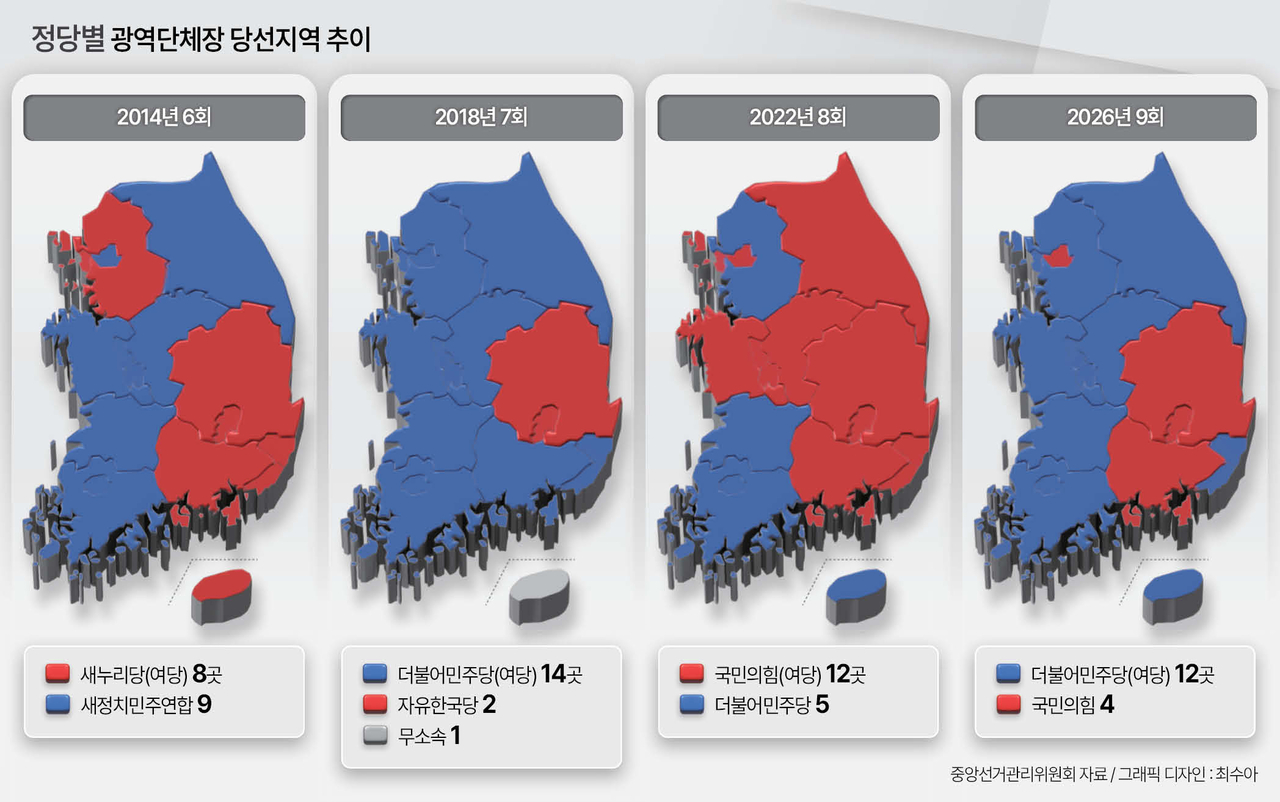
The ruling party's numerical victory in Wednesday's nationwide local elections has broadly reaffirmed public confidence in President Lee Jae Myung's governance, analysts say. The result is expected to inject fresh momentum into major policy priorities the administration had approached cautiously, including real estate tax reform and labor and financial sector overhauls.
However, the outcome is far from an unqualified triumph for Lee. People Power Party candidate Oh Se-hoon won the Seoul mayoral race — the most closely watched contest — and several former Cheong Wa Dae aides whom Lee had publicly backed were defeated in competitive races, confirming that a check on the ruling camp remains very much alive.
Political observers describe the local elections as delivering both a mandate and a warning to Lee. While the results give him a foundation to push an ambitious reform agenda in his second year in office, they also signal that voters expect a more measured approach on key issues such as Greater Seoul sentiment and housing policy.
Cheong Wa Dae had not issued any official statement on the election results as of Thursday morning, maintaining a cautious posture.
With questions of accountability already surfacing over some administrative confusion during the vote, analysts say the presidential office is choosing to observe the situation carefully rather than rush to interpret the results.
The June 3 simultaneous local elections were the first nationwide vote since the Lee administration took office roughly a year ago, effectively serving as a midterm referendum on his presidency. The ruling party expanded its hold on metropolitan and provincial governorships from five to 12, giving Lee a significantly stronger political base.
The stronger mandate is expected to accelerate the administration's so-called six-track reform agenda — covering regulation, finance, the public sector, pensions, education and labor — with the upcoming second round of ministerial policy briefings seen as the likely launch pad.
Some in political circles anticipate that follow-up legislation on prosecution reform — including whether to grant supplementary investigative powers to prosecutors under the new Public Prosecution Office — will advance in earnest, alongside a push for a special prosecutor probe into allegations of fabricated indictments.
At a Cabinet meeting he chaired on Monday, Lee directed acting Prosecutor General Gu Ja-hyeon to exercise authority with commensurate accountability, saying, "Anyone can make mistakes. When you do, you apologize and reverse course." The remarks were widely read as signaling his intent to press ahead with prosecution reform and the special prosecutor bill.
The Democratic Party leadership had initially sought to pass the fabricated-indictment special prosecutor bill before the local elections but held back out of concern it could hurt the party at the polls. Cheong Wa Dae had also asked the party to gather public opinion before proceeding.
Real estate policy is another area where significant changes are expected. With housing prices in Seoul showing renewed upward momentum, the government is expected to roll out additional measures combining expanded supply with steps to curb speculative demand. A Cheong Wa Dae official said a number of real estate policies would be announced after the election.
Markets are particularly watching for the possibility of stronger stabilization measures, including a restructuring of property holding and transaction taxes.
Personnel changes are also on the agenda as the administration looks to sharpen its governing structure. Cheong Wa Dae is reportedly reviewing a partial reshuffle of presidential staff and a Cabinet reorganization, including a new prime minister. Lee is said to be in final deliberations over whether to appoint Justice Minister Jeong Seong-ho, Ministry of SMEs and Startups Minister Han Seong-suk, or Chief of Staff Kang Hoon-sik to the post.
Still, the elections did not deliver a clean sweep for the president. Ha Jung-woo and Kim Byeong-uk, both former Cheong Wa Dae aides who ran for office, lost in Busan and Seongnam respectively, while Jeong Won-o — a Seoul mayoral candidate Lee had openly championed — fell short of expectations, leaving a visible mark on the administration.
Oh Se-hoon's victory in Seoul is expected to create considerable friction for Lee's central domestic priority: stabilizing the Greater Seoul housing market.
The Seoul mayor holds effective sway over the pace and direction of reconstruction and redevelopment projects, which form the backbone of the capital's housing supply policy.
Analysts warn that even if the central government pursues market stabilization through tax reform and financial regulation, the policy impact could be significantly diluted if Seoul City adopts a different approach to urban renewal and supply. By Seo Yeong-sang
sang@heraldcorp.com