Voting patterns mirror those seen in local elections four years ago; young men's support proved decisive in Seoul mayoral race
The June 3 local elections revealed a stark gender divide in voting preferences among voters in their 20s and 30s, reconfirming a polarization trend among young voters that closely mirrors patterns seen in the local elections four years ago.
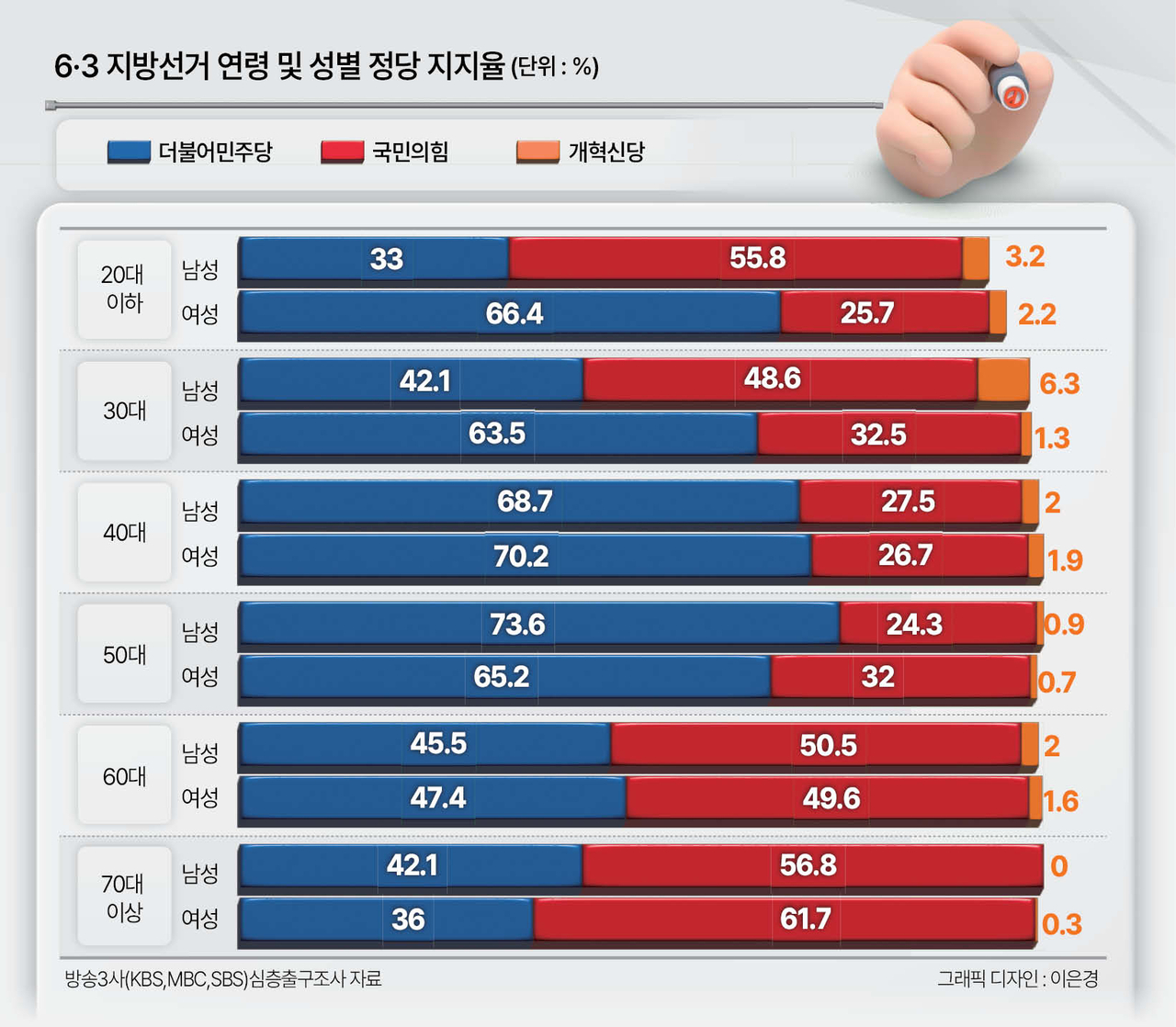
Exit poll data released Wednesday by the three major terrestrial broadcasters — KBS, MBC and SBS — showed that among male voters aged 18 to 29, 55.8 percent supported People Power Party candidates, 33.0 percent backed Democratic Party of Korea candidates, and 3.2 percent chose Reform Party candidates.
Among women in the same age group, the numbers were nearly reversed: 66.4 percent supported the Democratic Party, 25.7 percent backed the People Power Party, and 2.2 percent chose the Reform Party.
A majority of young men backed the conservative camp while a majority of young women favored progressive candidates, with political leanings splitting sharply along gender lines.
The same pattern held among voters in their 30s. Among men in that age group, 48.6 percent supported the People Power Party, 42.1 percent backed the Democratic Party, and 6.3 percent chose the Reform Party. Among women in their 30s, 63.5 percent supported the Democratic Party, 32.5 percent backed the People Power Party, and 1.3 percent chose the Reform Party. Voting tendencies among those in their 20s and 30s closely tracked the trends seen in exit polls from the 2022 local elections.
In those exit polls four years ago, men in their 20s and younger favored the People Power Party at 65.1 percent, while women in the same cohort backed the Democratic Party at 66.8 percent. Among voters in their 30s, men leaned toward the People Power Party at 58.2 percent, while women supported the Democratic Party at 56.0 percent.
Outside the 20s and 30s age groups, gender differences in voting preferences were far less pronounced nationwide. Voters in their 40s and 50s favored the Democratic Party regardless of gender, while those aged 60 and above showed strong support for the People Power Party.
Among voters in their 40s, 68.7 percent of men and 70.2 percent of women backed the Democratic Party, while 27.5 percent of men and 26.7 percent of women supported the People Power Party.
Among voters in their 50s, 73.6 percent of men and 65.2 percent of women supported the Democratic Party, while 24.3 percent of men and 32.0 percent of women backed the People Power Party.
Among voters in their 60s and those 70 and older, support for the People Power Party outpaced the Democratic Party across both genders.
In Seoul, the gender gap among young voters was especially pronounced. Some 75.3 percent of male voters in their 20s backed People Power Party candidate Oh Se-hoon, who won the Seoul mayoral race. Among women in the same age group, 48.5 percent supported Democratic Party candidate Jeong Won-o, while 41.4 percent backed Oh.
kido@heraldcorp.com