
Goldberg calls Lee Jae Myung 'a skilled politician who understands the value of the alliance'; Stevens says 'anti-Americanism' label is anachronistic
By Seo Ji-yeon, The Herald Business
Two former US ambassadors to South Korea have publicly pushed back against characterizations of the Lee Jae Myung government as anti-American or pro-China, drawing on their firsthand experience in Seoul to counter concerns raised in some US conservative circles that the new administration could weaken the alliance.
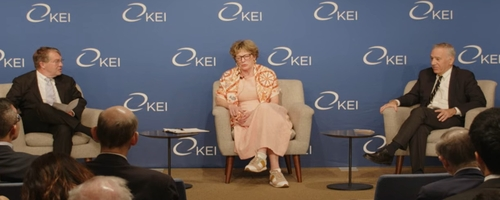
Philip Goldberg, the most recent US ambassador to South Korea, said at a Korea Economic Institute seminar in Washington on Thursday that he did not know where the notion of Lee Jae Myung as some kind of radical communist was coming from.
"I have met him personally and never got that impression," Goldberg said, calling Lee "a skilled politician."
While acknowledging that progressive-leaning governments tend to be somewhat less aligned with US international policy, Goldberg said Lee "understands the value of the alliance with the United States — particularly the US nuclear umbrella."
He added that Lee had been working to cooperate with President Donald Trump even on difficult issues such as trade and investment, and said he did not agree with the concerns raised in a recent Wall Street Journal opinion piece.
The remarks were widely seen as a direct response to criticism of the Lee government that has emerged recently in US conservative circles.
The Wall Street Journal published an outside opinion piece on June 1 that cited the controversy over a search and seizure at Osan Air Base, an investigation into a data breach at Coupang Inc, and remarks by Unification Minister Jeong Dong-young on classified information, arguing that threats to the South Korea-US alliance were growing.
The column drew particular attention in Washington diplomatic circles for raising concerns that the Lee government could tilt toward China and that security cooperation between the two countries could weaken.
Both former ambassadors, however, said such an interpretation went too far.
Kathleen Stephens, who served as US ambassador to South Korea from 2008 to 2011, said bipartisan support for the alliance in South Korea "continues to grow."
"President Lee also knows that the majority of the Korean people want a strong relationship with the United States," she said, adding that a distinction must be drawn between anti-Americanism and opposition to specific policies.
"Using the term anti-Americanism to describe Korean politics today sounds very anachronistic," she said.
The former ambassadors also offered a relatively positive assessment of the Lee government's approach to China.
Goldberg said that while the Yoon Suk Yeol government had taken a comparatively hard line toward China, the Lee government would likely seek to expand its diplomatic space with Beijing.
He drew a line, however, against reading that as a pro-China policy.
"It's more of a rebalancing than a full-on pro-China policy, as some in Washington might see it," he said.
The assessment suggests South Korea may be seeking a more pragmatic diplomatic course as the so-called "security with America, economy with China" strategy becomes increasingly difficult to sustain.
Analysts also note that with the Trump administration pressing allies harder on defense costs and trade, South Korea may look to broaden its diplomatic options.
Stephens also took a relatively forward-leaning position on the transfer of wartime operational control.
"If there is change, what matters is how that change is managed," she said. "I think it can be managed well."
She added, "Perhaps now is actually the right time."
She said, however, that a successful transfer would require trust between the two countries as a prerequisite. "There needs to be an underlying foundation of trust and confidence in each other's commitments," she said.
Meanwhile, Secretary of State Marco Rubio told a House hearing Wednesday that when it comes to leadership changes in South Korea, "sometimes in democracies, leaders are elected who are more favorable to US interests, and sometimes leaders are elected who have a different perspective — that's the nature of dealing with democratic countries."
sjy@heraldcorp.com





