
Options to grow with Mirinaezip, Baronaezip and Seoulnaezip programs
Seoul Metropolitan Government to back youth home purchases directly
![Seoul Mayor-elect Oh Se-hoon greets city employees as he arrives at Seoul City Hall on Thursday. [Yonhap]](https://wimg.heraldcorp.com/news/cms/2026/06/05/rcv.YNA.20260604.PYH2026060416000001300_P1.jpg)
With Oh Se-hoon winning a fifth term as Seoul mayor, the city's affordable housing programs targeting young residents are expected to expand, offering units below market price. Having campaigned on homeownership rather than rental assistance as the answer to the city's high real estate barriers, Oh is likely to draw continued support from young Seoulites who do not yet own a home.
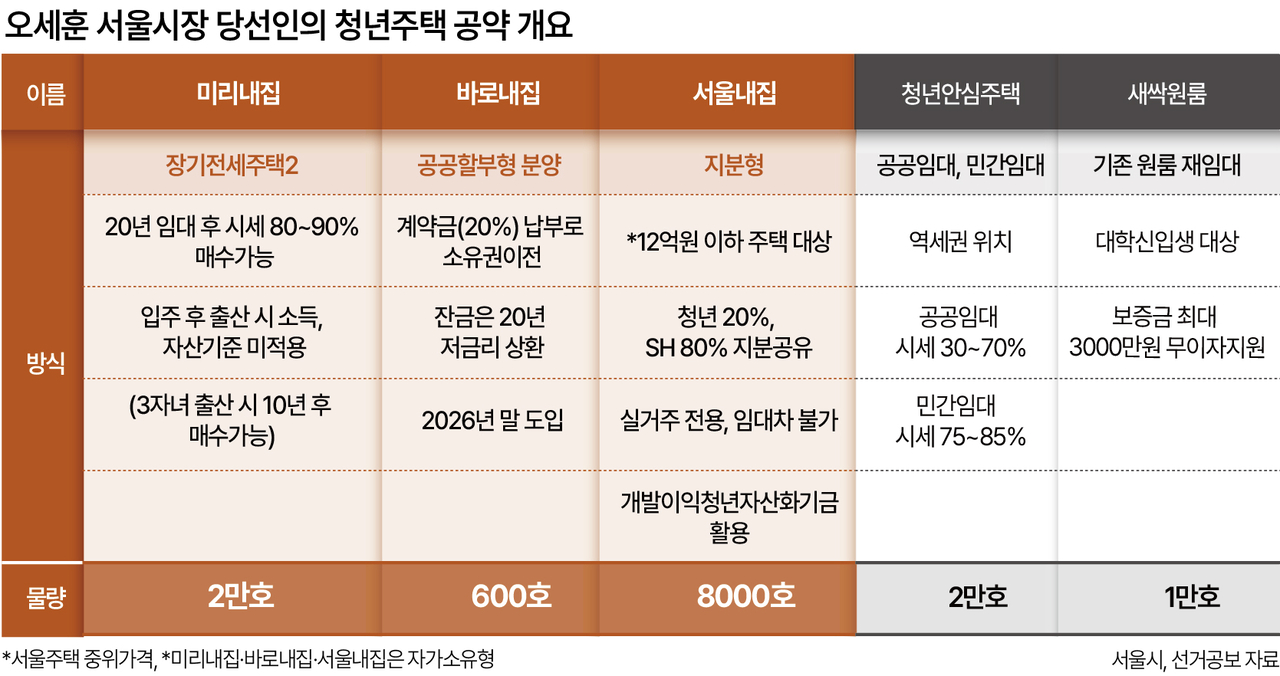
According to Oh's campaign pledges, the city plans to increase the supply of publicly owned, self-ownership-type housing — including installment-based pre-sale units and equity-share homes.
Baronaezip, a new model announced two weeks before the election, is an equity-share housing program under which the Seoul Housing and Communities Corp. (SH) and young buyers without property split ownership stakes. Targeting homes priced at 1.2 billion won (about $785,000) or less, buyers can become homeowners by putting up just 20 percent of the purchase price. A Seoul Metropolitan Government official said the city would "soon review the method of introduction and specific direction, including whether legislation needs to be amended, through consultations with SH."
The existing Mirinaezip program — long-term jeonse housing with a conversion-to-ownership option — will see its supply expanded by 20,000 units. A separate Baronaezip installment model, under which buyers pay only a down payment upfront and settle the balance over 20 years, is targeting 600 units, with the first round of applicants to be recruited within the year.
The programs are aimed at meeting strong demand among young people for homeownership. A 2024 Seoul residential conditions survey found that about 90 percent of young and newlywed households without property said they felt they needed to buy a home for their own use. Yet the number of households under 39 without property in Seoul has consistently grown to nearly one million, reflecting an acute housing crunch.
![Seoul Mayor Oh Se-hoon announces youth housing stability measures at Seoul City Hall on March 10. The city declared "The Dream Home+," a unified brand for youth housing stability, and said it would pursue three major policies through 2030: expanding housing supply for young residents, broadening housing cost support, and strengthening the residential safety net. [Yonhap]](https://wimg.heraldcorp.com/news/cms/2026/06/05/rcv.YNA.20260310.PYH2026031013490001300_P1.jpg)
Oh has long invested political capital in housing policy and consistently put forward programs aimed at young people who aspire to own a home. At a Seoul housing consultation fair held in March, he personally unveiled a lifecycle housing ladder — from "Saessak Studio" units for incoming university students, to Mirinaezip for newlyweds, to the Baronaezip public ownership model. The rollout raised public awareness of the programs. Just before the election, he also strategically introduced the Seoulnaezip homeownership model, drawing a clear contrast with the Democratic Party's platform of expanding rental housing.
Industry observers believe these policies had some effect on his approval ratings. Exit polls by the three major broadcasters — KBS, MBC and SBS — showed Oh, the People Power Party candidate, winning 56.8 percent support among voters in their 20s and younger in Seoul, and 59.7 percent among those in their 30s, far ahead of Democratic Party of Korea candidate Jeong Won-o, who drew 35.9 percent and 36.7 percent in those age groups respectively. Particularly notable was Oh's 53.6 percent support among women in their 30s — a sharp contrast to national surveys showing women in their 20s and 30s strongly backing the Democratic Party candidate.
One real estate expert said Oh would likely "try to hit two birds with one stone — securing housing supply through high-density, high-rise floor-area-ratio incentives to improve the viability of redevelopment projects, while channeling public housing to young residents." The expert added that the expansion of options for young people "is meaningful in itself."
Experts advise young people to take advantage of the policies while building a housing strategy suited to their stage of life.
Park Ji-min, head of the Wolyong Apartment Subscription Research Institute, said that while supply for young people would grow beyond current levels, "depending on the complex, it could amount to just a few dozen units." For those aiming to buy within a short time frame, he said "a realistic approach is to target large-scale supply sites first, such as the third-generation new towns." He added that those with a long-term goal of settling in Seoul might also consider "a more detailed strategy — living in a metropolitan area rental unit and timing a move into Seoul to coincide with new supply."
![‘서울 탈환 실패’ 정부, 재초환 등 규제 속도 늦추나 [부동산360]](https://wimg.heraldcorp.com/news/cms/2026/06/05/rcv.YNA.20251229.PYH2025122911780001300_T1.jpg)
hope@heraldcorp.com





