
Ranked among Asia's top 100 and Korea's top 10 courses, Lotte Skyhill CC Jeju was designed by master architect Robert Trent Jones Jr. with a simple philosophy: let nature be the course. A full grass replacement, pet-friendly rounds and an architectural resort next door make it a destination worth revisiting.
![The clubhouse at Lotte Skyhill CC Jeju. [Provided by Lotte Hotels]](https://wimg.heraldcorp.com/news/cms/2026/06/08/news-p.v1.20260605.f8851b440363496790684ac81b967b6c_P1.jpeg)
Standing on the vast expanse of Jeju turf with the island wind at your back, the ground underfoot feels firm yet yielding — dense and springy in equal measure. Cool-season grasses have long struggled here, scorching yellow under the island's punishing summer heat. Lotte Skyhill CC Jeju chose a bold answer to that problem: it stripped out the heat-sensitive turf entirely and replanted with hardy warm-season grass — known in Korea as "nanjihyeong" — that holds its green even through a heat wave. A few early-spring rains arrived just in time to help the new growth take root, knitting the fairways tight. The result is a course where Jeju's wind, volcanic stone and living turf feel inseparable.
A world-class course between stone walls, reimagined
The course was designed by Robert Trent Jones Jr., the architect behind 13 of America's top 100 golf courses. His philosophy here was disarmingly restrained: leave Jeju's stone walls, forests and natural contours exactly as he found them, and let the land become the course. The result is 36 holes spread across a 1.65-million-square-meter site, where basalt stone walls wind quietly between fairways. Golfers, however, will find little mercy. The layout has earned a place on Golf Travel's list of Asia's top 100 courses and Korea's top 10, and its difficulty has not softened since the course opened in 2005. The KLPGA regular tour returns here every year — a professional endorsement that carries its own quiet prestige.
The most striking change on this visit was the wholesale replacement of the fairway grass. Every fairway on the public-access courses has been converted from cool-season to warm-season turf — not a partial swap carried out while the course stayed open, but a full closure and complete replanting. Jeju summers grow hotter each year, and the old grass had been burning yellow in the heat, leaving uneven playing conditions. Warm-season turf is the answer: it stays green through extreme heat, grows denser after rain and produces a clean ball lie thanks to its tight density. The conversion marks a shift toward year-round stable conditions and a premium, eco-conscious course identity.
![Hill Course No. 1 at Lotte Skyhill CC Jeju. [Provided by Lotte Hotels]](https://wimg.heraldcorp.com/news/cms/2026/06/08/news-p.v1.20260605.a8ffa575c9e049c5b4245ed369c50ded_P1.jpg)
![Hill Course No. 6 at Lotte Skyhill CC Jeju. [Provided by Lotte Hotels]](https://wimg.heraldcorp.com/news/cms/2026/06/08/news-p.v1.20260605.d0b9ea37d57d405a94c3317c50847efb_P1.jpg)
18 holes open to the sea, 18 wrapped in forest
The members-only Sky and Ocean courses face the sea. Step onto the first tee of the Sky Course on a clear day and the outline of Marado island floats on the horizon — a view almost too good to turn your back on for a tee shot. Midway through the round, a stretch known as the "Hallasan Break" awaits: an uphill slope that reads visually as a downhill, a topographic illusion straight out of Jeju's famous gravity road. Trust your eyes and the ball will betray you. It is the kind of hole where a caddie's advice suddenly feels indispensable.
On Ocean Course No. 3, the waters off Seogwipo and the distant World Cup Stadium share a single frame — panorama is not too strong a word. No. 5 is the hardest of all 36 holes: a long par 3 flanked front and back by water hazards that punish any lapse in concentration. Lose focus for a moment and the ball vanishes with barely a ripple.
The public Forest and Hill courses offer a different mood entirely. Instead of sea views, dense woodland closes in on either side. The designer preserved Jeju's natural forest, threading fairways between the trees so that cresting a hill suddenly reveals a stretch of coastline. The trees also serve a practical purpose, breaking the island's persistent wind.
Hill Course No. 3 narrows between a stone wall and a water hazard, making the second shot's distance calculation as important as the drive. No. 7 is the hole most golfers name as their favorite: from the top of the rise, the Seogwipo coastline and the entire course spread out below, the colors shifting with every change in wind direction. The same hole looks like a different painting each time.
The Forest Course carries the stillness of a deep Scandinavian woodland. Nos. 3 and 5 open onto wide, unobstructed fairways that invite a full-blooded drive. The rhythm of the round here alternates between forest quiet and sudden sea views, tension and release — a cadence that stays with you long after the 18th hole.
![Ocean Course No. 5 at Lotte Skyhill CC Jeju. [Provided by Lotte Hotels]](https://wimg.heraldcorp.com/news/cms/2026/06/08/news-p.v1.20260605.4484a9476ff74454bbc4e802c4af4eb1_P1.jpg)
![A pet-friendly round in progress at Lotte Skyhill CC Jeju. [Provided by Lotte Hotels]](https://wimg.heraldcorp.com/news/cms/2026/06/08/news-p.v1.20260605.37290432ab604772bbac6d5b8e8d6f43_P1.jpeg)
An extra minute, and a four-legged playing partner
Starting in March this year, the tee-off interval on the members courses was extended from seven minutes to eight. One minute sounds trivial, but the difference is felt: the pressure of the group behind eases, and there is time for one more breath on the tee. New private check-in lanes and dedicated lockers have also been added.
On-course diversions add to the experience. The "LUA Special Cart" and the "Lotteria Burger Cart" are each available to one group per day on a first-come, first-served basis at 140,000 won (about $92) per group. The LUA cart comes with a souvenir — a Baekcharm doll or luggage tag — and the burger cart doubles as a backdrop for a memorable on-course photo.
One of the course's more unusual offerings is its pet-friendly round program, the first of its kind at a Korean golf course when it launched in 2019. Each participating group receives a package that includes a dedicated cape, treats and toys for their dog. All proceeds go to a stray-animal shelter. A four-legged companion padding across the fairway beside its owner sounds incongruous — but in practice it fits into the scenery with surprising ease.
Pre-round warm-up takes place at a 290-meter driving range with no boundary fence, the sight line dissolving into open sky. The facility also includes Jeju's only dedicated bunker and approach practice area — ideal for sharpening the short game. Both are open to the general public, not just golfers with tee times.
![An aerial view of Lotte Resort Art Villas Jeju. [Provided by Lotte Hotels]](https://wimg.heraldcorp.com/news/cms/2026/06/08/news-p.v1.20260605.33d6edd6797146298fe12dccd968eead_P1.jpg)
![Lotte Resort Art Villas Jeju. [Provided by Lotte Hotels]](https://wimg.heraldcorp.com/news/cms/2026/06/08/news-p.v1.20260605.979bd0c3154a47a69de14bb1977037ac_P1.jpeg)
After the round: an architectural journey awaits
The 88-seat clubhouse restaurant looks out over the fairways and the sea. The menu features abalone and dried pollack hangover soup, a house-made cheese katsu set and a Jeju octopus kadaif and cold buckwheat noodle set. After 18 holes on foot, a bowl of that soup is the kind of quiet comfort only golfers fully understand. The pro shop carries Titleist, Callaway and FootJoy.
A round can flow naturally into an architectural tour at the adjacent Lotte Resort Art Villas Jeju. The villa complex was designed by five teams representing Eastern and Western architecture — Seung H-Sang, Dominique Perrault, Lee Jong-ho, Kengo Kuma and DA Group — each responsible for one block. Guests who brought a dog should consider the pet-dedicated room (244 square meters, or about 74 pyeong; 1 pyeong equals 3.3 square meters) in Lee Jong-ho's block. The "Nolmeong Swimmeong Package," which includes a luxury pet house and welcome gift, connects directly with the pet-friendly round program.
The "Olle Garden" path linking the villas stays open around the clock. Walking it at dusk, the day's tension dissolves into the breeze. At the community center Art Cordelia, guests can close the evening with sea urchin and seaweed soup or a clear Jeju seafood hangover soup while looking out over the water and the course. The below-ground club lounge stays open until 11 p.m.
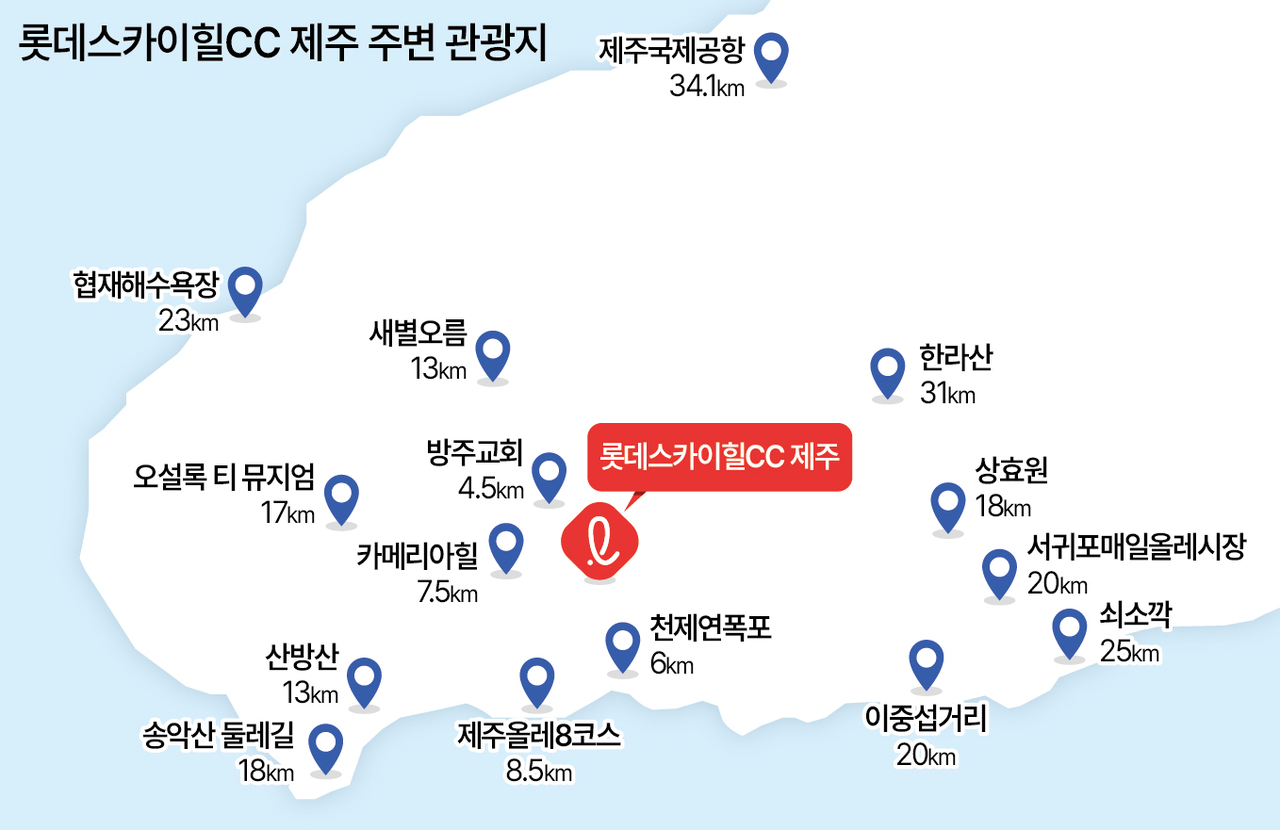
Beyond the fairways: the whole island is a destination
Step outside the course and attractions appear in every direction. Jungmun Tourism Complex is 15 minutes by car. Cheonjeyeon Falls, the Songaksan trail, Soesokkak estuary and the Osulloc Tea Museum are all within easy reach. Lee Jung-seop Street in Seogwipo offers small galleries and cafes at a leisurely pace, and Seogwipo Maeil Olle Market is the right place to sit down with a plate of black pork and a cold beer. Golf, architecture and food — everything is within a 30-minute radius.
The one variable is the weather. Jeju's capricious wind and sudden rain are a challenge for golfers and an unforgettable memory for travelers. In that spirit, every structure at Lotte Skyhill CC Jeju and Art Villas follows the contours of the natural landscape. Visitors pass through briefly. Leaving always feels too soon. That is precisely why they come back.
andy@heraldcorp.com





