Wonik IPS, Eugene Technology among sharp decliners; Femteck holds gains; analysts say AI demand intact
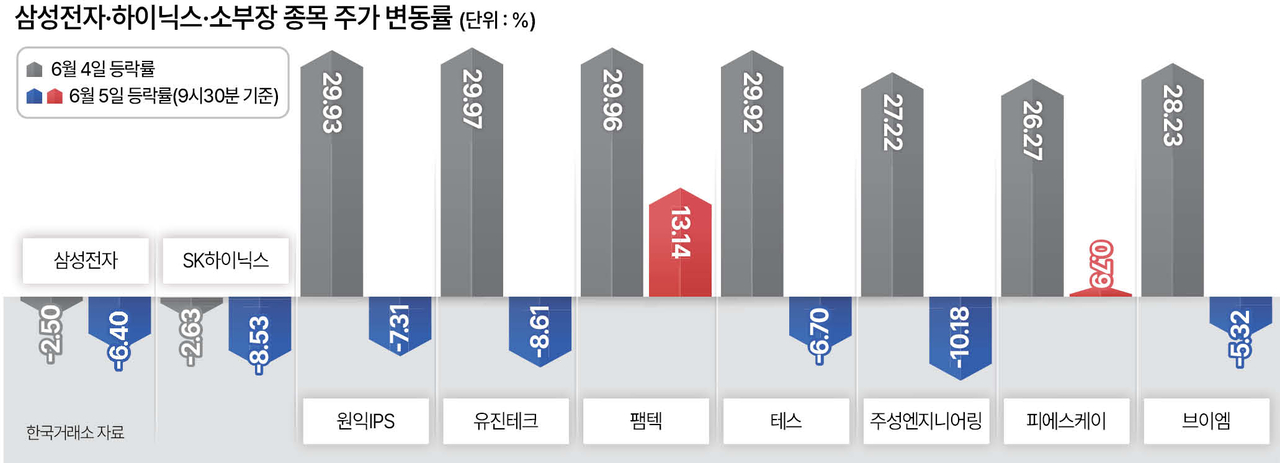
Semiconductor materials, parts and equipment stocks that led a Kosdaq rebound by hitting their daily upper price limits Thursday reversed sharply lower Friday, amplifying volatility in the sector. With large-cap chipmakers including Samsung Electronics and SK Hynix posting steep declines, most semiconductor materials stocks also weakened, raising questions about whether the recent semiconductor rally can be sustained.
According to Korea Exchange data, most semiconductor materials, parts and equipment stocks that hit their upper limits Thursday turned lower in early trading Friday. As of 9:30 a.m., Wonik IPS was down 7.31%, reversing a 29.93% surge from the previous session. Eugene Technology, which had jumped 29.97% Thursday, was down 8.61%. Jusung Engineering, which had surged 27.22% Thursday, fell 10.18%, giving back a portion of its gains.
VM also slipped 5.32% after rising 28.23% Thursday. Femteck, however, extended its rally, climbing 13.14% after a 29.96% gain the previous day. PSK added 0.79% after surging 26.27% Thursday, holding up relatively well. The moves highlighted a clear split among stocks that had risen in tandem just a day earlier.
Large-cap semiconductor stocks also weakened. Samsung Electronics fell 6.40% after declining 2.50% Thursday, while SK Hynix dropped 8.53% following a 2.63% loss the previous day. Profit-taking pressure — built up after a sharp short-term rally centered on Samsung Electronics and SK Hynix — was spilling over into materials and equipment stocks as well.
Markets pointed to Broadcom's below-consensus AI chip sales guidance as a factor dampening investor sentiment. Overnight on Wall Street, the Dow Jones Industrial Average and the S&P 500 rose 1.73% and 0.41%, respectively, but the tech-heavy Nasdaq edged down 0.09%. The Philadelphia Semiconductor Index fell 2.15%.
The Kosdaq also tumbled, briefly breaking below the 1,000 level during trading Friday. The index had crossed 1,000 for the first time on a closing basis in January and climbed as high as 1,200 in April, but has since surrendered much of those gains during a recent correction. Analysts at brokerages said the broader improvement in industry conditions driven by expanding AI investment remains intact, and advised investors to distinguish between short-term volatility and medium-to-long-term growth potential.
Lee Dong-ju, a researcher at SK Securities, said fund flows over the past week showed investors selling semiconductor materials exchange-traded funds and rotating into large-cap technology stocks with stronger earnings momentum, but that underlying conditions for semiconductor materials and equipment companies had not changed. "Earnings estimate upgrades for domestic semiconductor materials and equipment companies have continued over the past month, so any further pullback is actually a good buying opportunity," he said. He added that demand for memory chip production capacity expansion in the current AI cycle is far stronger than in previous cycles, and that investment intensity is on track to expand from a 2025 rebound through 2028.
Policy expectations that helped fuel Thursday's surge in materials stocks also remain in play. The Financial Services Commission held a meeting this week with research center heads at brokerages and officials from the Korea Financial Investment Association to discuss measures to revitalize the Kosdaq market and gather industry views. The National Growth Fund — a vehicle set to raise 150 trillion won (about $98.1 billion) over five years — is seen as a key demand variable for the Kosdaq market. Brokerage analysts estimated that roughly 10.4 trillion won could flow into the Kosdaq market when both direct and indirect support channels are included.
hajun825@heraldcorp.com