Foreign sell-off triggers warning signs across financial and equity markets; 20 consecutive sessions of net selling; won-dollar rate hits post-financial-crisis high; fears grow that 1,500-won-plus exchange rate could become entrenched
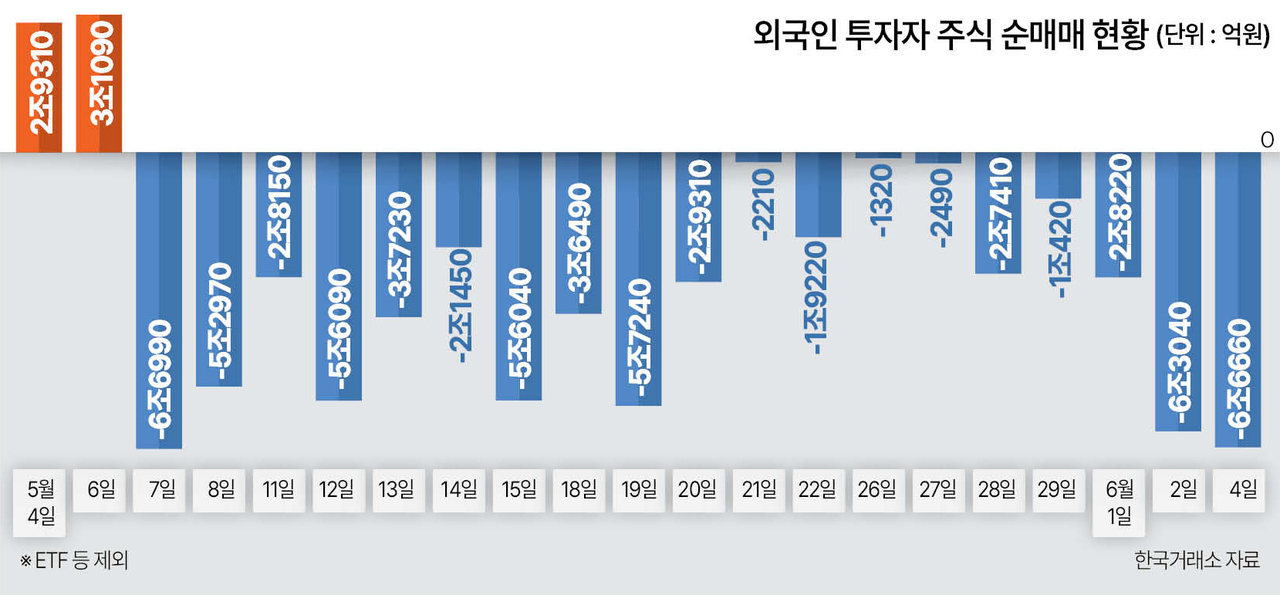
The Kospi has entered what markets are calling the historic "8,000 era," but a massive exodus of foreign capital is deepening market anxiety. Foreign investors have net sold nearly 120 trillion won (approximately $78.5 billion) worth of Korean equities so far this year, including 20 consecutive trading sessions of net selling in an unprecedented flight from the market.
The sell-off, concentrated in large-cap semiconductor stocks, sent the Kospi tumbling toward the 8,000 mark in early trading Friday, producing what traders described as a "black Friday." The won-dollar rate also surged past 1,540 won. With foreign selling and a weakening won feeding off each other, instability in both the equity and foreign exchange markets is intensifying.
According to Korea Exchange data, foreign investors net sold a total of 116.6 trillion won ($76.2 billion) worth of Kospi-listed stocks — excluding exchange-traded funds — from the start of the year through Thursday. The pace accelerated sharply in the most recent month: from May 4 through Thursday, foreigners net sold 60.6 trillion won, nearly half the year's total in just one month.
The selling has been concentrated in the benchmark semiconductor heavyweights. This year, foreign investors have net sold 60.2 trillion won worth of Samsung Electronics shares and 40.8 trillion won worth of SK Hynix shares. Together, those two stocks account for 101 trillion won in net selling — the vast majority of total foreign outflows.
The net selling continued Friday. As of 10:20 a.m., foreigners had net sold 1.6 trillion won worth of shares. If the trend holds through the close, it will mark 20 consecutive trading sessions of net selling — the ninth-longest such streak on record.
The Kospi opened Friday down 316.21 points, or 3.66 percent, at 8,323.20 and extended its losses through the morning. A sidecar — a temporary halt on program sell orders triggered by a rapid decline — was activated shortly after the open. By 10 a.m., the index had fallen 6.49 percent to 8,078.73.
The semiconductor giants at the center of foreign selling bore the brunt of the decline. Samsung Electronics fell 5.83 percent, dropping into the 330,000-won range, while SK Hynix slid 7.70 percent into the 2.1-million-won range. SK Square, SK Hynix's largest shareholder, also tumbled 8.08 percent.
Kosdaq broke below the 1,000 mark as well. The index opened down 14.51 points, or 1.38 percent, at 1,035.22 and extended its losses. By 10:02 a.m., it had fallen 5.12 percent to 995.98.
Market participants say the current wave of foreign selling is nearly without precedent — both in scale and duration. Foreign investors net sold Kospi shares for 19 consecutive trading sessions from May 7 through Thursday, the longest such streak in roughly six years. The previous record was 30 consecutive trading sessions of net selling from March 5 through April 16, 2020, when the COVID-19 shock roiled global financial markets.
Single-day net selling figures have also been record-breaking. On Thursday, foreign net selling on the Kospi totaled 6.9880 trillion won, the second-largest daily figure on record. The all-time record was also set this year: on Feb. 27, foreigners net sold 7.0812 trillion won in a single session.
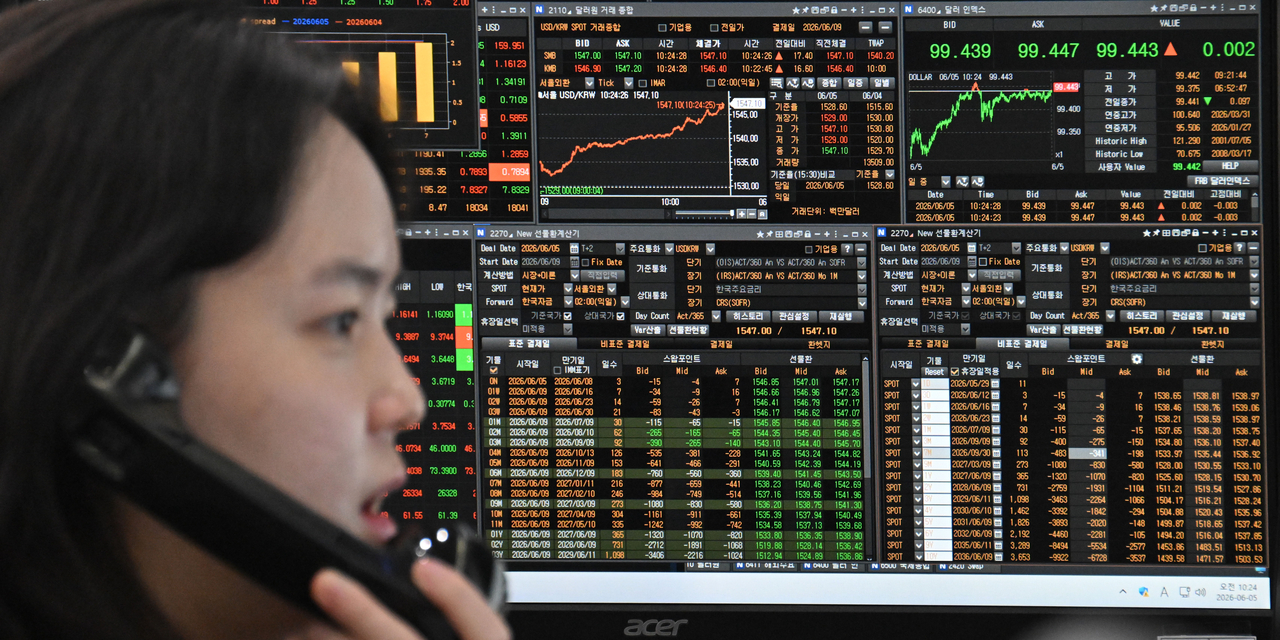
The sustained foreign outflows have pushed the won sharply lower. The won-dollar rate opened Friday at 1,529.0 won — down 0.7 won from the previous session — before climbing past 1,540 won during intraday trading in the Seoul foreign exchange market.
Market participants are increasingly worried that foreign selling and the rising won-dollar rate could lock each other into a vicious cycle.
Foreign investors ultimately measure returns in dollar terms, meaning a weaker won can erode gains even when Korean share prices rise. If the won depreciates faster than the Kospi advances, dollar-denominated returns can turn negative. As a result, when the exchange rate enters a rising phase, foreign investors tend to reduce their Korean equity exposure or repatriate capital. Analysts say the recent concentration of foreign net selling in top market-capitalization stocks such as Samsung Electronics and SK Hynix is already dampening broader investor sentiment toward won-denominated assets.
Foreign selling itself amplifies upward pressure on the exchange rate. When foreign investors sell Korean stocks and convert the proceeds from won to dollars for repatriation, dollar demand in the foreign exchange market rises. Higher dollar demand pushes the rate up further, which in turn makes Korean equities less attractive to foreign investors — a self-reinforcing loop.
In practice, the two trends have been lengthening in tandem. Foreign net selling has now stretched to 20 consecutive trading sessions, while the won-dollar rate has closed above 1,500 won for 13 consecutive trading sessions.
"Foreign equity buying and selling flows have long been a key driver of exchange rate movements, given how large a role foreigners play in our financial markets — but since mid-May, daily net selling has surged to around 3 trillion won," said Jeong Yong-taek, a researcher at IBK Investment Securities. "These factors do not look like they will disappear anytime soon."
th5@heraldcorp.com