Ronaldo, 41, and Messi, 39 — a final World Cup for football's two emperors
![Cristiano Ronaldo dribbles past Lionel Messi during a match between FC Barcelona and Juventus at Camp Nou in Barcelona, Spain, in December 2020. [Getty Images]](https://wimg.heraldcorp.com/news/cms/2026/06/09/news-p.v1.20260609.346febc4e19d431d86c895e0ea98c3f1_P1.jpg)
Stories in films usually stay on the screen. A street girl falling for a cold-hearted chaebol, or a vengeful spirit crawling out of a television set — none of that happens in real life. Sport is the one exception. The human story of raw talent and relentless effort triumphing over grinding poverty or illness remains the only arena where reality still outdramas fiction. Two legends who gave football fans a taste of something beyond the human — something almost divine — from the 2000s through the 2010s and into the 2020s will light their final flame at the World Cup, which opens Friday. Lionel Messi, 39, and Cristiano Ronaldo, 41, are on the verge of a sixth World Cup appearance, a feat matched only by Mexico's Guillermo Ochoa.
Prodigies who overcame poverty and illness — parallel childhoods that shaped two legends
![A young Lionel Messi, center front row, playing for Newell's Old Boys, an Argentine youth club. [Getty Images]](https://wimg.heraldcorp.com/news/cms/2026/06/09/news-p.v1.20260607.99967e6f3f5a4e9a82fac1bf92ed5f3d_P1.jpg)
The two men share strikingly similar origin stories — unmistakable talent from an early age and near-catastrophic setbacks overcome along the way. The legend of Messi began with his maternal grandmother. Born in Argentina, where football is a religion, and with a father who coached a local club side, Grandoli, Messi joined Grandoli's youth team at age four. It was his grandmother who truly set him on his path, persuading him to play in a local youth match. When she arrived to watch and heard that a player was missing, she asked the organizers to let her grandson fill in. Messi dazzled, and his football journey began in earnest. His grandmother's eye for talent was matched only by her love for him — most of the childhood footage and photographs of Messi with a ball at his feet that circulate online were filmed or taken by her, according to accounts of those who knew the family. To this day, Messi honors her memory by raising both hands toward the sky every time he scores.
His great trial came at age 11, when he was diagnosed with growth hormone deficiency. Treatment cost between $1,000 and $1,500 a month — a sum far beyond the means of a steelworker father and a cleaning-worker mother. Argentina's deepening fiscal crisis at the time made even prominent local clubs reluctant to foot the bill.
![The contract FC Barcelona signed with Messi when he was 13, famously written by the club's then-technical director Carles Rexach on a paper napkin from a restaurant because no proper paper was at hand. [Getty Images]](https://wimg.heraldcorp.com/news/cms/2026/06/09/news-p.v1.20260607.f4b3d47720a14fd9ac0ccf67414539a4_P1.jpg)
The solution came from Spanish giants FC Barcelona. Technical director Carles Rexach was immediately captivated watching Messi play, but the club hesitated — it had no precedent for signing a 13-year-old. When Messi's father threatened to take his son elsewhere, a panicked Rexach grabbed the nearest thing to hand — a paper napkin from a restaurant table — and wrote out a contract on the spot. The document, now reportedly kept in a frame, reads less like a formal agreement than a personal pledge: "Despite some dissenting opinions within the club, I commit to bringing Lionel Messi to La Masia. I take full responsibility for this decision."
![A childhood photo of Cristiano Ronaldo. The image became doubly famous after Nike — his sponsor — cropped it to show only his face before posting it on social media, and fans then tracked down the original, which showed Ronaldo wearing an Adidas kit. [Nike official social media]](https://wimg.heraldcorp.com/news/cms/2026/06/09/news-p.v1.20260607.a7380aab57a046d48bdfd75e4ce4d726_P1.jpg)
Cristiano Ronaldo's childhood was even harder than Messi's. His father was an alcoholic, his brother struggled with drug addiction, and his mother worked as a cleaning woman to keep the family afloat. As a boy, Ronaldo was often hungry, and he would linger behind a local McDonald's hoping staff would hand him a burger to ease the pangs.
He grew up in Funchal, on the island of Madeira — one of Portugal's poorer regions — in what was by local standards the poorest household on the street. The other neighborhood children would not let him join their games, so he played alone in an empty lot. One day a football rolled his way, and the joy he felt kicking it back stayed with him. He pestered his mother until she let him play, and he worked his way up through CF Andorinha and CD Nacional before joining Sporting CP's youth academy.
Crisis struck Ronaldo at 17, when doctors told him he needed surgery for tachycardia — an abnormally rapid heartbeat. The unexpected ordeal brought his fractured family together. His father and brother found work and saved money, and after more than a year of the whole family pooling their earnings, Ronaldo had the operation and recovered. He then threw himself into rehabilitation and intensive training, rising through Sporting's ranks so quickly that he became the only player in the club's history to appear for the youth, reserve and first teams all in the same season.
Beyond human — how Messi became 'the Messiah'
Messi entered La Masia, Barcelona's famed youth academy. The institution was known for making sure young players kept up with their schooling in case a professional career did not materialize — but the coaching staff saw enough in Messi to exempt him from academic study entirely. Instead, they put him on a professional-grade diet and lifestyle regimen from an early age. Word spread well beyond Spain that Barcelona's "secret weapon" was somewhere inside La Masia.
![Messi celebrates his first goal for FC Barcelona at the club's home ground in May 2005, riding on the back of Ronaldinho, who provided the assist. [Getty Images]](https://wimg.heraldcorp.com/news/cms/2026/06/09/news-p.v1.20260607.5fcc94e851094b92a4735bf7c211bdd4_P1.jpg)
In the 2004-05 season, the "secret weapon" finally appeared in a first-team match. Messi had already stunned the football world in friendly games, gliding past top-class defenders such as Puyol and Thuram with ease. He made his official La Liga debut at 17 — the youngest player to do so at the time — and on May 1, 2005, he received a pass from Ronaldinho against Albacete and scored, becoming the youngest Barcelona player ever to find the net in the league. That year brought further glory: playing for Argentina's under-20 national team at the FIFA U-20 World Cup, he won the tournament and took home both the Golden Ball as tournament MVP and the Golden Shoe as top scorer.
The debut was dazzling, but life at the club was not easy. Barcelona's star at the time, Ronaldinho, was distracted by poor training habits and friction with the coaching staff, while key players such as Eto'o and Deco were hampered by injury. Messi carried so much of the team's burden that fans began calling him the "young breadwinner of the household."
It took me 17 years and 114 days to become an overnight success.
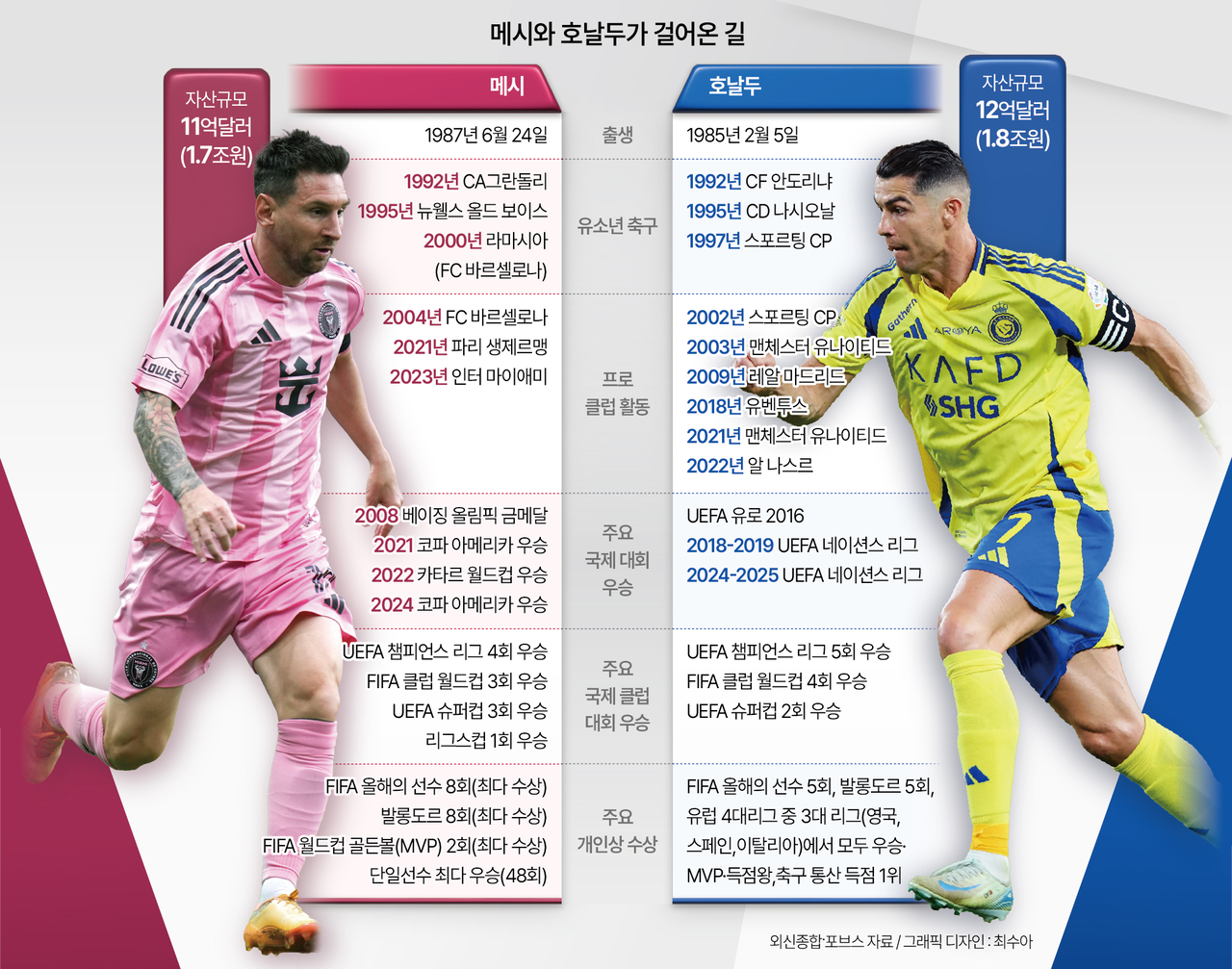
Messi went on to play 778 games for Barcelona through 2021, scoring 672 goals and adding 268 assists. During his time at the club he won the FIFA World Player of the Year award twice, the Ballon d'Or twice, and the combined FIFA Ballon d'Or — which merged the two honors — four times. From 2009 through 2012 he swept both awards in four consecutive years, a feat never matched before or since. He later added one more Ballon d'Or and one FIFA World Player of the Year award during his time at Paris Saint-Germain (2021-22), and one more of each while at Inter Miami in 2023 and 2024.
For all his club brilliance in the 2010s, his record with the national team in international competition was a source of frustration. He won gold at the 2008 Beijing Olympics, but at the World Cup — the sport's ultimate prize — he had little to show, and Argentina repeatedly fell short at the Copa America, losing to Chile on multiple occasions.
![Argentina captain Messi, center, lifts the trophy after his side defeated France in the final of the 2022 FIFA World Cup in Qatar. [Getty Images]](https://wimg.heraldcorp.com/news/cms/2026/06/09/news-p.v1.20260607.895607be21fb4d2dbaab083b694ac8d6_P1.jpg)
The weight of those failures led Messi to announce his international retirement in 2016 — a decision he later reversed. The reaction in Argentina was extraordinary. Billboards reading "No Te Vayas Lio. PERDONANOS" — "Don't go, Leo. Forgive us" — went up at airports and along highways. Then-President Mauricio Macri called Messi personally to persuade him to stay. The city of Buenos Aires erected a statue in his honor, and rallies and petition drives against his retirement spread across the country. Diego Maradona, who had told the national team players "don't come back unless you win," drew nationwide condemnation for the psychological pressure he had placed on them.
After reversing his retirement and returning to the squad, Messi's fortunes with Argentina changed as if by magic. He finally won the Copa America in 2021, then lifted the World Cup in Qatar in 2022 — taking the Golden Ball as well — and added another Copa America title in 2024.
'The greatest in European history' — and a star whose appeal transcended the game
![Ronaldo performs his trademark celebration — a spinning jump followed by a shout of "Sí!" — after scoring at Real Madrid's Santiago Bernabéu stadium in 2014. [Getty Images]](https://wimg.heraldcorp.com/news/cms/2026/06/09/news-p.v1.20260607.52c1e8c471304ea0a8598c07098f4b53_P1.jpg)
After his youth years and early professional career in Portugal, Ronaldo wrote the opening chapter of his legend in the English Premier League. Promoted to Sporting CP's first team at 16, he put on a commanding performance against Manchester United in 2002, helping his side to a 3-1 victory. His play caught the eye of United manager Sir Alex Ferguson, who pushed hard to sign him. Ronaldo joined Manchester United ahead of the 2003-04 season for a transfer fee of 12.24 million pounds — the highest ever paid for a teenage player in English football history at the time.
How much United expected of Ronaldo was evident from the squad number they gave him: No. 7, the shirt previously worn by club legends David Beckham, George Best and Eric Cantona.
I consider myself the best footballer in the world. If you don't believe you are the best, you will never achieve your maximum potential.
One quality that set Ronaldo apart from ordinary players was his ability to perform from the very first season at a new club, unaffected by the pressure of a big transfer fee or a famous shirt number. Most players who move to a top club for a large sum spend their first year struggling under the weight of expectation, drawing criticism from fans before gradually finding their feet in a new league. Ronaldo, by contrast, was named Manchester United's player of the year in his debut 2003-04 season.
From 2009 to 2018, Ronaldo played for Real Madrid — a move his mother had long dreamed of and one he himself had always wanted. His years at Madrid were widely regarded as his golden era, and they coincided with the fiercest chapter of his rivalry with Messi, as the two faced each other in El Clásico — the storied fixture between Real Madrid and FC Barcelona. During that period alone, Ronaldo won the Ballon d'Or twice, the FIFA World Player of the Year award twice, and the combined FIFA Ballon d'Or twice.
![Ronaldo lifts the trophy after Real Madrid's victory in the UEFA Champions League final at the NSC Olimpiyskiy Stadium in Kyiv, Ukraine, on May 26, 2018. [Getty Images]](https://wimg.heraldcorp.com/news/cms/2026/06/09/news-p.v1.20260607.7347cc170729438884685c3f16bb425c_P1.jpg)
At Real Madrid, Ronaldo was the player who made his team champions. The club had long been derided as "Round of 16 Madrid" for its inability to go deep in European competition, but with Ronaldo it soared to two La Liga titles and four UEFA Champions League titles. Most remarkably, from the 2015-16 season through the 2017-18 season, Real Madrid won the Champions League three consecutive times — a feat without precedent. The run gave credibility to club president Florentino Pérez's remark that the 80 million pounds paid for Ronaldo made "the most expensive player actually the cheapest."
When Ronaldo moved to Juventus in 2018, his transfer fee rose to 105 million euros (approximately $121 million) and his annual salary climbed to 30 million euros — up from a peak of 21 million euros at Real Madrid, even though he was 33 and widely considered past his athletic prime. He led Juventus to the Serie A title in each of his first two seasons, though critics noted that his broader influence across Europe had dimmed: there was no Champions League title, and no Ballon d'Or or FIFA World Player of the Year award during this period. Still, by the time he left Juventus in 2021, Ronaldo had won league titles in three of Europe's four major leagues — the Premier League, La Liga and Serie A.
With the national team, Ronaldo delivered Portugal its first and only UEFA European Championship title, the tournament considered second only to the World Cup in prestige. He also won the UEFA Nations League twice. Yet his record at the World Cup itself remains the one conspicuous gap in an otherwise extraordinary career.
The 'Messi-Ronaldo War' — a rivalry that captivated the world beyond football
He is an alien. He is graciously condescending to play football with the rest of us earthlings.
Having two players of such otherworldly caliber active at the same time made comparisons inevitable. The result was what fans came to call the "Messi-Ronaldo War." Players, coaches and pundits alike found it impossible to dodge the question of which of the two was superior.
In the early years, Messi was the overwhelming consensus pick. Some argued that drawing the comparison at all was simply a marketing strategy — a way to elevate Ronaldo to Messi's level and generate attention. But as Ronaldo closed the gap in Ballon d'Or wins from 2013 onward, that view faded. Messi himself later recalled that 2019 — when Ronaldo came closest to matching his award tally — was "painful."
Ronaldo was the more sensitive of the two to the rivalry. The easiest way to unsettle him during a match, it was widely noted, was for the crowd to chant Messi's name. Even in national team fixtures, a "Messi! Messi!" chant from the stands could visibly shake the composure that Ronaldo otherwise wore like armor. When he felt confident, he could brush it off — after an away match against Dinamo Zagreb in 2011, he quipped that people were jealous because he was good-looking and rich. But after he moved away from Europe's top leagues, his reactions grew sharper. Playing for Al Nassr in Saudi Arabia since 2022, Ronaldo responded to opposition fans chanting Messi's name during a 2024 league match with an obscene and insulting gesture, earning a one-match suspension and a fine of 30,000 riyals (approximately 10 million won).
Ronaldo is a fantastic player. He is on another level. He has been making football history and continues to do so. It is hard to find a player who has performed so consistently for so long. Personally, I think Ronaldo is a player from another world.
Beyond their shared status as players in a class of their own, the two have more differences than similarities. Ronaldo, at 187 centimeters, is widely regarded as the greatest aerial player in history, his basketball-player leap giving him an advantage few can match in the air. Messi, at 169 centimeters, turned his slight frame into an asset — his low center of gravity makes him a master of the body feint, using subtle shifts of his upper body to wrong-foot defenders. His short, rapid stride keeps the ball so close to his feet that observers have long said it looks permanently attached to him.
![Messi, left, and Ronaldo smile together as nominees at the 2014 FIFA Ballon d'Or Gala at the Kongresshaus in Zurich, Switzerland, in January 2015. [Getty Images]](https://wimg.heraldcorp.com/news/cms/2026/06/09/news-p.v1.20260608.dd238f8456744dba814c7b829d66507a_P1.jpg)
After leaving Barcelona, Messi passed through PSG before settling at Inter Miami, yet the image of him as a one-club man — a Barcelona player through and through — remains powerful. The drama of his original contract, the fact that the club raised him from boyhood, and the years he spent carrying the team on his back have all cemented that bond. Ronaldo, by contrast, is seen as a journeyman who moved frequently between big clubs — an impression reinforced by his habit of disparaging the leagues he left behind. He once said Serie A was "dead" when he arrived at Juventus, and later claimed that only the Premier League had maintained its quality while Spanish and Italian football had lost theirs.
Their personalities and private lives are almost mirror opposites. Messi is famously introverted — his La Masia contemporaries Gerard Piqué and Cesc Fàbregas, who grew up alongside him as part of the so-called "Class of '87," have said they assumed for a long time that he simply could not speak. Ronaldo, by contrast, is as flamboyant off the pitch as on it, a natural showman who takes as much pride in his appearance as in his football.
There is an old saying that a footballer's wife is either his childhood sweetheart or a model. Messi belongs to the first category. He married his childhood sweetheart Antonela Roccuzzo in 2017, after the couple had already welcomed sons in 2012 and 2015. A third son followed in 2018.
Ronaldo is closer to the second. After a string of reported romances with models and broadcasters including Paris Hilton, Kim Kardashian, Gemma Atkinson and Irina Shayk, he had his first son through an undisclosed arrangement in 2010. In 2016, he met Georgina Rodríguez, then working as a sales assistant at a Gucci store, and the two have been in a common-law relationship ever since. In addition to his eldest son, Ronaldo has twins born via surrogate in 2017 and two daughters with Georgina — five children in total, two sons and three daughters.
![Ronaldo and Messi shake hands before the start of a friendly match between Argentina and Portugal at Old Trafford in Manchester, England, in November 2014. [Getty Images]](https://wimg.heraldcorp.com/news/cms/2026/06/09/news-p.v1.20260608.54f3d659ec064b77afbeca77158fbd9a_P1.jpg)
Tax evasion, clashes with fans — the controversies that shadowed two superstars
For all the joy they brought to fans around the world on the pitch, both men generated considerable controversy off it. Messi made global headlines in 2013 when tax evasion allegations surfaced. Prosecutors alleged that from 2007 to 2009, he and his father had channeled image-rights income through shell companies registered in tax havens, evading a total of 4.1 million euros — worth roughly 5.3 billion won at the time. At trial, Messi maintained that he had focused solely on football and left all financial matters to his father and lawyers, insisting he had no knowledge of any tax evasion. Public opinion in Spain largely sided with him — many felt it was unreasonable to expect a player who had skipped compulsory secondary education to pursue his football career to understand the mechanics of tax fraud. Spain's Supreme Court, however, ruled against him in 2017, finding that Messi "was aware of his obligations and that ignorance does not exempt one from responsibility." He received a 21-month prison sentence and a fine of 2 million euros (approximately 2.6 billion won), but was granted a suspended sentence and avoided jail.
Ronaldo has faced repeated accusations of poor conduct. In 2022, as his relationship with Manchester United was deteriorating, he struck the hand of a 12-year-old autistic fan who was filming his injured leg as he left the pitch after a match. The boy had been devoted enough to high-five Ronaldo on his way in, but the blow left a visible bruise on his hand and reportedly caused him anxiety for some time afterward. The moment was captured on video, which spread widely on social media and drew an outpouring of anger from fans. British supporters called for Ronaldo to face child abuse charges, but police concluded their investigation with a caution. Ronaldo received a two-match ban and a fine. The boy's parents later said Ronaldo denied any wrongdoing, offered no apology and provided no compensation.
South Korean fans know Ronaldo by a nickname that translates roughly as "Ronaldo the Thief" — a reference to an incident on July 26, 2019, when he failed to appear in an exhibition match between Team K League and Juventus FC despite having been advertised as a participant. The event organizer, The Festa, had promoted Ronaldo's appearance on the basis of a contract clause requiring Juventus to pay a penalty if he played fewer than 45 minutes — yet Ronaldo never took the field at all. After the Asian tour ended and the squad returned to Italy, Ronaldo posted a message on social media thanking Chinese fans, with no mention of Korea whatsoever, further enraging Korean supporters.
The incident led to a class-action lawsuit against The Festa, which the plaintiffs won outright — but The Festa subsequently went bankrupt, and not a single won in compensation was ever paid.
Two decades at the top — a World Cup farewell to close an era
![Messi and his family pose with the trophy after Inter Miami won the MLS Cup final at Chase Stadium in Fort Lauderdale, Florida, in December 2025. From left: eldest son Thiago, wife Antonela, second son Mateo, Messi, and youngest son Ciro. [Getty Images]](https://wimg.heraldcorp.com/news/cms/2026/06/09/news-p.v1.20260608.9077ff2c87284336bee52c1c81f2f4e3_P1.jpg)
A footballer's peak is generally reckoned to last five or six years. These two have sustained theirs for well over ten — approaching two decades. Messi now plays in Major League Soccer and Ronaldo in the Saudi Pro League, but the fact that both are still performing at a high level in their 40s is itself proof that they belong to a different category.
The GOAT — Greatest of All Time — debate that has consumed football since the 2010s appears to have reached a verdict, effectively in Messi's favor. The consensus lineage of "Pelé — Maradona — Messi" has hardened into received wisdom. Maradona, who had always been invoked as the standard against which Messi was measured — the two sharing the same homeland — ultimately anointed his successor himself, saying: "My Maradona is Messi."
The decisive factor in Messi's claim to the title was the World Cup, football's supreme honor. Immediately after Argentina's victory at the 2022 Qatar World Cup, FIFA's official X account posted: "The GOAT debate is settled. The ultimate prize is now part of the collection. The legacy is complete." Ronaldo has yet to win a World Cup, and his chances of doing so at this tournament in North and Central America are considered relatively slim.
![Ronaldo and his family greet supporters at his unveiling as an Al Nassr player at Mrsool Park stadium in Riyadh, Saudi Arabia, in 2023. Ronaldo has five children in total, including a youngest daughter not pictured. [Getty Images]](https://wimg.heraldcorp.com/news/cms/2026/06/09/news-p.v1.20260608.3c665f2cb25f4aaf850b25105a754ce2_P1.jpg)
This year, Spain, France, England, Argentina and Brazil are considered the leading contenders for the title. Portugal is rated a tier below. In the individual scoring charts, Messi is projected to finish around fourth or fifth in the Golden Boot race, Ronaldo around seventh or eighth. The player most widely tipped to win both the Golden Boot and the tournament MVP award is France's Kylian Mbappé — a self-described "Ronaldo kid" who idolized Ronaldo and once imitated his Real Madrid unveiling celebration. From Ronaldo's perspective, this World Cup could serve as a coronation of his successor.
Yet as the saying goes, the ball is round, and in football anything can happen. Even if the two legends bow out gracefully at this World Cup, the star power they generated — which spilled far beyond the pitch — looks set to shine for some time yet. Messi's net worth is estimated at around $1.1 billion (approximately 1.7 trillion won), built from his salary and club contracts, global sponsorships with Adidas, PepsiCo and Mastercard, and personal ventures including hotels and a beverage line.
Ronaldo's net worth is estimated at between roughly $1.2 billion and as much as $1.4 billion (approximately 1.8 trillion to 2 trillion won). He became the first footballer in history to reach billionaire status through career earnings alone, driven by a succession of landmark contracts. His move to the Saudi Pro League came with an annual salary of approximately $200 million — the highest of any athlete in the world at the time of signing. He is one of a handful of athletes, alongside Michael Jordan and LeBron James, to hold a lifetime contract with Nike. Beyond that, he serves as the global face of brands including cryptocurrency exchange Binance and watchmaker Jacob & Co., commands substantial fees for advertising, and generates revenue across hotels, fashion and bottled water through his own CR7 brand — named after his initials and jersey number.
"The Visionary" is a series by The Herald Business's international desk profiling the power leaders shaping global trends — exploring what made them who they are, the philosophies and visions that drive them, and the stories behind their rise.
kate01@heraldcorp.com