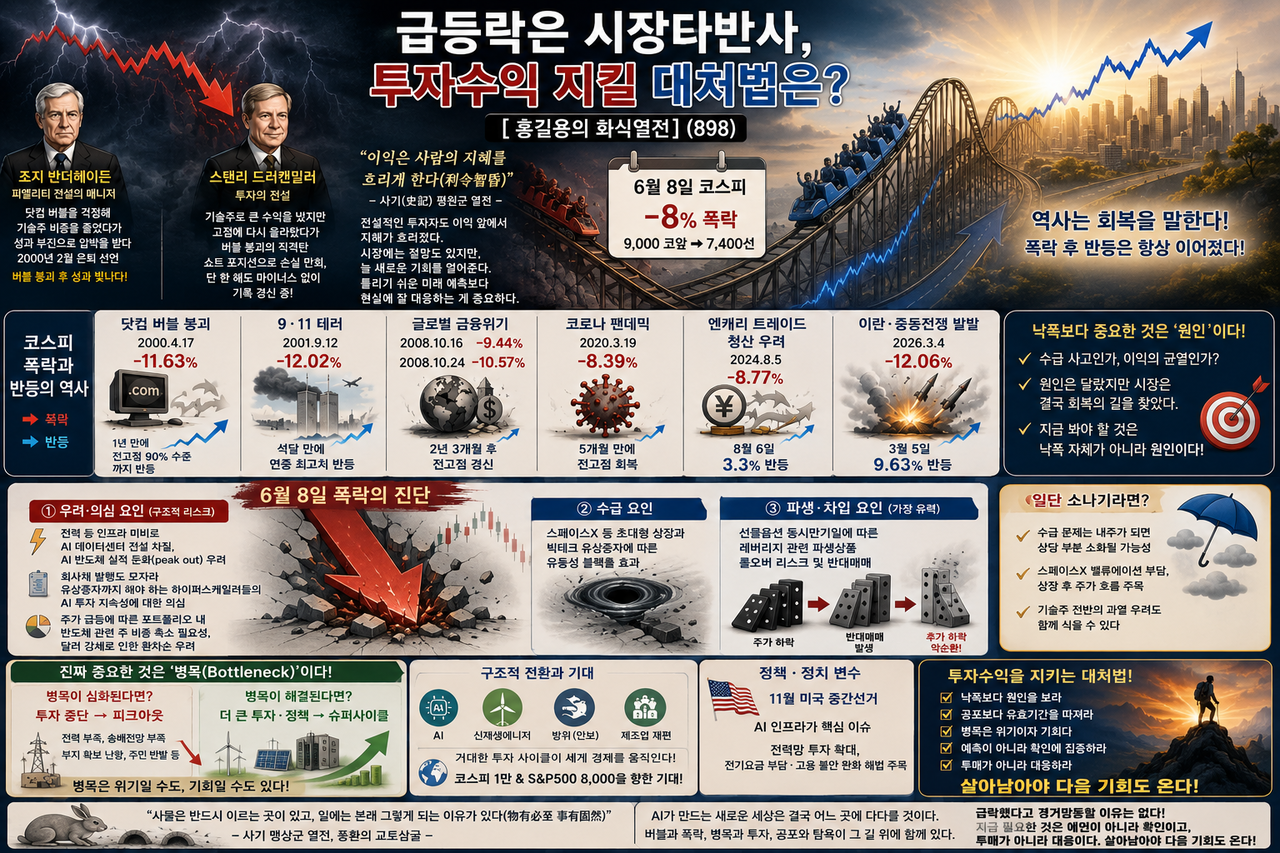
George Vanderheiden, the legendary portfolio manager at Fidelity, grew so worried about the dot-com bubble's excesses that he began trimming his technology holdings in the late 1990s. But after portfolio rebalancing left his fund unable to capture the tech rally's gains, client complaints and management pressure mounted. Vanderheiden ultimately announced his retirement in February 2000 at the age of 55. Just one month after he left, the dot-com bubble began to collapse in late March 2000 — and his portfolio finally came into its own.
Stanley Druckenmiller — the investment legend now drawing fresh attention as a backer of Treasury Secretary Scott Bessent and Federal Reserve Chair Kevin Warsh — also had a bruising encounter with the dot-com bubble. He had invested in tech stocks early and booked substantial gains, but unable to resist a market that kept climbing, he jumped back in near the peak and took a direct hit when the bubble burst. Rather than retire, Druckenmiller moved to his private firm Duquesne Capital and recouped his losses through short positions. That allowed him to maintain a record of never posting a negative annual return, a streak he holds to this day.
"Profit clouds a person's judgment." (利令智昏)
The line comes from the "Biography of Lord Pingyuan" in Sima Qian's "Records of the Grand Historian." Even legendary investors have had their judgment clouded by profit. Markets bring despair, but they also open new opportunities. Stay in the game and you can seize them. Responding well to present reality matters more than trying to predict a future that is easy to get wrong.
Sharp drops are part of the market... start with the cause
The Kospi tumbled more than 8 percent on Monday. Just a week earlier it had been within reach of 9,000; now it had slid to the 7,400 level. Wild swings are a normal part of market life, and drops of more than 8 percent are not without precedent. Consider the history of Kospi crashes and recoveries.
√ Dot-com bubble collapse: down 11.63 percent on April 17, 2000; rebounded to about 90 percent of the prior peak within a year.
√ Sept. 11 attacks: down 12.02 percent on Sept. 12, 2001; rebounded to the year's high within three months.
√ Global financial crisis: down 9.44 percent on Oct. 16, 2008, and down 10.57 percent on Oct. 24, 2008; surpassed the prior peak 27 months later.
√ COVID-19 pandemic: down 8.39 percent on March 19, 2020; recovered the prior peak within five months.
√ Yen carry-trade unwind fears: down 8.77 percent on Aug. 5, 2024; rebounded 3.3 percent the following day.
√ Iran-Middle East war outbreak: down 12.06 percent on March 4, 2026; rebounded 9.63 percent on March 5, 2026.
The causes of each crash differed, but the market ultimately found its way back. What matters now is not the size of the drop but its cause — whether this sell-off reflects a supply-and-demand disruption or a crack in corporate earnings. The Monday plunge can be traced to a handful of factors.
√ AI data center construction delays due to inadequate power and other infrastructure; fears of a peak-out in AI semiconductor earnings.
√ Doubts about hyperscalers' capacity to keep investing in AI, given that some are resorting to rights offerings on top of corporate bond issuance.
√ The need to trim semiconductor weightings in portfolios after a sharp share price run-up; concerns about foreign-exchange losses from a stronger dollar.
√ A liquidity black-hole effect from mega-listings such as SpaceX and rights offerings by big tech companies.
√ Rollover risk and forced selling tied to leveraged derivatives on the futures and options simultaneous expiration date.
The first three factors are concerns or suspicions. If they materialize, their severity could make them structural problems on the scale of a full-blown crisis.
If semiconductor demand is delayed or contracts, the first clues should emerge in second-quarter earnings reports due out in early July and in subsequent guidance. Evidence bearing on hyperscalers' investment capacity should also surface in those same results. Paradoxically, if semiconductor demand is delayed, hyperscalers may actually find themselves with more financial headroom. And the pressure from surging share prices eases when those prices fall sharply.
The factor most worth watching is the bottleneck in AI infrastructure — power supply, transmission and distribution grids, and community opposition. AI is not just a semiconductor story. Data centers consume enormous amounts of electricity, and where power is scarce, transmission and distribution networks must be built out. Where those networks are lacking, the problems of securing power plants, energy storage systems, cooling facilities and land follow in turn.
A Federal Reserve Bank of St. Louis study released in January found that AI-related investment accounted for as much as 38 percent of US GDP growth. If problems emerge with US AI investment, South Korea and other East Asian countries linked through supply chains will not be immune.
The remaining two factors are supply-and-demand issues.
SpaceX's offering is expected to raise $86 billion, and Alphabet's rights offering $85 billion. OpenAI and Anthropic are expected to raise $60 billion and $50 billion, respectively, through initial public offerings this year. Whether market liquidity can absorb all of that is a critical question. US household net worth stands at $184 trillion, with equity holdings reaching $68 trillion. One encouraging sign is that investors around the world, not just in the United States, want exposure to all four companies.
OpenAI and Anthropic have already raised $160 billion and $110 billion, respectively, through pre-IPO rounds over the past 15 months. Even as hundreds of billions of dollars flowed into unlisted companies during that period, US equity markets continued their AI tech rally. This is a market that moves on extreme concentration anyway. If SpaceX, OpenAI and Anthropic trade well after listing, the liquidity black-hole concern may not grow any larger.
This sell-off is largely supply-and-demand driven — but there are things to watch
The most likely primary culprit behind the crash is derivatives and leveraged investing — confirmed by the fact that the Korean market's decline on Monday was unusually steep.
Market volatility has increased since leveraged products tied to Samsung Electronics and SK Hynix as individual stocks were permitted, following the earlier approval of KODEX Leverage. The volatility of Samsung Electronics and SK Hynix is, in effect, the volatility of the Kospi. The key question is what trigger effect leveraged derivatives will produce on Thursday, when futures and options expire simultaneously. If derivatives push share prices below a certain threshold, margin calls cascade from leveraged accounts, driving the market lower still in a vicious cycle.
If this is just a passing storm, the supply-and-demand problem will be the first to clear, and much of it could be absorbed by next week. There is also no shortage of voices saying SpaceX's valuation — 100 times sales — is excessive. If its post-listing share price disappoints, broader concerns about overheating in tech stocks could cool as well.
But supply and demand is not what really matters. What matters are the underlying concerns and suspicions. Investors need to watch whether the semiconductor earnings outlook changes, whether hyperscalers' investment plans waver, and whether the bottleneck around power, transmission and distribution grids, and data center site acquisition deepens. The bottleneck is particularly the crux of the current debate. If it halts investment, that is a peak-out. If it instead triggers larger investment and policy responses to resolve it, that is a supercycle.
Many observers appear to agree that the global economy has entered a vast structural transition — one where AI, renewable energy, defense and security, and manufacturing realignment are all converging, rather than a simple technology boom. If a long-term investment cycle drawing enormous capital from around the world plays out, corporate earnings could surge and production efficiency could improve dramatically.
A difficult trade — if you sell now, at what price can you buy back in?
Expectations for Kospi 10,000 and S&P 500 8,000 spring from the same premise: that a massive investment cycle driven by AI, renewable energy, defense and manufacturing realignment is reshaping the global economy. The power shortages and infrastructure bottlenecks the market fears today could, from a different angle, be signals pointing to the next investment opportunity.
In the November US midterm elections, all House seats, one-third of Senate seats and 39 governorships will be on the ballot. AI infrastructure has already become a central issue in American politics. Solutions that expand data center and power grid investment while minimizing higher electricity bills and job insecurity for local communities are a real possibility.
A decline of more than 20 percent from the peak is a bear market; a drop in the 10 percent range is a correction. The short-term moving average (20-day) has been broken, but the medium-term line (60-day) is still holding. Technical analysis is statistics, and those statistics are grounded in the collective reactions of market participants. From that perspective, the trend is still pointing upward. Even Druckenmiller bought back in well above the price at which he had sold — and paid the price for it.
Excessive optimism causes people to overlook risk. With optimism running high, a cautious posture is called for. There is no reason to panic just because the market has sold off sharply. Look at the cause, not the size of the drop — and instead of fearing the fear itself, ask how long that fear is likely to last.
"Things must arrive somewhere, and events have reasons why they turn out as they do." (物有必至,事有固然)
The line comes from strategist Feng Huan in the "Biography of Lord Mengchang" in the "Records of the Grand Historian," as he taught the lesson of the three burrows of the cunning hare.
The new world that AI is building will ultimately arrive somewhere. The road there, however, is neither straight nor smooth. Bubbles and crashes, bottlenecks and investment, fear and greed all travel it together. A sharp drop is no reason to act rashly.
kyhong@heraldcorp.com