'Should refrain from mentioning by-election,' Oh says
Partial re-runs possible for city and district council seats
PPP leader Jang's call a 'political slogan,' mayor says
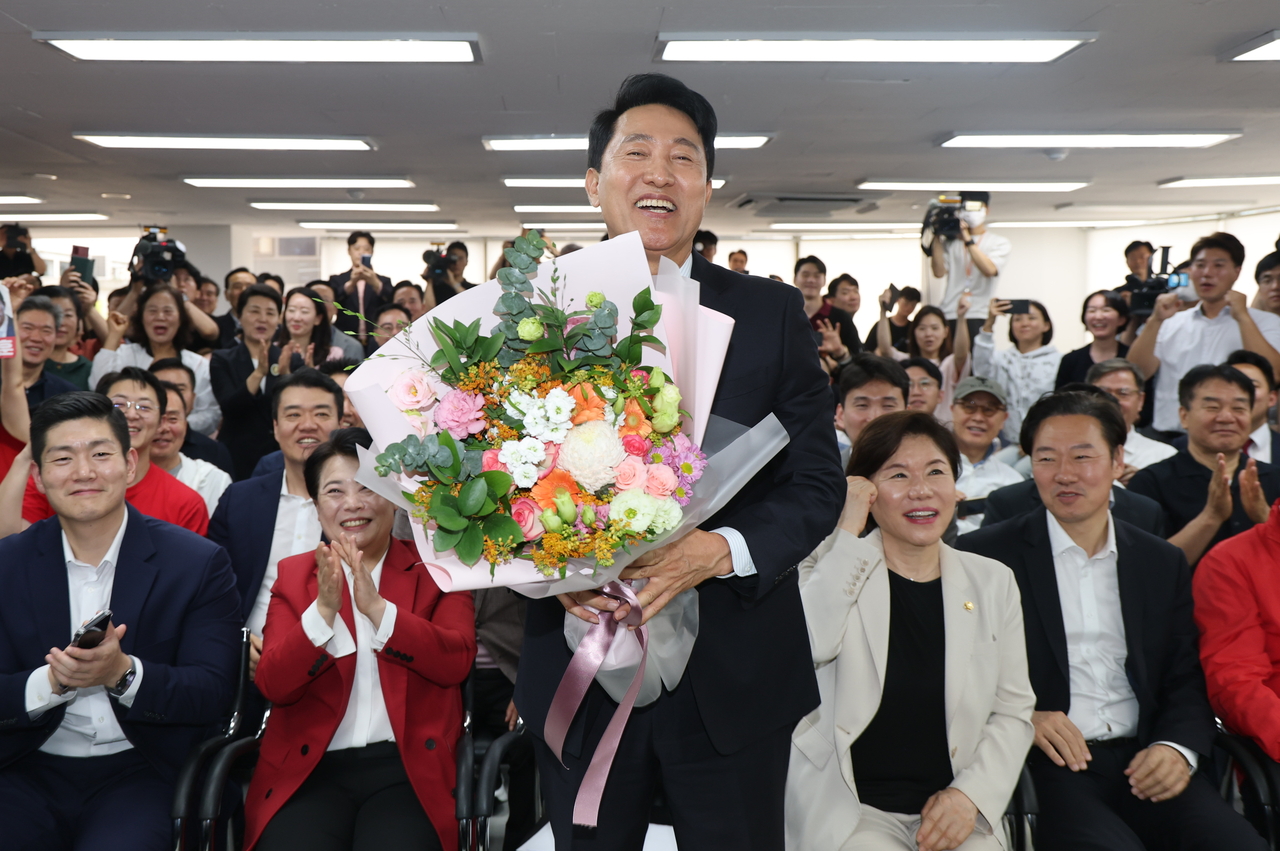
Seoul Mayor Oh Se-hoon said Monday that the roughly 60,000-vote margin in the Seoul mayoral race makes it structurally difficult for the ballot shortage to have affected the outcome, though he acknowledged that partial re-runs for city and district council seats remain a real possibility.
Speaking on the JoongAng Ilbo YouTube channel program "Hwang Hyeon-hui's Uncomfortable Yeouido" that morning, Oh said the gravity of the mayoral office meant he should hold back from personally calling for a by-election. He added that young people's demands — seizing on the by-election issue to push for reform of the National Election Commission and stricter election management — deserved to be taken seriously.
Asked whether he would comply if young people pursued litigation leading to a by-election, Oh said he had no choice in the matter. "If a lawsuit is filed, goes through an election complaint process and reaches an invalidation suit, I must accept the outcome," he said. He added, however, that the law requires grounds sufficient to have affected the result before a by-election can be ordered, and that standard must be respected.
On the prospect of a mayoral re-run specifically, Oh said the gap between the candidates had widened to more than 60,000 votes, making it realistically hard for the ballot shortage to have changed the result. Oh defeated Democratic Party of Korea candidate Jeong Won-oh by 60,259 votes, a margin of 1.15 percentage points.
He was more open to partial re-runs for lower-level races, however. "There are city council, district council and proportional representation seats decided by margins of just a few hundred votes," Oh said. "The courts will weigh those cases carefully."
Oh was dismissive of People Power Party leader Jang Dong-hyeok's call for nationwide by-elections, questioning whether it reflected a party consensus and saying it functioned as a "political slogan." He drew a sharp contrast with young voters, whose calls for a re-run he said were rooted in a concern for procedural fairness and were "well worth listening to."
"Young people cannot tolerate unfairness," Oh said. "The ladder of social mobility has already collapsed, leaving deep frustration with our society — and now they feel that even the last fair opportunity has been taken from them. That is why their anger runs so deep."
Oh said the erosion of pride in Korean democracy was what angered young people most. "National income has risen, our cultural influence has grown, K-content is acclaimed around the world — and then, out of nowhere, people are turned away from the polls because there are not enough ballots. That is simply intolerable," he said. He added that many had moved beyond seeing the episode as mere incompetence, concluding it amounted to fraud.
cook@heraldcorp.com