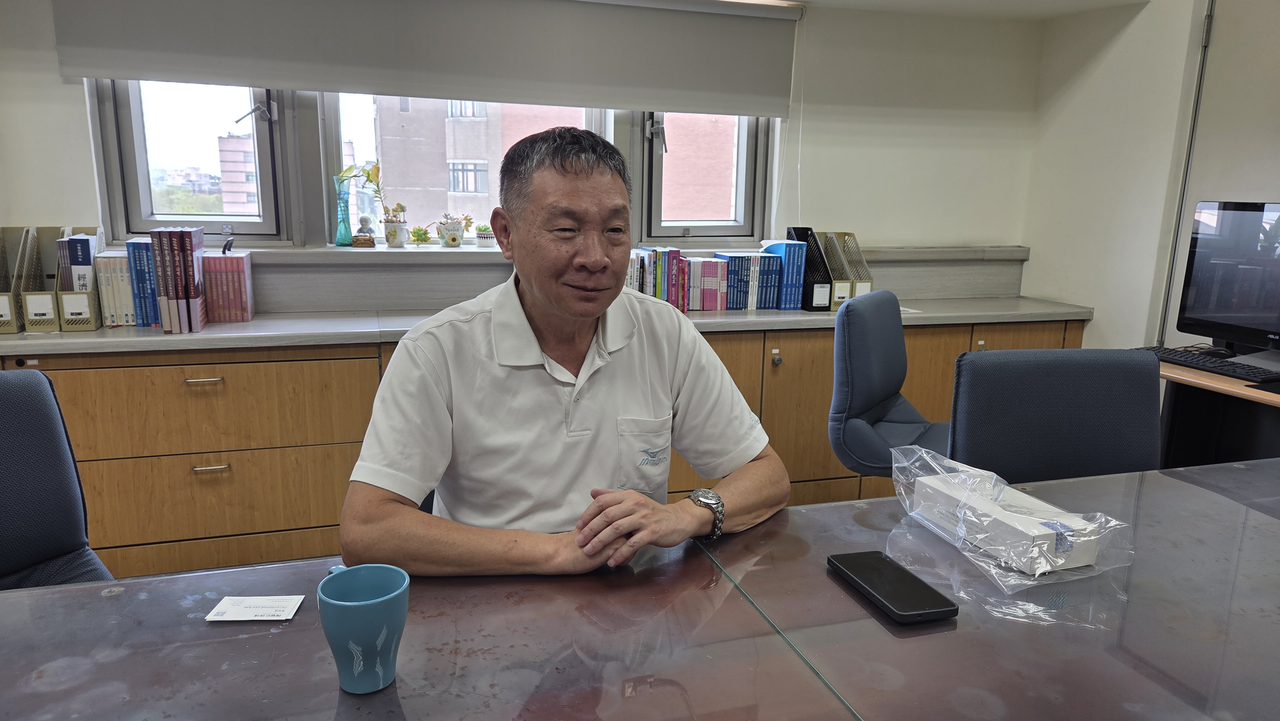
Wu Da-ren, professor at National Central University
Says semiconductor profits need redistribution, but the industry is 'not a public good'
Taiwan grapples with widening gap between semiconductor and non-semiconductor workers
Young people coin term 'beggar superman' in self-deprecating nod to financial hardship
Analyst warns of 'Taiwan disease' as industrial imbalance deepens
The monthly salary gap between an average Taiwanese worker and a semiconductor industry employee has surpassed 50 to one — roughly 2 million won (about $1,290) versus 100 million won.
Taiwan's economy is growing at its fastest pace in history on the back of a semiconductor boom, but the economic divide between those inside and outside the industry continues to widen.
Taiwan's total fertility rate last year stood at 0.695 — lower than South Korea's and the lowest in the world. According to the World Inequality Lab, the top 10 percent of income earners account for 48 percent of total income, while the bottom 50 percent take home just 12 percent — a concentration of wealth more severe than in the United States.
Wu Da-ren, a professor and lead researcher at the Taiwan Economic Development Research Center at National Central University, met with this reporter June 3 at the university's campus in Taipei. "Unlike Taiwan, South Korea has not staked the nation's future on a single industry like semiconductors," he said. "It has diverse, globally competitive industries — steel, automobiles, shipbuilding — providing a solid foundation." He described South Korea as being in a better position than Taiwan, but warned: "If Korea also fails to achieve balanced development, the wealth gap will only worsen."
Taiwan's economy has surged on the back of the AI boom. In the first quarter of this year, its GDP growth rate hit 13.69 percent — the highest quarterly figure in 39 years, since 1987, and well above South Korea's 3.6 percent and China's 5.0 percent. Last year's annual growth rate of 8.63 percent topped India (7.2 percent), China (5.0 percent) and the United States (2.2 percent).
Taiwan's per capita GDP already surpassed South Korea's last year. Taiwan's statistics agency projects the island's per capita GDP at $40,921 this year, set to break the $40,000 threshold ahead of South Korea's estimated $37,932. Stock markets are booming as well. Driven by TSMC's record earnings, Taiwan's Taiex index has risen 485 points so far this year, and Taiwan's stock market capitalization has climbed to fifth in the world, overtaking Canada and India.
But the boom casts a long shadow. With the semiconductor industry — led by TSMC — accounting for more than 20 percent of Taiwan's GDP, the gains have been heavily concentrated in that sector. The average salary across all industries is roughly 46,000 New Taiwan dollars (about 2 million won), yet 70 percent of Taiwan's population earns below that average. The median wage is just 38,000 New Taiwan dollars (about 1.88 million won). In 2025, average wage growth of 3.1 percent fell far short of the 8.7 percent economic growth rate.
"Taiwan's total employed population is around 12 million, of whom about 1 million work in the IT and electronics sector — and only about 300,000 of those are in the semiconductor industry," Wu said. "Less than one-tenth of the workforce is benefiting from the semiconductor boom."
He added that industries outside semiconductors — metals, petrochemicals and others — are actually contracting under the weight of US reciprocal tariffs. "On top of that, Taiwan must invest $500 billion (about 775 trillion won) in the United States — far more than South Korea's $350 billion (about 500 trillion won)," he said. "In this environment, other industries are seeing little or no growth, or are actually declining, and that is deepening polarization."
Some analysts say Taiwan's government has focused its support so narrowly on high-tech export industries such as semiconductors that the competitiveness of other sectors is now in crisis. The structural imbalance has grown so pronounced that a new term has emerged to describe it: "Taiwan disease."
Among young Taiwanese, another expression has taken hold — "beggar superman" (乞丐超人), referring to the practice of buying only deeply discounted food nearing its expiration date at convenience stores. The ratio of housing prices to median income in Taipei stands at 15.41 times, surpassing both Hong Kong (14.4 times) and Seoul (13.9 times). On a monthly salary of less than 2 million won, with roughly 700,000 won going to housing costs, there is almost nothing left to spend or save. That is the backdrop to Taiwan's record-low total fertility rate of 0.695.
According to Taiwanese job portal Yes123, about 40.2 percent of Taiwanese workers under 39 said their spending exceeds their income. Some 22.4 percent said they have no savings at all, and 72.7 percent said they are in debt. More than half — 54.9 percent — said they consider themselves failures in life.
A Yes123 official said young Taiwanese fear becoming either parasites or paupers, and called on the government to attract more foreign investment and encourage companies to return home.
Wu said the debate over wealth redistribution is necessary, but cautioned against treating semiconductors as a public good. The Taiwanese government is already collecting higher income taxes from electronics industry workers and using part of the revenue to provide subsidies to economically vulnerable groups. The government also offers housing support of between 5,000 and 10,000 New Taiwan dollars (about 250,000 to 500,000 won) per month, scaled to income level.
Taiwan also plans to introduce birth subsidies to address its low birth rate. Wu outlined the policy: parents receive 5,000 New Taiwan dollars (about 250,000 won) per child per month from birth through age six, regardless of how many children they have. From age seven to 18, the government provides 2,500 New Taiwan dollars (about 120,000 won) directly each month, with the remainder deposited into a dedicated savings account — giving the child a government-funded nest egg of around 400,000 New Taiwan dollars (about 17 million won) by age 18.
On the broader redistribution debate, Wu drew a firm line. "The semiconductor industry endured brutal losses and enormous risk during downturns — all borne by the companies themselves," he said. "Demanding that they now hand over profits to society simply because the cycle has turned up contradicts market principles." The right approach, he said, is to collect revenue through legitimate tax mechanisms such as corporate and income taxes, and let the government redistribute those funds for welfare and other social purposes.
Wu said South Korea's strength lies in having a robust manufacturing base beyond semiconductors. "If an AI bubble burst becomes reality, Taiwan has no other industry to absorb the shock or take its place," he said. "But South Korea has globally competitive anchor industries — shipbuilding, automobiles — that remain strong."
He offered a final piece of advice for South Korea's industrial policymakers: "Balance in the portfolio must be the top priority. A nation should never stake everything on a single technology or a single industry. Building competitiveness across a diverse range of sectors is essential." — From Taipei, by Park Ji-young
go@heraldcorp.com