33 fatalities recorded last year; market-type public corporations double death toll
Disability hiring improves past legal threshold, but safety ratings deteriorate — Korea Coal Corp. rated 'very poor'
![Police, the National Forensic Service, the Korea Occupational Safety and Health Agency, the National Disaster and Safety Research Institute, and the Korea Infrastructure Safety and Technology Institute conduct a joint investigation at the site of a bridge deck collapse on the Seoul-Sejong Expressway construction project in Anseong, Gyeonggi Province, on May 28. The accident occurred May 25, when a bridge deck structure being installed on a pier collapsed, killing or injuring 10 workers who fell from above. [Yonhap]](https://wimg.heraldcorp.com/news/cms/2026/06/11/rcv.YNA.20250228.PYH2025022809070006100_P1.jpg)
Work-related accident fatalities at South Korea's public institutions have risen for three consecutive years, with 33 workers killed last year alone, according to a new government report. Despite a push to strengthen safety management, 158 people died in workplace accidents at public institutions over the past five years. Disability employment, by contrast, has consistently improved, with the overall hiring rate now exceeding the legally mandated minimum.
The figures come from "Public Institutions of the Republic of Korea 2026," published Thursday by the National Assembly Budget Office. The report counted 158 workplace accident fatalities at public institutions over the five years from 2021 to 2025. The annual toll fell from 39 in 2021 to 26 in 2022, then climbed again — 30 in 2023, 30 in 2024 and 33 last year.
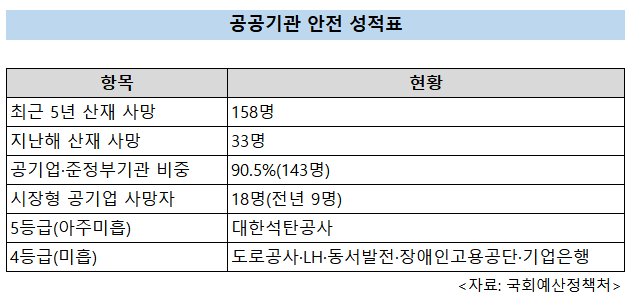
Last year's 33 fatalities were three more than the previous year, and 32 of them — 97 percent of the total — occurred at public corporations and quasi-governmental agencies. The same two categories accounted for 143 of the 158 deaths, or 90.5 percent, recorded over the five-year period.
By institution type, market-type public corporations saw their accident death toll double, from nine in 2024 to 18 last year, representing 56.3 percent of all fatalities at public corporations and quasi-governmental agencies combined. Quasi-market-type public corporations, meanwhile, saw their toll fall from 13 to seven over the same period.
Safety management ratings also deteriorated.
The government evaluates public institutions on safety management and assigns ratings on a five-tier scale, from Grade 1 (excellent) to Grade 5 (very poor).
Last year's assessment produced a Grade 5 rating for the first time since 2022. Korea Coal Corp. was the sole institution to receive the lowest rating, with evaluators citing a comprehensive lack of safety management capacity, including the absence of a dedicated safety organization and qualified safety professionals.
The number of Grade 4 (poor) institutions also grew, from two the previous year to five. Korea Expressway Corp., Korea Land and Housing Corp. (LH), Korea East-West Power, the Korea Employment Agency for Persons with Disabilities and Industrial Bank of Korea all received Grade 4. Korea East-West Power's rating dropped two levels, from Grade 2 (good) the year before.
On the disability employment front, however, the trend continued to improve. Public institutions collectively employed people with disabilities at a rate of 4.16 percent last year, above the legally mandated minimum of 3.8 percent. The rate has risen 0.35 percentage points over five years, up from 3.81 percent in 2021, and the total number of disabled employees increased from 17,369 to 18,020.
However, other public institutions — a separate administrative category — were the only group to fall short of the mandatory rate, posting a disability employment rate of just 3.76 percent.
A total of 132 public institutions paid levies last year for failing to meet their disability employment obligations. The combined levy came to 17.046 billion won (about $11.2 million), down roughly 3.5 billion won from the previous year.
The National Assembly Budget Office said institutions rated Grade 4 or 5 are required to undergo consulting, diagnostic reviews and training from specialized safety agencies, with compliance checked quarterly. "The assessment results are also reflected in public institution management evaluations," it added.
fact0514@heraldcorp.com