After FAANG, a new acronym captures the giants of the AI age — and the money game is just beginning
Not long ago, "FAANG" was the defining investment shorthand for the American stock market — a grouping of Facebook (now Meta), Apple, Amazon, Netflix and Google that came to symbolize the mobile and platform era. Through the 2010s, those five companies led the bull run on Wall Street as the era's defining growth stocks.
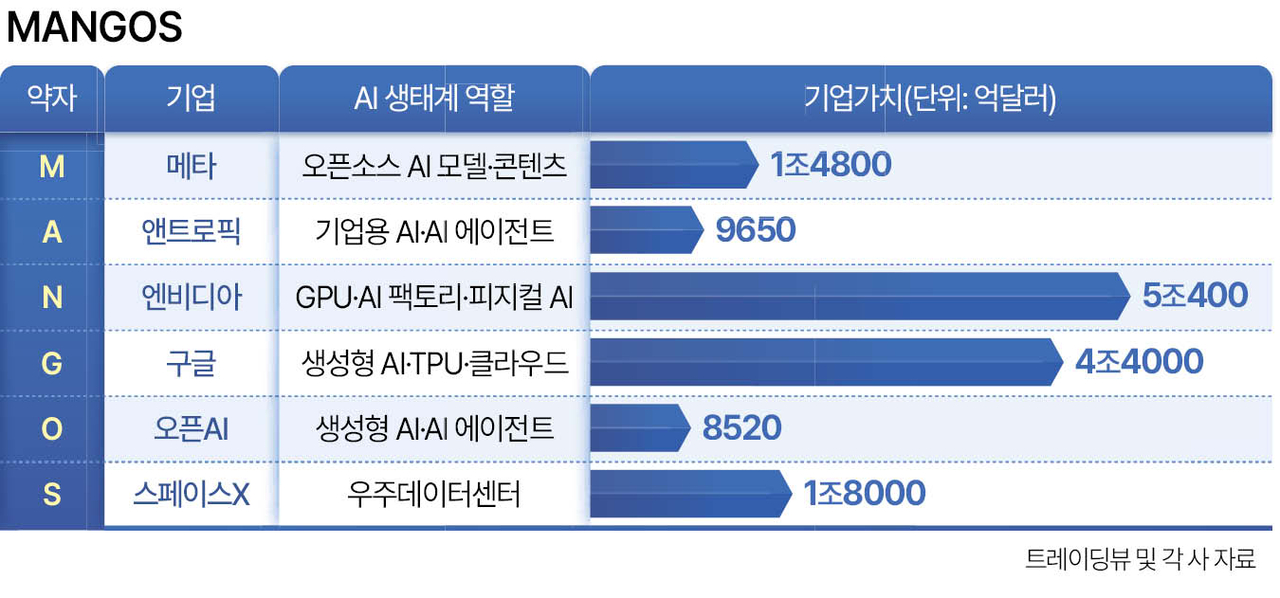
Now a new era is taking shape. As the AI age accelerates, a new acronym is rapidly gaining traction in investment circles: MANGOS — Meta, Anthropic, Nvidia, Google, OpenAI and SpaceX.
MANGOS is a newly coined term grouping the companies seen as central to the AI ecosystem, according to the financial investment industry Wednesday. What they share is a commanding role in the most critical segments of the AI industry.
Meta is building an open-source AI model and content ecosystem, while Anthropic is expanding its presence in the enterprise AI and AI agent markets. Nvidia leads in GPUs, AI factories and the physical AI space, and Google is deepening its push into generative AI, tensor processing units and cloud services. OpenAI is at the forefront of the generative AI and AI agent race, and SpaceX — backed by its Starlink satellite network — is drawing attention as a next-generation AI infrastructure company.
The valuations of these companies have already swelled into the trillions of dollars. Nvidia's market capitalization stands at $5.04 trillion, Google's at $4.4 trillion and Meta's at $1.48 trillion.
Among the unlisted companies, Anthropic is valued at roughly $965 billion and OpenAI at around $852 billion. SpaceX is pursuing an IPO targeting a valuation of $1.8 trillion.
Where FAANG companies pursued high profitability through platform and software-driven growth, the MANGOS companies are competing for AI dominance through massive capital expenditure — data centers, semiconductors, power infrastructure and space assets. The competition has shifted away from expanding user bases and monetizing advertising and subscriptions, toward a large-scale capital race to develop AI models, build data centers and secure semiconductors.
Some in the industry describe the AI sector as having become in effect a "money game" among a handful of mega-corporations. As astronomical sums pour into data centers, power infrastructure and AI semiconductors, a structure is emerging in which only companies with enormous financial firepower can stay in the race.
As AI rivalry intensifies, the MANGOS companies are moving aggressively to raise capital. According to Reuters, SpaceX secured more than $250 billion in investor demand during its IPO process — roughly 3.5 to four times its $75 billion fundraising target. With some large institutional investors yet to submit subscriptions, final demand could climb further. SpaceX is set to list on the Nasdaq on Thursday.
OpenAI, the developer of ChatGPT, set a Silicon Valley record in March when it raised $122 billion from Amazon, Nvidia, SoftBank and others at a valuation of $852 billion — the largest fundraising round in the region's history. The company has also announced plans to invest $600 billion in AI infrastructure by 2030.
Listed companies are also moving aggressively to shore up their finances. Alphabet recently announced an $84.75 billion capital expansion plan, and reports have emerged that Meta is considering a share offering — adding to the wave of capital-raising for AI investment.
Analysts say this shift is fundamentally different from the FAANG era. Back then, big tech companies built highly profitable businesses on platform and software models and used buybacks to boost earnings per share and return on equity.
In the AI era, however, large-scale physical investment in data centers, semiconductors and power infrastructure has become essential, making securing investment capital a higher priority than buybacks.
"In the past, FANG companies could maintain high profitability without massive capital expenditure," said Kim Il-hyuk, a researcher at KB Securities. "In the AI era, capital investment in data centers, power and semiconductors is indispensable."
He added that IPOs and share offerings are not necessarily negative for share prices, and that "ultimately, what matters is how much growth can be generated with the capital raised."
South Korean retail investors are also channeling money into MANGOS companies. According to the Korea Securities Depository, as of Sunday, Korean investors held $18.1 billion worth of Nvidia shares, $8.6 billion in Alphabet and $1.17 billion in Meta. If unlisted MANGOS members — OpenAI, Anthropic and SpaceX — eventually go public, investor interest from South Korea is expected to surge further.
By Song Ha-jun
hajun825@heraldcorp.com