![The SpaceX logo. [Reuters]](https://wimg.heraldcorp.com/news/cms/2026/06/11/9/news-p.v1.20260608.ca7c92d838f14585a34b078c46c87255_P1.jpg)
SpaceX, which has drawn intense attention from investors worldwide, is set to list on the Nasdaq on Friday local time. Korean retail investors will also be able to purchase shares directly that day. Market analysts are advising a cautious approach, citing the high volatility typically seen on a stock's first day of trading.
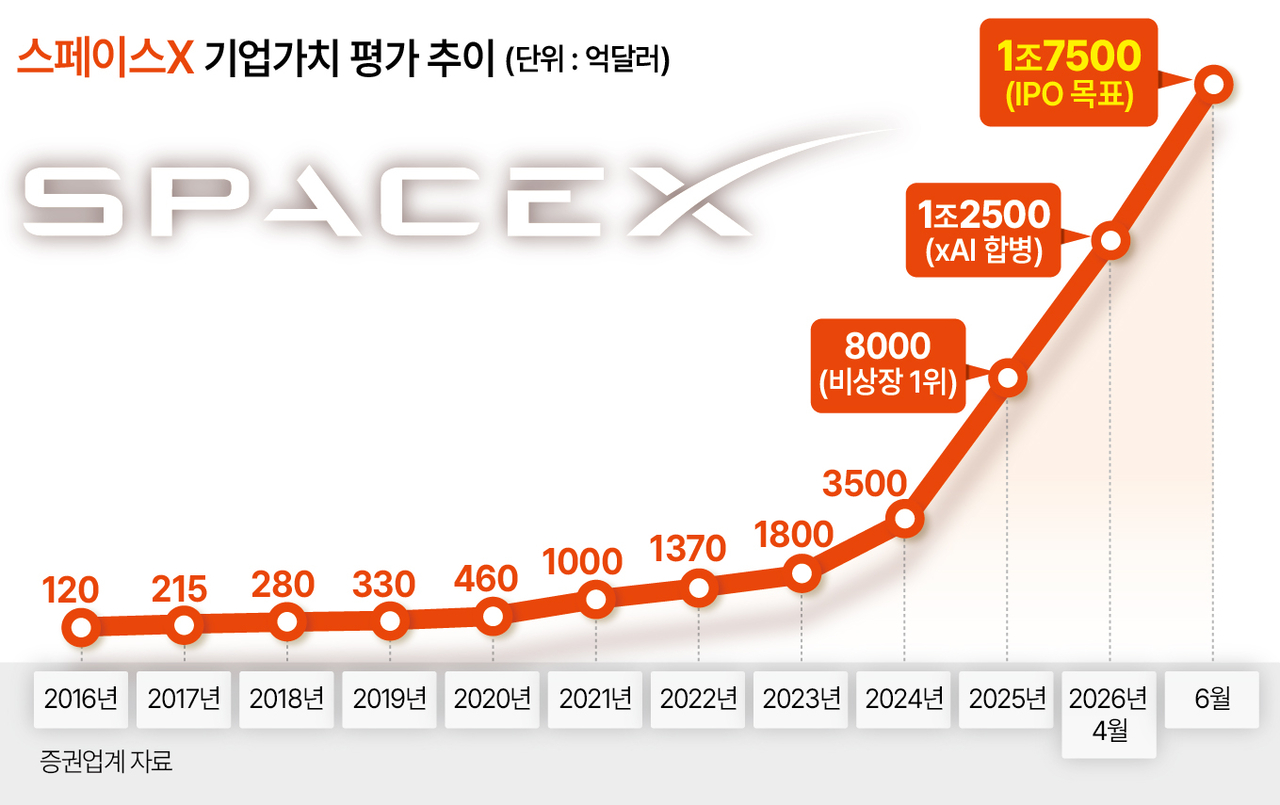
Elon Musk's aerospace company plans to raise $75 billion through its initial public offering. The target valuation stands at $1.75 trillion (approximately 2,667 trillion won), which would instantly place SpaceX among the top 10 companies in the world by market cap, leapfrogging both Meta and Tesla.
The record-breaking valuation has sparked fierce debate, however. Last year, SpaceX posted sales of just $18.7 billion while recording an operating loss of $4.9 billion.
Based on last year's sales, the company's price-to-sales ratio comes to roughly 96 times — far above Nvidia's 13 times, Tesla's 15 times and Apple's 10 times. The market is effectively pricing in future growth potential rather than current earnings.
On the credit side, SpaceX has received favorable assessments. Bloomberg reported on Wednesday that SpaceX had informed investors it received investment-grade ratings from Moody's, Fitch and S&P.
Markets have taken note of the fact that a loss-making company secured investment-grade ratings. SpaceX posted a net loss of $4.28 billion in the first quarter of this year. However, contracts with Google and Anthropic have given the company medium- to long-term revenue visibility.
Korean retail investors were not allocated shares in the IPO. To invest, they must either buy SpaceX shares directly on the US market or gain exposure through domestic or international space and aerospace exchange-traded funds.
The first thing investors should check is when trading actually begins. SpaceX will list on the Nasdaq under the ticker SPCX on Friday local time. IPO stocks, however, do not begin trading the moment the regular session opens. A price discovery process — in which IPO allocations are confirmed and buy and sell orders are aggregated to set the opening price — must first be completed, meaning the exact start time varies from stock to stock.
Investors should also be mindful of first-day volatility. Analysts at home and abroad are urging caution against chasing the stock on listing day, as IPO shares often swing sharply in early trading depending on supply and demand.
According to Kathy Donnelly, co-author of the investment book "Lifecycle Trade," many IPO stocks surge on their first day only to fall below their opening-day low within weeks. The stronger a company's growth story, the more likely expectations are already priced into the shares before trading begins.
The high proportion of retail investors is another variable. SpaceX is reported to have allocated roughly 30 percent of the total IPO shares to retail investors — an unusually large share given that the typical retail allocation in the US IPO market runs between 5 and 10 percent.
The concern is that a higher retail investor share can amplify price volatility in early trading. When Robinhood listed in 2021, it allocated 20 to 35 percent of its IPO shares to retail investors, yet its share price still fell more than 8 percent on its first day.
A limited float will also add to volatility. The shares being released to the market through this IPO amount to $75 billion — roughly 4.2 to 4.9 percent of the company's total valuation. With the float constrained, the share price could swing sharply in early trading based on supply and demand.
Conversely, the expiration of lock-up periods could flood the market with shares. Existing shareholder stock is expected to be released to the market in three broad tranches. Shares held by employees and general investors can be sold on a rolling basis starting two days after the second-quarter earnings release through 180 days after listing. Some key investors and executives face a lock-up running from two days after the fourth-quarter earnings release through two days after the second-quarter 2027 earnings release. CEO Elon Musk's stake becomes eligible for sale 366 days after listing.

moon@heraldcorp.com