City targets 'rail access within 10 minutes of home' under 9th elected administration
Six lines — including Gangbuk Transversal, Nangok, Seonam and Seobu — to span 68.5 km total
Average subway access time projected to fall from 9.97 to 8.03 minutes
Rail 'non-coverage zone' to shrink from 33% to 27% if third-phase plan is realized
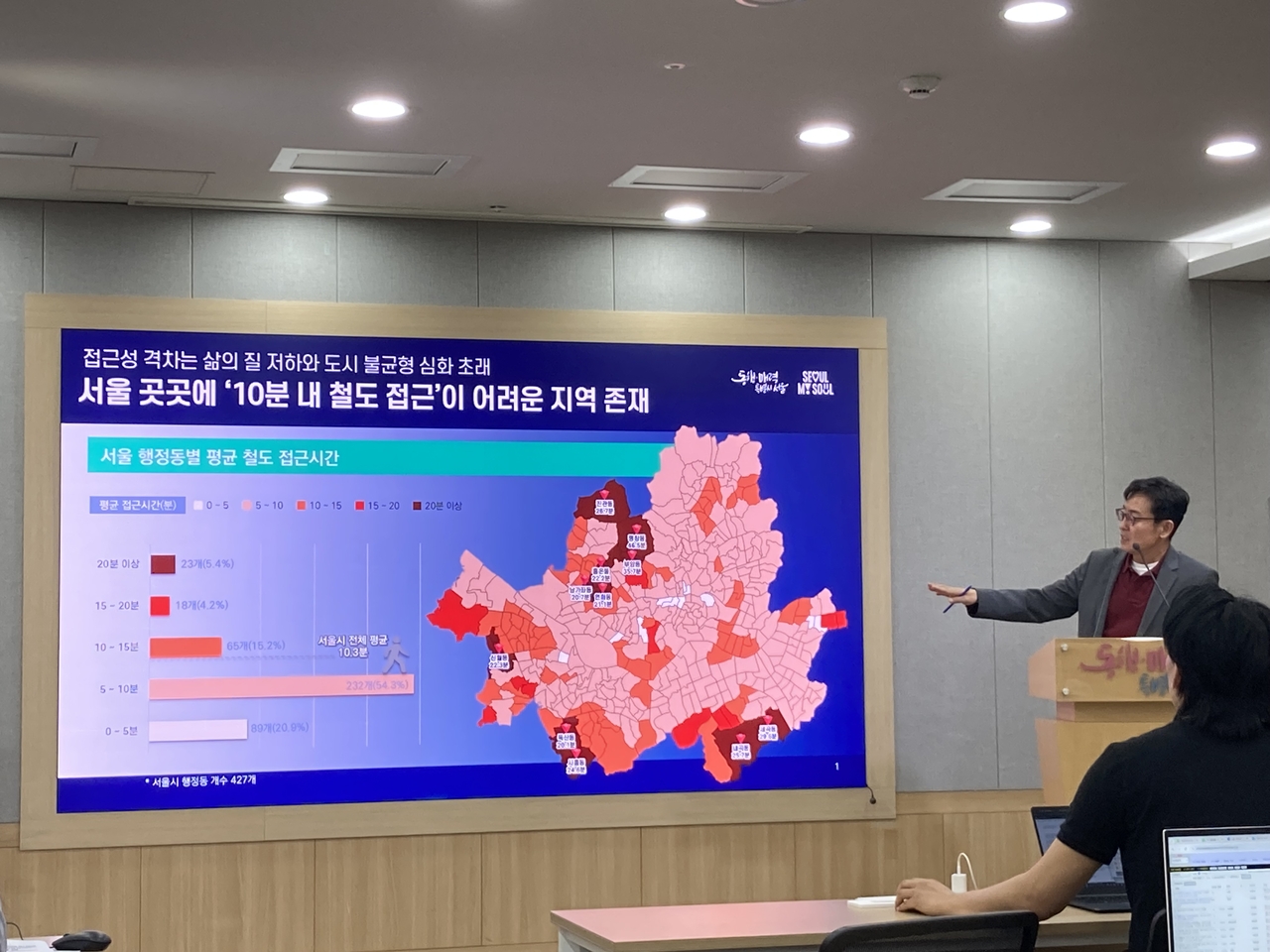
Seoul is pushing ahead with its Third Urban Rail Network Construction Plan, aimed at giving every resident rail access within a 10-minute walk of home. The project is budgeted at 9.2 trillion won (approximately $6.04 billion). The city's goal is to secure official project designation this year and complete preliminary feasibility reviews within the term of the 9th elected administration.
The Seoul Metropolitan Government outlined the plan's rationale at a briefing at Seoul City Hall on Thursday morning. Yeo Jang-gwon, the city's transportation bureau chief, said 23 neighborhoods in Seoul currently require more than 20 minutes on foot to reach the nearest rail station. "The goal of this third urban rail network plan is how quickly we can close that transportation gap," he said.
Under the 8th elected administration, the city made notable progress on urban rail: the Dongbuk Line and Wirye Line tram entered their final construction phases, the Ui-Sinseol extension broke ground ahead of schedule, and the Wirye-Sinsa Line and Myeongmok Line both cleared preliminary feasibility reviews.
The 9th administration's urban rail agenda carries the vision of "happy daily lives connected by rail from anywhere in Seoul." Its three goals are to establish a subway-within-10-minutes environment near every home, expand rail stations in transportation-underserved areas, and accelerate ground-breaking on long-pending local projects by strengthening their financial viability.
Yeo said that since the urban rail network plan launched in 2008, only eight projects have cleared preliminary feasibility reviews in 18 years. "We don't want urban rail projects to become a source of false hope for citizens any longer," he said. "This third plan underscores securing real executability."
To that end, the city is targeting preliminary feasibility approval for six lines within the 9th administration's term: the Gangbuk Transversal Line, Nangok Line, Seonam Line, Seobu Line, Seobu Line Southern Extension and Sillim Line Northern Extension. The six lines total 68.5 kilometers in combined length, with a combined project cost of 9.1996 trillion won. Broken down by line, the costs are 3.2 trillion won for the Gangbuk Transversal Line, 2.6 trillion won for the Seonam Line, 2.5 trillion won for the Seobu Line, 550 billion won for the Nangok Line, 177 billion won for the Seobu Line Southern Extension and 76 billion won for the Sillim Line Northern Extension.
The Gangbuk Transversal Line, running from Mokdong Station to Cheongnyangni Station, is the longest of the six at 25.79 kilometers. Route alignment improvements will boost its financial viability and establish it as a key corridor linking the northeastern, northwestern and southwestern parts of the city. The Nangok Line, connecting Boramae Park Station to Nanhyang-dong, will be revived with a focus on serving transportation-disadvantaged communities while securing commercial viability.
The Seonam Line — with a main line running from Magok Naru Station to Gasan Digital Complex Station and a branch line from the Seobu Truck Terminal to Dangsan Station — expands on the earlier Mokdong Line plan to more effectively ease congestion in the western part of the city. For the Seobu Line, the city will draw on the successful precedent of the Wirye-Sinsa Line and apply a range of measures, including conversion to a publicly funded project, to ensure the line proceeds without further interruption.
Two additional lines — the Seobu Line extension from Seoul National University Entrance Station to the main gate of Seoul National University, and the Sillim Line extension from Saetgang Station to Yeouido — will close gaps in the existing network and improve rail accessibility.
Yeo said the Nangok Line, which is currently under feasibility review, and the Seobu Line, for which a feasibility application is scheduled in the first quarter of next year, are expected to move fastest among the six. "We will do our best to ensure all six lines pass preliminary feasibility review within the next administration's term," he said.
![A map showing the six lines included in Seoul's Third Urban Rail Network Construction Plan. [Provided by Seoul Metropolitan Government]](https://wimg.heraldcorp.com/news/cms/2026/06/11/news-p.v1.20260611.602681a36b9d4c0f8889901e343e5fec_P1.jpg)
If the plan is realized, the average time to reach a subway station is projected to fall from 9.97 minutes to 8.03 minutes, and the population within the service catchment of the new lines is expected to grow by 360,000 to reach 7.83 million.
Yeo said the plan, if completed, would fulfill the campaign pledge of putting a subway station within 10 minutes of every home, and projected that the share of the city outside rail coverage would shrink from 33 percent to 27 percent.
The city has also been actively lobbying for reforms to the preliminary feasibility review system to speed up rail project approvals. Seoul's rail projects have long struggled to clear the reviews under an evaluation framework weighted heavily toward economic returns. Under the proposed reforms, projects would receive bonus points for "balanced regional development" and "public transit system efficiency," raising the likelihood of approval.
As a result, the Ministry of Planning and Budget incorporated those criteria into its preliminary feasibility review reform package on March 10, and also updated the methodology for calculating the monetary value of travel time benefits. The city plans to use the reformed system to actively advance rail projects centered on transportation-underserved areas.
To finalize the Third Urban Rail Network Construction Plan as quickly as possible, the city will consult with relevant agencies including the Ministry of Land, Infrastructure and Transport and hold hearings with the Seoul Metropolitan Council. A public hearing is also planned for June 30 at the Seosomun Annex of Seoul City Hall.
Following that, the city will move into the formal administrative process of seeking Ministry of Land, Infrastructure and Transport approval in the second half of the year. The goal is to maximize feasibility and maintain project continuity without interruption or delay, drawing on the city's accumulated expertise in streamlining urban rail procedures.
In addition, the city plans to assess the viability of a new light rail line — the Dongbu Line — connecting Gangnam and Gangbuk by incorporating the latest ridership demand data, with a view to adding it through an amendment to the third network plan.
Mayor Oh Se-hoon said the city would spare no effort in advancing rail projects without setback, building on the track record and determination demonstrated during the 8th administration. "We will move swiftly to expand rail infrastructure and transform transit services, so that citizens feel the difference and Seoul leads an overwhelming era of transportation transformation," he said.
ikson@heraldcorp.com