
National Health Insurance Service analysis of flu prescriptions finds older doctors and ENT specialists more likely to prescribe antibiotics
![[123RF]](https://wimg.heraldcorp.com/news/cms/2026/06/11/news-p.v1.20260611.8d82d0ca8d804187adcf836b0ee710a3_P1.jpg)
Antibiotics were prescribed to 13 percent of flu patients who had no complications, according to new data from South Korea's National Health Insurance Service.
The NHIS analyzed 1.4 million outpatient treatment episodes involving adult flu patients diagnosed at primary care clinics between July 2023 and June 2024, finding an average antibiotic prescription rate of 27.7 percent, with a median of 12.4 percent.
An episode was defined as all related medical visits within 28 days of the initial consultation, grouped as a single treatment case.
Of all outpatient episodes, 18.3 percent — or 256,823 cases — were classified as low-risk, meaning the patient had no underlying chronic conditions and no complications such as pneumonia.
Antibiotics are generally unnecessary in low-risk cases, yet 13.3 percent of them — 34,041 episodes — resulted in an antibiotic prescription.
Episodes involving antibiotic prescriptions lasted about 13 percent longer than those without, a difference the NHIS described as statistically significant.
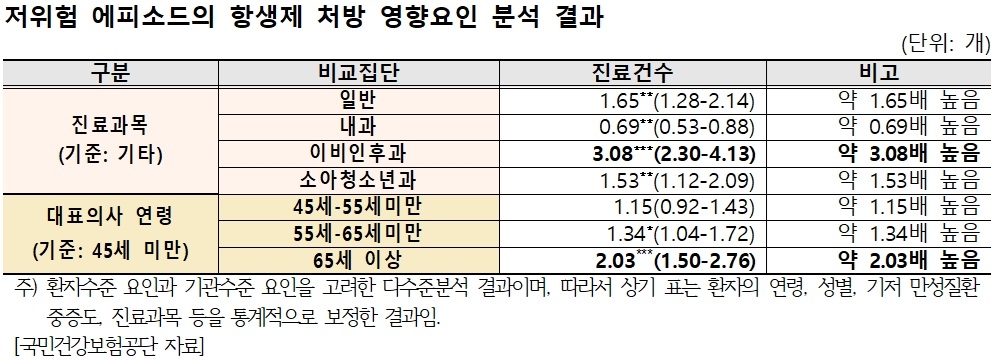
Among the factors associated with antibiotic prescribing in low-risk episodes, the age of the treating physician stood out: older doctors were more likely to prescribe antibiotics, as measured by odds ratio.
The odds ratio indicates how many times more likely antibiotics are to be prescribed in a given group compared with a reference group. A value above 1 means a higher likelihood of prescription.
Physicians aged 65 and older were 2.03 times more likely to prescribe antibiotics in low-risk cases than those under 45, while doctors between 55 and 64 showed an odds ratio of 1.34.
By specialty, ear, nose and throat clinics had the highest odds ratio at 3.08, followed by general practice clinics — those without a designated specialty — at 1.65, and pediatrics at 1.53.
Park Young-min, a professor of family medicine at Ilsan Hospital, said preemptive antibiotic prescriptions for uncomplicated flu do little to shorten the overall treatment period. "Precise, patient-tailored care is needed, along with a shared effort by the medical community and the public to reduce drug misuse," he said.
Meanwhile, the data revealed another prescribing pattern: gastrointestinal drugs were prescribed in an average of 77.2 percent of flu treatment episodes, with a median of 91.4 percent, suggesting they are routinely bundled with flu treatment as a matter of habit.
An NHIS official said ensuring that people are not harmed by unnecessary medication is a core responsibility of the agency, and called for a review of reimbursement standards covering antibiotic use in uncomplicated influenza and the routine co-prescription of gastrointestinal drugs.
thlee@heraldcorp.com





