SK Group chairman tells Nikkei the facility could be operational within two to three years; says semiconductors from both countries play key role in economic security
SK Group plans to build an AI factory in Japan. An AI factory is a facility that uses power and data as raw materials to produce "tokens," the core unit of AI computation. The planned facility will combine SK's high-bandwidth memory with Nvidia's graphics processing units to deliver high computing performance while minimizing power consumption. Nvidia CEO Jensen Huang recently cited AI factories as a blueprint for collaboration with South Korea's industry, and SK is set to launch its first AI factory in South Korea next year.
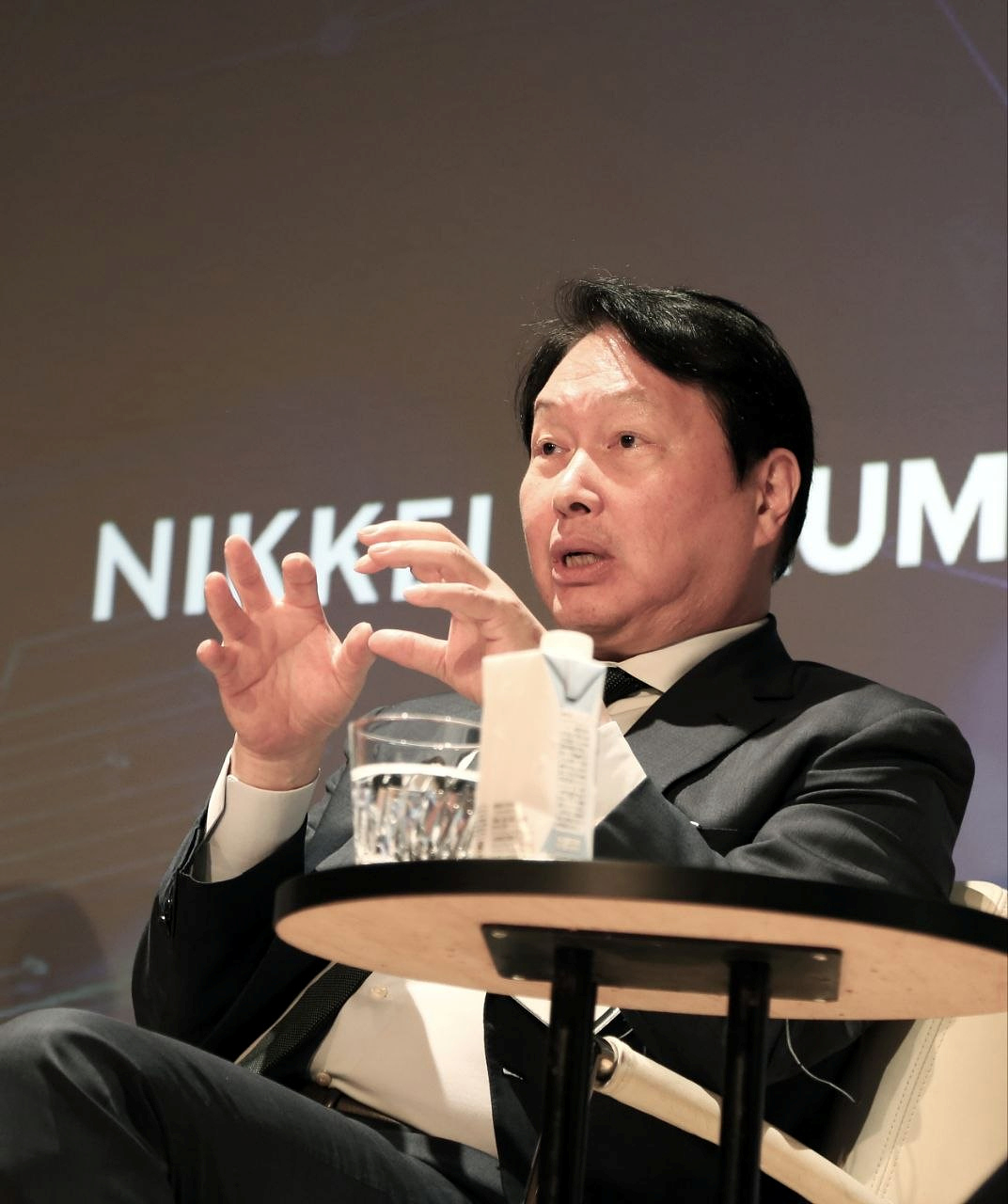
SK Group Chairman Chey Tae-won said Thursday in an interview with the Nikkei that he plans to launch an AI factory in Japan — the first outside South Korea. SK Group is in talks with Japanese companies with the goal of bringing the facility online within two to three years. Chey said he envisions a gigawatt-scale data center — equivalent to the power consumption of a major city — and that the group is scouting candidate sites where it can secure large tracts of land and sufficient electricity. He did not disclose a specific investment figure.
Chey also said many industries are currently grappling with serious semiconductor shortages, and that SK is considering building semiconductor factories outside South Korea if it can further expand production capacity. "Japan is an excellent candidate," he said, noting that the country has a fully developed ecosystem for semiconductor manufacturing, including equipment, materials and a reliable power supply.
On the Yongin cluster — originally targeted to complete four semiconductor factories by 2045 — Chey said he would bring that timeline forward by several years or more. On where to direct profits from semiconductor sales, he said, "Demand for semiconductors is very strong right now, so most of it is going into factory construction," adding that the factories themselves need to be "AI-ified" and that SK will continue expanding its engineering workforce.
On profit-sharing, which has become a prominent social debate in South Korea, Chey said, "As profits grow, so should our contributions to society — and we will continue that not only in South Korea but in Japan as well." On Kioxia, the Japanese NAND flash chipmaker in which SK holds a major stake as a key shareholder and strategic partner, he said, "We are also competitors and there are limits to collaboration, but I would like to explore various forms of cooperation in talent, research and development, and the semiconductor ecosystem."
Chey also reiterated his longstanding push for South Korea-Japan economic cooperation. On Rapidus, the Japanese chipmaker the government is backing as part of its effort to revive the domestic semiconductor industry, he said SK is "ready to cooperate at any time if needed." He added that SK maintains ongoing ties with Japanese semiconductor materials and equipment makers such as Tokyo Electron, and that "connecting the South Korean and Japanese semiconductor ecosystems plays a major role in the economic security of both countries."
Chey also said SK is pursuing AI investment activities in the United States alongside Japanese partner companies, and that the group has begun discussions with Japanese firms "to generate synergies in new AI-driven projects."
keg@heraldcorp.com