Import price of mackerel jumps 97.4% since early this year
Imported chicken legs, chicken breast also on the rise
Retailers scrambling to diversify sourcing, cut costs amid high exchange rate
Import food prices are surging on the back of a high exchange rate and rising logistics costs, with sharp increases recorded across seafood staples such as mackerel and croaker as well as poultry products including chicken legs and chicken breast.
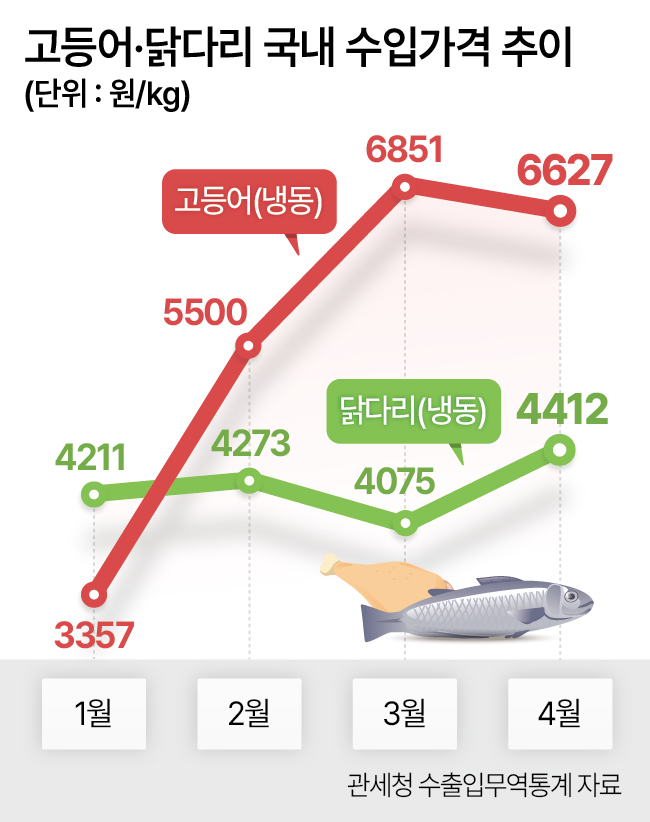
According to Korea Customs Service trade statistics released Friday, the import price of frozen mackerel stood at 6,627 won per kilogram in April, up 67.8 percent from a year earlier. Compared with prices at the start of this year, the figure has nearly doubled — a jump of 97.4 percent. Mackerel was priced at 3,357 won per kilogram in January but surged to 5,500 won in February when the Iran war broke out. Prices have remained elevated since, reaching 6,851 won in March before easing slightly to 6,627 won in April.
A key driver of the price increase is Norway's reduction of its mackerel fishing quota. Acting on scientific recommendations from the International Council for the Exploration of the Sea, Norway cut its mackerel catch allocation this year by 52 percent from the previous year to 79,000 metric tons. That supply squeeze was compounded by a high exchange rate and rising logistics costs stemming from the Middle East situation.
Other seafood categories also posted significant gains. Chilled live octopus rose 26.3 percent year on year to 31,828 won per kilogram (about $21). Frozen croaker climbed 26.2 percent to 8,734 won. Chilled salmon, which relies heavily on air freight, rose 17.4 percent to 17,055 won. Pacific saury (up 15.4 percent), webfoot octopus (15.3 percent), pollock (13.2 percent) and common octopus (10.2 percent) also recorded notable increases.
Chicken prices have continued to climb. Frozen chicken legs reached 4,412 won per kilogram, up 24.1 percent from a year ago. The product was priced in the 3,000-won range in early last year before crossing the 4,000-won threshold in September. Frozen chicken breast rose 40.0 percent, while frozen chicken wings gained 12.7 percent. Imported chicken has emerged as a substitute as domestic supply has grown unstable due to highly pathogenic avian influenza. Industry observers warn that the price increases could feed through to consumers, given how widely fried chicken chains rely on imported poultry.
![A shopper browses the aisles of a hypermarket in Seoul. [Yonhap]](https://wimg.heraldcorp.com/news/cms/2026/06/12/rcv.YNA.20260520.PYH2026052012750001300_P1.jpg)
Behind the import price increases are a high exchange rate and prolonged logistics cost pressures tied to the Middle East situation. The won-dollar exchange rate has held above 1,500 won since May 15. The Shanghai Containerized Freight Index, a gauge of global maritime shipping costs, stood at 2,726.48 on June 5, up 6 percent from the previous week. That is 104.5 percent above the 1,333.11 recorded on Feb. 27, when the Middle East war broke out.
Retailers are working to contain costs and secure supply. E-mart began selling Chilean mackerel this month after the high exchange rate pushed up the cost of importing Norwegian mackerel, prompting the chain to find alternative sourcing for part of its volume. Chilean mackerel is priced up to 50 percent below the Norwegian variety. For shrimp meat, E-mart has also shifted toward Peruvian product, which can be imported duty-free, reducing its reliance on Southeast Asian suppliers subject to roughly 20 percent tariffs.
Lotte Mart has been securing large advance contracts for whole Norwegian salmon sashimi and importing it directly via air freight, bypassing intermediate distribution. Air-freighted salmon prices have risen about 10 percent from a year ago due to the high exchange rate. With US beef prices up roughly 10 to 15 percent year on year amid the high exchange rate, the retailer has expanded its Australian beef lineup, which runs about 10 percent cheaper than the American alternative.
"Grocery prices that consumers feel in their daily lives keep going up, so we are focusing on diversifying our sourcing," an official at a major hypermarket said. "If the Middle East situation drags on further, price increases will be unavoidable not only for seafood and meat but across a wide range of products."
![‘밥상·외식 물가’ 주범 셋, 얼마나 올랐나 봤더니? [세모금]](https://wimg.heraldcorp.com/news/cms/2026/06/11/rcv.YNA.20260329.PYH2026032904950001300_T1.jpg)

korean@heraldcorp.com