Semiconductor bonus inflows reshape the housing market; balloon effect bypasses post-Oct. 15 regulations; experts warn of overheating and potential price correction
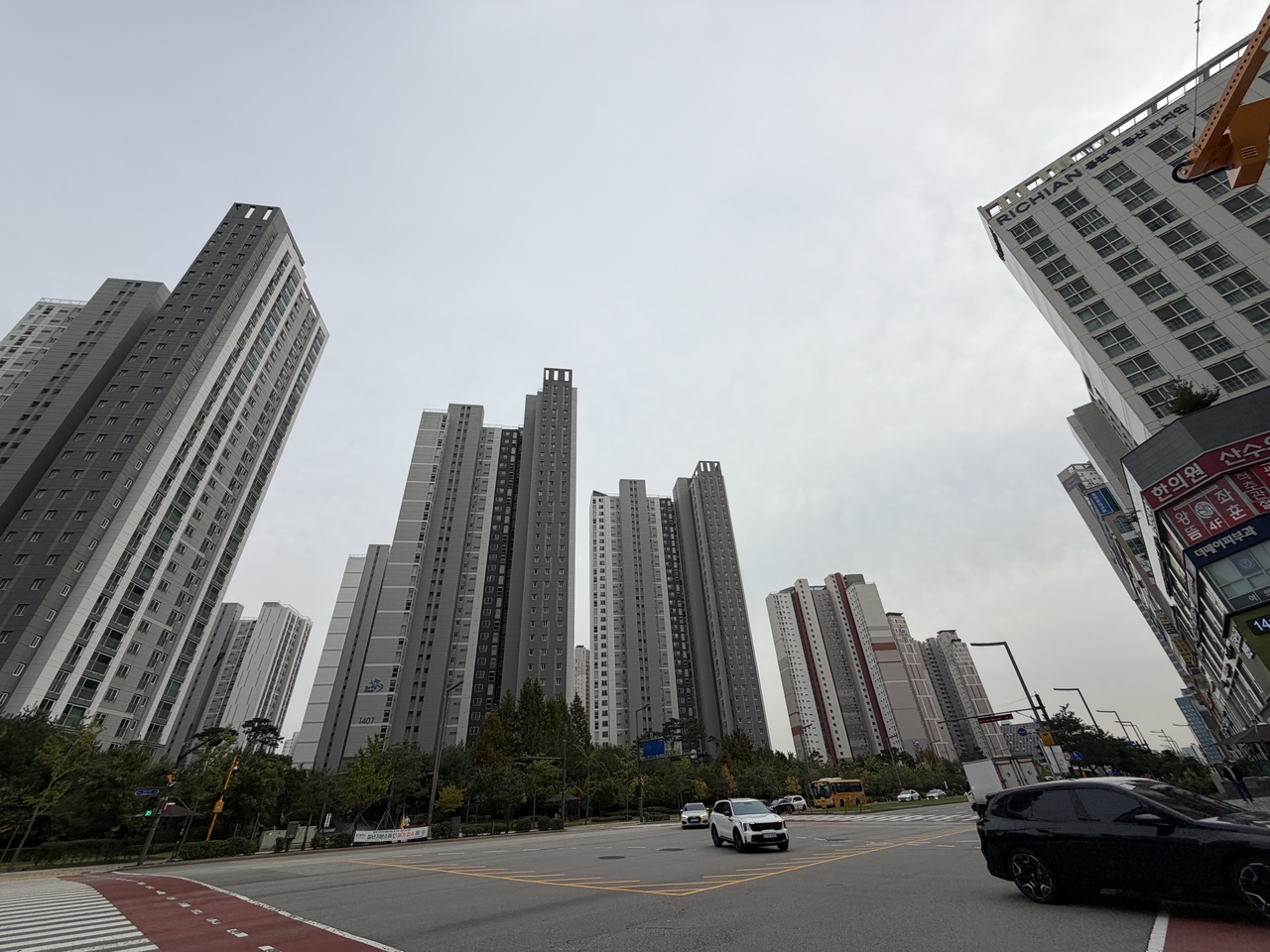
The semiconductor industry's upswing is reshaping South Korea's housing market. Apartment prices in Dongtan, Hwaseong, Gyeonggi Province — where workers can live close to major chipmakers — have been posting the steepest weekly gains in the country, and actual transaction prices there have now overtaken those in Gwanggyo, long favored for its proximity to Gangnam. Experts say buying demand has been driven in part by expectations of in-house loans and performance bonuses at nearby chipmakers such as SK Hynix and Samsung Electronics, but they also point to a balloon effect as investment flows sidestep land-transaction permit zone regulations.
Young semiconductor workers flock to Dongtan, pushing past Gwanggyo
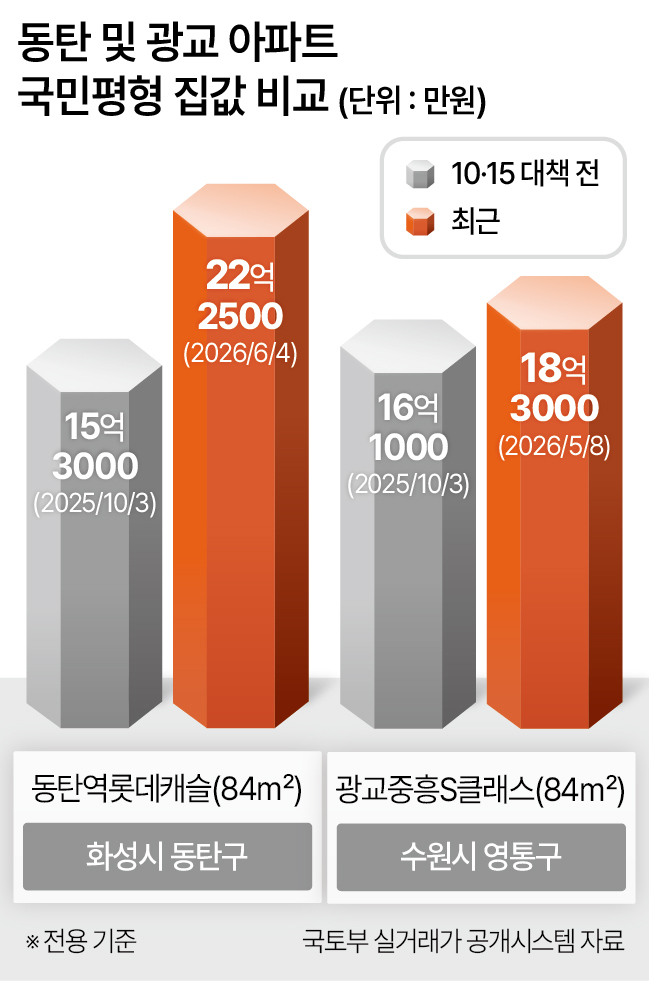
According to the Ministry of Land, Infrastructure and Transport's real transaction price disclosure system, an 84-square-meter unit (exclusive use area) at Dongtan Station Lotte Castle — widely regarded as Dongtan's flagship apartment complex — sold for 2.225 billion won (approximately $1,460,000) on the 33rd floor on June 4, surpassing the record high for the same floor plan at Gwanggyo Jungheung S-Class in Suwon's Yeongtong-gu, which fetched 1.83 billion won on the 13th floor.
A smaller 65-square-meter unit in the same complex also sold for 1.647 billion won (32nd floor) in April, topping the 1.55 billion won paid a month later for a larger 74-square-meter unit at Gwanggyo Central View (13th floor).
Market observers consider this reversal remarkable. Gwanggyo had long been the most expensive residential area in southern Gyeonggi Province after Bundang, thanks to its location on the Suin-Bundang Line connecting directly to Gangnam. The commute from Gwanggyo Central Station to Pangyo Station takes about 19 minutes and to Gangnam Station roughly 33 minutes. Easy access to Samsung Digital City in Maetan-dong, Suwon, had long drawn Samsung employees and Gangnam-bound commuters to the area.
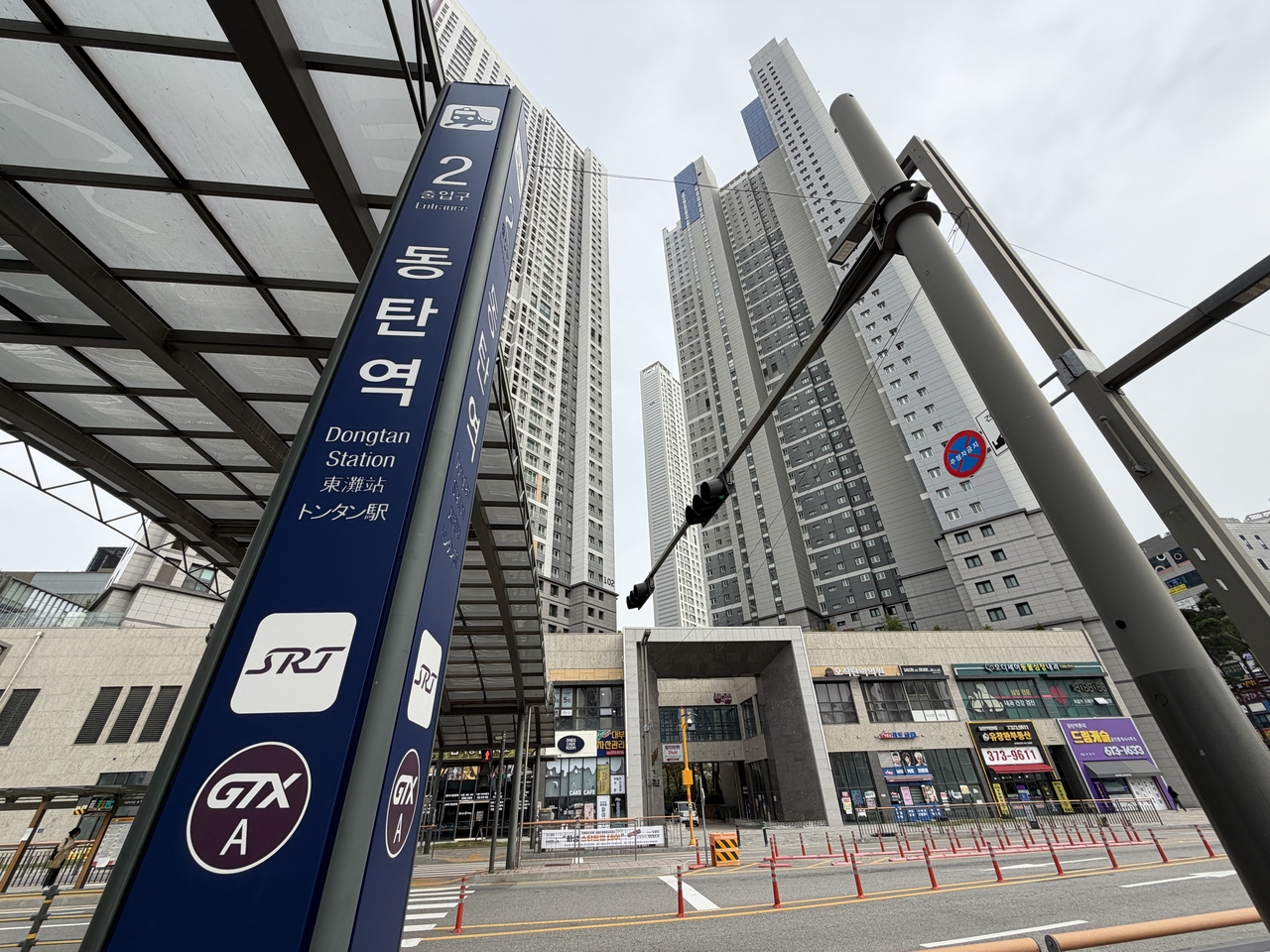
Recently, however, young semiconductor workers who have benefited from the boom at Samsung Electronics and SK Hynix have been flocking to Dongtan, triggering the price overturn. High-earning employees at nearby Samsung Electronics, ASML, Hyundai and Kia have been snapping up homes there. Hwaseong, the city that encompasses Dongtan, has an average resident age of 40.0 this year, earning it a reputation as a young city. Anticipation over the opening of the Greater Seoul Express Railway (GTX) line has also fueled demand.
Nam Hyeok-woo, a real estate researcher at Woori Bank, said the two areas are broadly comparable in terms of live-work proximity, apartment density and liveability — Gwanggyo has a Galleria department store while Dongtan has a Lotte department store. "The one difference is that Dongtan will gain a GTX line," he said.
Asking prices are reflecting this trend even faster. No 84-square-meter units at Dongtan Station Lotte Castle are currently listed for sale. Asking prices for mid-to-large units of 102 square meters and above have reached as high as 2.7 billion won, while some larger floor plans at Dongtan Station Sibeom Hanwha Dreamplus Prestige are listed at 3 billion won. Gwanggyo asking prices remain lower. At Jayeon & Hillstate, a 1,764-unit complex near Gwanggyo Central Station, 32 units of 84 square meters are on the market with asking prices ranging from 1.75 billion won to 2.3 billion won.
Price reversal accelerates after Oct. 15 measures; balloon effect takes hold
Experts say that while semiconductor workers' bonuses are concentrating in certain areas, the more fundamental driver of Dongtan's price surge is a balloon effect. Unlike Gwanggyo, which is designated a land-transaction permit zone and carries an owner-occupancy requirement, Dongtan allows gap investment — buying a property with an existing tenant in place.
Dongtan's overtaking of Gwanggyo in price coincides precisely with the period when all of Seoul and 12 locations in Gyeonggi Province were placed under land-transaction permit zone restrictions. On Oct. 3 last year, an 84-square-meter unit at Dongtan Station Lotte Castle sold for 1.53 billion won while a comparable unit at Gwanggyo Jungheung S-Class fetched 1.61 billion won.
After the measures took effect, a unit at Dongtan Station Lotte Castle sold for 1.75 billion won (44th floor) in November, overtaking the 1.64 billion won (18th floor) paid for a Gwanggyo Jungheung S-Class unit the same month.
A real estate agent near Dongtan Station said many buyers from outside the area had purchased units with tenants in place, betting on further price gains. "There were quite a few cases of people living in other parts of the country buying with a tenant already in the unit, expecting prices to keep rising," the agent said, adding that some existing Dongtan residents who want to upgrade within the area have also been buying with tenants while waiting to move.
Lending conditions have also played a role. Because Dongtan has not been designated a speculative overheating zone or other regulated area, buyers can borrow up to 70 percent of the property value under loan-to-value ratio rules. Given the area's relatively young average age of 39.5 and concentration of high earners, various loan programs — including first-time homebuyer loans — have likely seen wide use.
According to the Supreme Court Registry Information Plaza, the loan index for collective buildings (apartments, officetels and commercial properties) in Dongtan-gu, Hwaseong, averaged 71.55 in May. The loan index measures the ratio of mortgage collateral set against the transaction price; a reading above 70 means buyers financed more than 70 percent of the purchase price through loans.
Nam noted that actual transaction prices for complexes near Dongtan Station now exceed those of the top apartments near Cheongnyangni in Seoul, even though both are on the same GTX line. "With the possibility of additional regulations such as land-transaction permit zone designation being raised, there remains a risk that prices could fall back to more fundamental levels," he said.
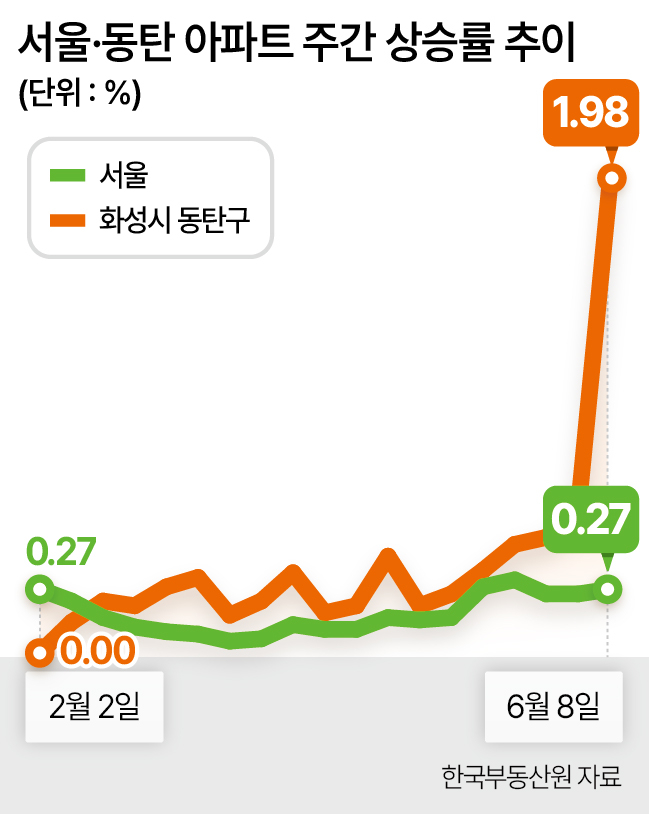
Meanwhile, according to the Korea Real Estate Board, Dongtan posted a weekly apartment price gain of 1.98 percent in the second week of June (as of June 8), the highest in the country. That figure dwarfs the 0.26 percent recorded in Suwon's Yeongtong-gu — which includes Gwanggyo — and the 0.2 percent in Yongin's Suji-gu, and is more than four times the 0.42 percent gain seen in Gangseo-gu, Seoul's top-performing district.
![오세훈 “집무실에 ‘신통기획 현황판’ 설치하라”…31만호 속도전 [부동산360]](https://wimg.heraldcorp.com/news/cms/2026/06/12/ams.V01.photo.HDN.P.20260604.P12026060413283818466282139_T1.jpg)
hss@heraldcorp.com