Revised regional transport guidelines to take effect this month; metropolitan situation rooms to step in when transfers are delayed
AI-assisted emergency care demonstrated from ambulance to ER
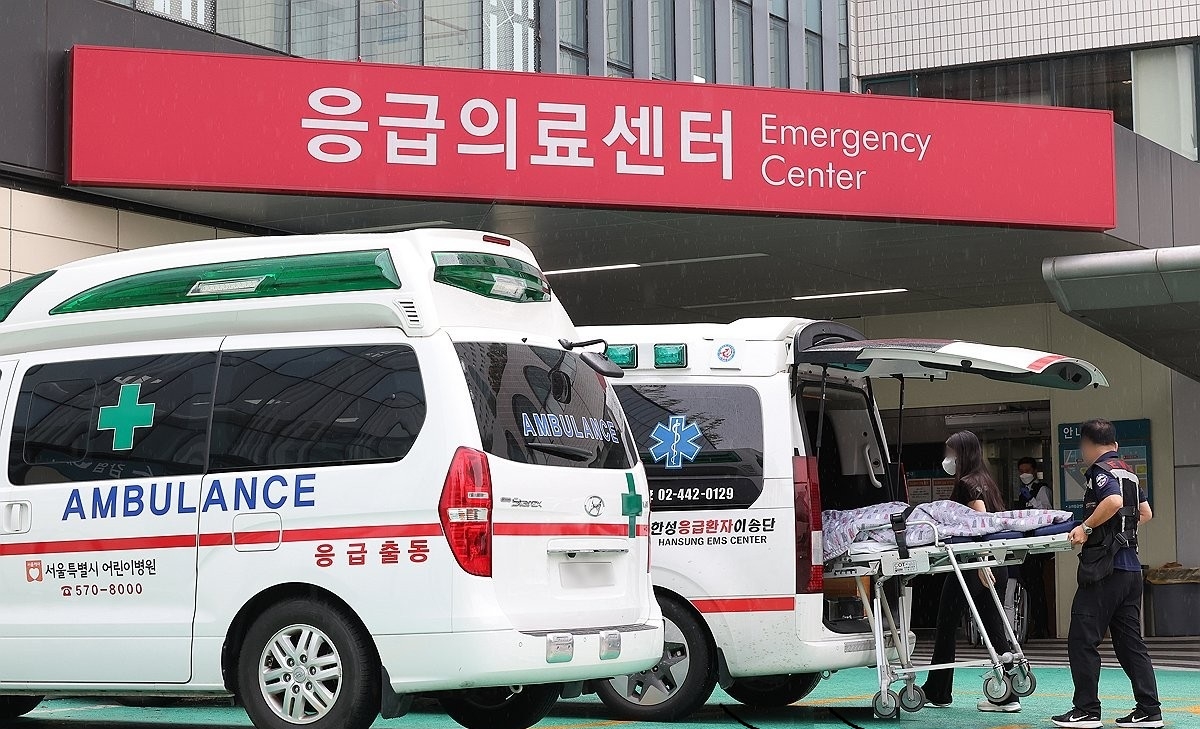
A pilot program that overhauled the emergency patient transport system in the Gwangju and Jeolla regions to address delays caused by hospitals refusing to accept patients will be expanded to Daegu and North Gyeongsang Province.
The Ministry of Health and Welfare said Friday that Minister Jeong Eun-kyeong held a meeting at Kyungpook National University Hospital to review a demonstration of the Daegu and North Gyeongsang smart transport system and discuss revised transfer guidelines.
Under the revised guidelines, when a critically ill emergency patient is identified, multiple hospitals are contacted simultaneously to check availability. If no hospital can be selected, an inter-regional transfer is requested.
Daegu plans to strengthen patient acceptance and care coordination with neighboring cities and provinces while reinforcing communication channels among emergency medical institutions.
Specifically, critically ill patients classified as pre-KTAS grades 1 or 2 will be referred simultaneously to six regional and local emergency centers through a multi-hospital transfer coordination network. If none can accept the patient, the patient will be sent to a designated priority-acceptance hospital. Should that process also stall, the inter-regional transport system will be activated.
North Gyeongsang Province has an uneven distribution of medical facilities relative to its large area and faces geographic challenges including mountainous terrain and the remote island of Ulleungdo. To address this, the province has drawn up a long-distance transport plan for critically ill patients that incorporates helicopter transfers and integrated transport-referral coordination.
Fire department paramedic units will select the receiving hospital. If a delay occurs, the emergency management center and the metropolitan situation room will respond jointly, with regional and local emergency centers within the area serving as priority-acceptance hospitals.
When a patient requires transfer for definitive treatment, 119 paramedic units will handle the transport, while doctor helicopters and fire department helicopters will be used for emergency patients in medically underserved areas.
In both regions, the metropolitan situation room will support hospital selection for patients who cannot be handled within the local area.
The revised guidelines discussed Friday will take effect this month and will be continuously reviewed and adjusted by paramedic units and emergency medical institutions.
The pilot program allows cities and provinces to refine their transfer guidelines based on regional characteristics, while metropolitan situation rooms respond to transfer delays by searching for receiving hospitals nationwide, coordinating integrated transport-referral linkages, or designating priority-acceptance hospitals.
The government said the average daily death toll in the Gwangju and Jeolla regions declined during the pilot period and that field evaluations found the program significantly helped resolve the non-acceptance problem. It added that it plans to expand the system nationwide by September.
Meanwhile, ahead of Friday's meeting, Kyungpook National University Hospital showcased an AI-assisted clinical support system at a technology demonstration.
The system introduces AI across the entire process — from the moment an emergency patient boards an ambulance to when they receive treatment in the emergency room — analyzing the patient's condition to identify the most suitable hospital.
Emergency medicine physicians from Kyungpook National University Hospital and Samsung Medical Center who attended the demonstration said that if AI transformation were fully implemented on the ground, it would significantly reduce the workload on medical staff and allow more patients to be treated even with a limited number of emergency room beds.
Minister Jeong said: "I will closely monitor the expansion of the pilot program in other cities and provinces to minimize the problem of emergency rooms refusing to accept patients."
thlee@heraldcorp.com