Cumulative gain of 8.80% this year tops Suji, Gwangmyeong; hagwon belt, reconstruction prospects and Seoul access fuel demand
![A view of the Pyeongchon new town area in Dongan-gu, Anyang. [Anyang City]](https://wimg.heraldcorp.com/news/cms/2026/06/14/ams.V01.photo.HDN.P.20241015.202410150946466116280359_P1.jpg)
Apartment prices in Dongan-gu, Anyang, Gyeonggi Province have climbed sharply this year, as reconstruction hopes for first-generation new towns combine with rising prices in southeastern Gyeonggi residential areas — including Seongnam's Bundang-gu and Gwacheon — pushing demand toward the Pyeongchon area.
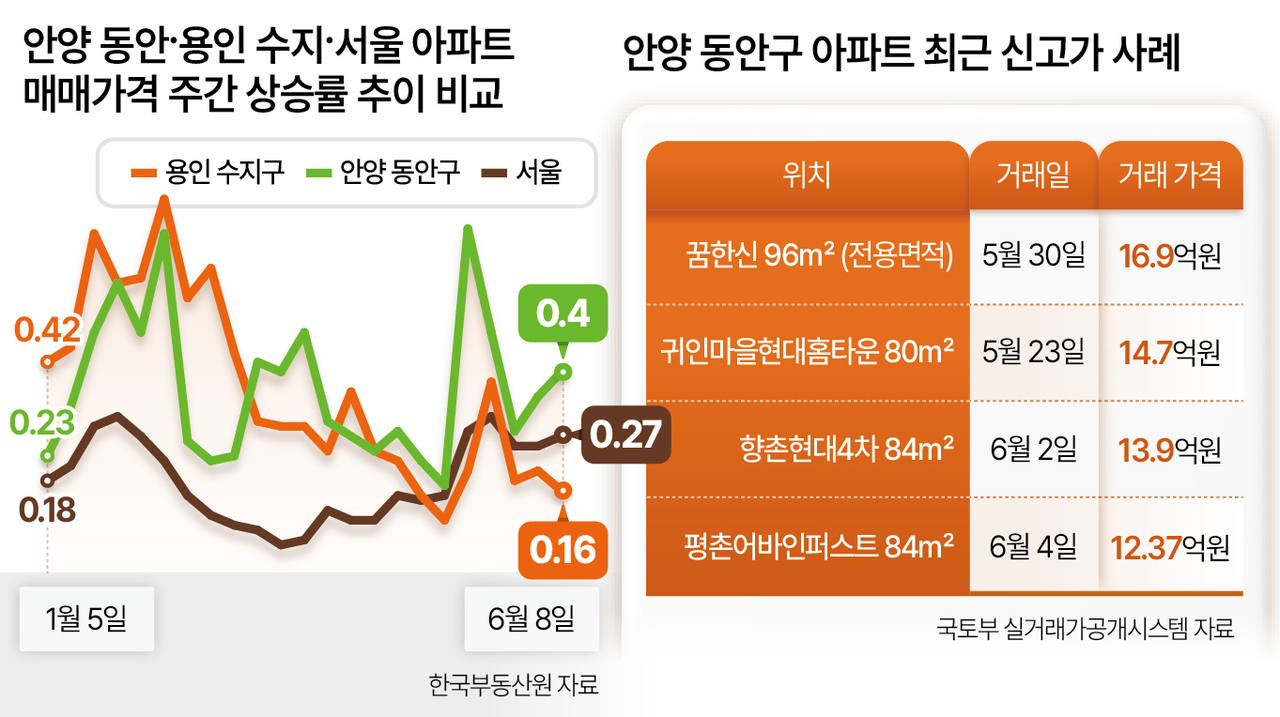
According to the Ministry of Land, Infrastructure and Transport's actual transaction price disclosure system, a 90-square-meter unit at Kkum Hanshin in Pyeongchon-dong, Dongan-gu sold for 1.69 billion won (about $1.11 million) on May 30, setting a record high. Nearby, an 80-square-meter unit at Gwiin Maeul Hyundai Hometown also broke its record on May 23, trading at 1.47 billion won.
The data bear out the trend. According to the Korea Real Estate Board's weekly apartment price index, Dongan-gu posted a cumulative apartment sale price gain of 8.80% for the year as of the second week of June — the highest of any district in the country. Yongin's Suji-gu (8.56%) and Gwangmyeong (8.19%) followed.
The head of a real estate agency in Bisan-dong, Dongan-gu said that compared with Dongtan, where some complexes have seen 30-pyeong units — roughly 99 square meters — surpass 2 billion won, buyers now see Pyeongchon as offering better value for money. "When the Oct. 15 measures were announced, Dongan-gu was included in the regulated zone, but there are still complexes that haven't recovered to their previous peaks," the agent said. "Among prospective buyers, there's a sense that room for further gains remains."
In Hwaseong's Dongtan-gu, the cumulative price gain this year stood at 7.19%. Dongtan-gu and three other new administrative districts were created in March following a reorganization, however, meaning cumulative data there have only been tracked from February transactions onward — which has kept the reported gain relatively low.
Analysts point to strong residential amenities — centered on the area's school district — as a key driver of price gains in Dongan-gu. Subway Line 4 runs through the district, and commuters using Beomgye or Pyeongchon stations can reach the Gangnam business district in roughly 40 minutes via a transfer at Sadang.
The Pyeongchon hagwon intersection along Gwiin-ro and Pyeongchon-daero in Dongan-gu is home to a dense concentration of private tutoring academies — more than 300 registered hagwon within a roughly 500-meter stretch, making it one of the most prominent hagwon districts in Gyeonggi Province and denser than the well-known Junggye-dong hagwon belt in Seoul's Nowon-gu.
Reconstruction expectations for first-generation new towns are also pushing prices higher. The Kkum Maeul area, where a 30-pyeong unit recently changed hands at close to 1.7 billion won, is one of three Pyeongchon leading districts designated for priority reconstruction. The Gwiin Block (Zone A-17) — comprising four complexes, Kkum Maeul Kumho, Hanshin, Life and Hyundai — has issued a tender notice for a design firm, with bidding closing June 15.
The Minbaek Block (Zone A-18), which includes four complexes — Kkum Maeul Wooseong, Dong-A, Geonyeong 3rd and Geonyeong 5th — is also set to close its design selection tender on June 15, with Korea Asset Trust serving as the project operator.
Saem Maeul, the largest of the three Pyeongchon leading districts, is also advancing through the project approval process. The Saem Maeul Daewoo, Hanyang, KGM, Imgwang and Ubang complexes are pursuing a reconstruction plan that would expand the site to 4,127 units. The complex designated Korea Land Trust and KB Real Estate Trust as preliminary project operators last November and plans to apply for special improvement zone designation this month.
Demand is flowing not only into reconstruction-targeted complexes but also into newly built ones. Most new apartment buildings in Dongan-gu sit outside the Pyeongchon new town land development zone, keeping their prices relatively accessible — a factor that has drawn a steady stream of younger owner-occupier buyers.
An 84-square-meter unit at Pyeongchon Irvine First in Hogye-dong, Dongan-gu sold for 1.237 billion won on June 4, setting a record high. A separate survey by KB Real Estate, based on KB Kookmin Bank's apartment purchase loan data for last year, found the complex was the most purchased apartment by buyers in their 30s over the past year.
Kim In-man, director of the Kim In-man Real Estate Economic Research Institute, said demand for well-connected outer residential areas near Gangnam had traditionally concentrated in Bundang and Gwacheon, but sharp price increases in those areas have pushed Pyeongchon forward as an alternative.
Kim added that among Pyeongchon new town reconstruction projects, certain complexes — including Kkum Maeul — are regarded as having relatively sound project viability among first-generation new town redevelopments, ranking behind only Bundang's Sibeom and Yangji Maeul districts.
quq@heraldcorp.com