New actuarial assumptions to reflect inflation in expense projections
Industry-wide BEL increase estimated at 2 trillion won ($1.45 billion)
Some insurers could see liabilities climb 4–5%
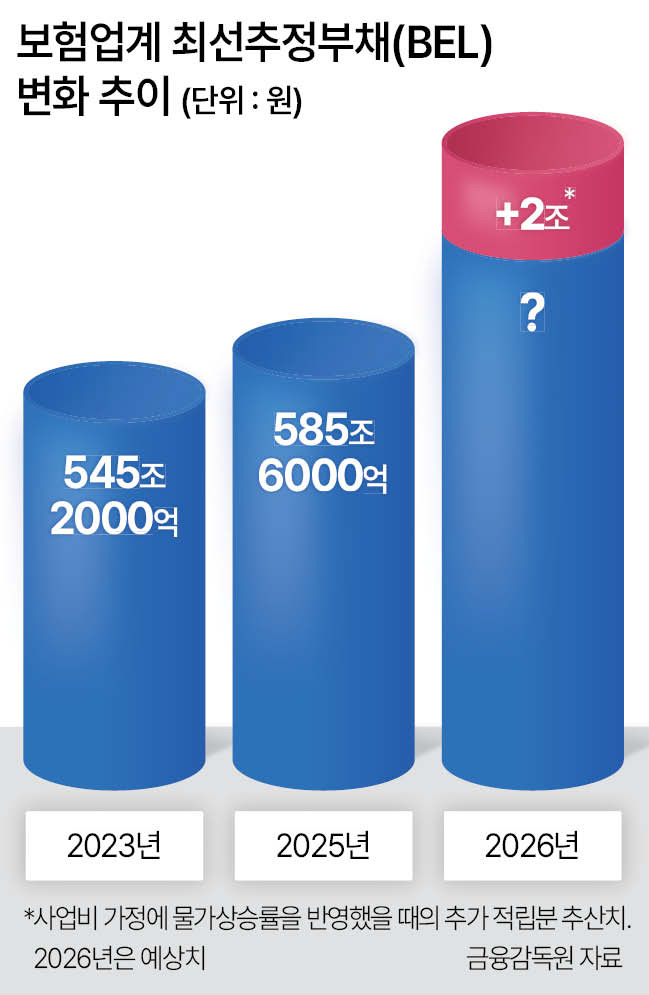
South Korean insurers are estimated to face roughly 2 trillion won ($1.45 billion) in additional reserve requirements as new actuarial standards take effect from the second-quarter settlement. The new standards incorporate inflation into expense assumptions such as new-contract costs and policy maintenance costs. The added liabilities are expected to erode the contractual service margin (CSM), the key measure of future profits from in-force policies, while also weighing on earnings and capital adequacy.
According to the insurance industry and financial regulators, the additional best-estimate liabilities (BEL) that insurers must set aside this year under the "actuarial supervision advancement plan" are estimated to total around 2 trillion won across the industry. Earlier, insurers submitted to regulators impact assessments showing how the new actuarial assumption standards would affect their balance sheets, BEL, risk adjustment (RA) and CSM, and regulators are now compiling and analyzing the results.
BEL represents the present value of projected future insurance payouts and expenses, net of expected premiums — money set aside in advance to cover future obligations. While 2 trillion won amounts to just 0.4 percent of the industry's total BEL of 585.6 trillion won, the impact varies sharply by company. Insurers with weaker expense structures could see their own BEL rise by as much as 4 to 5 percent.
The Financial Services Commission and the Financial Supervisory Service announced the actuarial supervision advancement plan earlier this year, pledging to rein in what they described as "elastic accounting" practices in the insurance sector. Because the revised expense assumptions apply retroactively to all in-force policies — not just new contracts — they carry the heaviest industry-wide impact among the various measures in the plan.
The higher liabilities eat into CSM, which represents the future profits insurers expect to earn from their existing policy portfolios. The increase also reduces capital, pulling down the Korea Insurance Capital Standard (K-ICS) solvency ratio, the industry's key financial health indicator. Companies hit hardest face simultaneous pressure on both future profitability and capital adequacy. "Depending on a company's financial strength, some will feel it more in their profit and loss, others more in their K-ICS ratio," an industry official said.
As a result, insurers ranging from large players to smaller firms have engaged consulting services from major accounting firms including Samil PwC and Samjong KPMG. Large non-life insurers are focused on calibrating the appropriate level of expense assumptions under the new standards, while life insurers and smaller companies facing heavier burdens are leaning toward invoking an exemption clause. Regulators included a provision allowing exceptions when an insurer can present and document a reasonable basis for not reflecting inflation.
The burden grows heavier for smaller players. Mid-size and digital insurers with thin CSM buffers could find that the increase in liabilities translates directly into losses rather than merely reduced profits. Digital insurers in particular argue that incorporating inflation runs counter to their business model. Because most policy maintenance and administration is handled through online self-service, they say their cost structure has little exposure to labor-driven inflation — and that once systems are built, processing costs tend to fall rather than rise.
Regulators say they will make decisions after fully hearing out industry views. "The standard a company considers reasonable and the standard regulators consider reasonable may differ," a regulatory official said. "If a company has a reasonable basis, we will allow it to set and apply its own standard."
Ultimately, a tug-of-war between insurers and regulators over how broadly to recognize such reasonable grounds is expected to continue. Detailed guidelines incorporating the new standards are set to be finalized and distributed by the end of this month and will apply immediately to the second-quarter settlement.
psj@heraldcorp.com