Seoul Metro analyzed last year's ridership data on days with rainfall of 10mm or more and heat wave days above 33 degrees Celsius during summer; both weather conditions reduced ridership by 3.5%, with weekend drops exceeding 5%
Seoul Metro, led by President Kim Tae-gyun, said an analysis of Seoul subway ridership data shows that weather conditions — including rain and extreme heat — have a measurable impact on how residents move around the city.
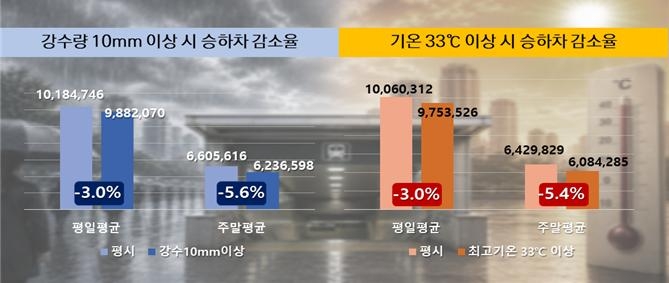
Notably, ridership fell by the same rate of 3.5 percent on both rainy days and heat wave days.
On days last year when rainfall reached 10mm or more, average daily ridership stood at 8.84 million — about 320,000 fewer riders than the baseline average of 9.16 million.
Similarly, on days from June through September last year when the daily high temperature hit 33 degrees Celsius or above, average ridership came to 8.70 million, compared with 9.02 million on other days — a drop of roughly 320,000 passengers.
The decline was particularly pronounced on weekends. On rainy weekends with rainfall of 10mm or more, average ridership fell from 6.61 million to 6.24 million — a drop of about 370,000, or 5.6 percent below the weekend baseline. On weekends when temperatures reached 33 degrees Celsius or higher, ridership slipped from 6.43 million to 6.08 million, down roughly 350,000, or 5.4 percent.
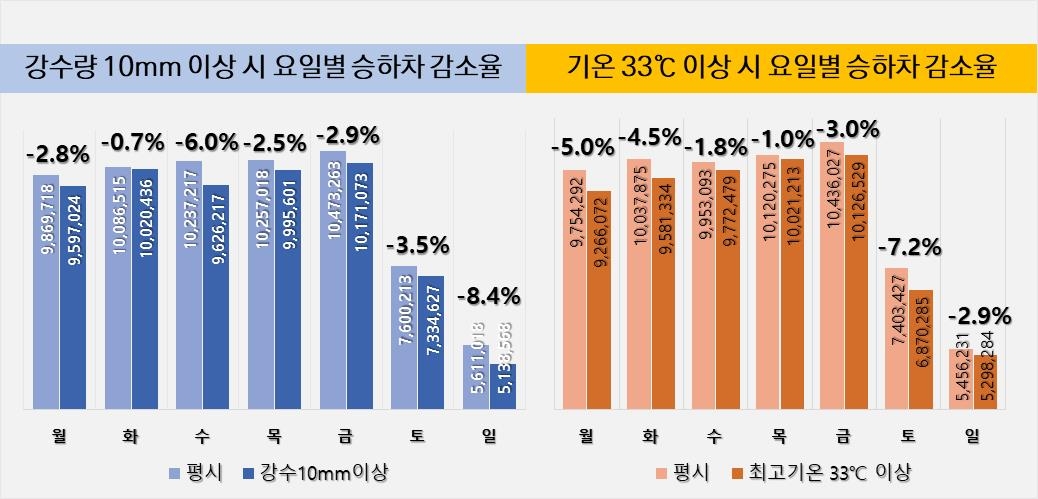
Breaking the data down by day of the week, Sunday saw the steepest drop on rainy days — down 8.4 percent from the baseline — followed by Wednesday at 6.0 percent. On extreme heat days, Saturday recorded the largest decline at 7.2 percent, with Monday and Tuesday falling 5.0 percent and 4.5 percent, respectively.
Seoul Metro attributed the sharper weekend declines to the nature of weekend travel. Because weekday trips are dominated by commuting, leisure and outdoor activities — which make up a larger share of weekend travel — are more sensitive to adverse weather.
The analysis drew on 2025 subway ridership data. Rainy days were defined as those with total daily precipitation of 10mm or more, while heat wave days were defined as days between June and September when the daily high reached 33 degrees Celsius or above.
"Ahead of the full summer season, our analysis of how rain and extreme heat affect subway use shows that weather conditions have a significant influence on how residents travel," said Ma Hae-geun, head of Seoul Metro's operations division. "We will continue to use a wide range of data to analyze travel patterns and improve the transportation services we provide to the public."
seouldream01@heraldcorp.com