Press briefing held to mark second anniversary in office
Agency deems standalone 'law distortion' cases unsuitable for investigation
Chief calls for revision of CIO Act to address staffing and structural shortfalls
By Choi Eui-jong, The Herald Business
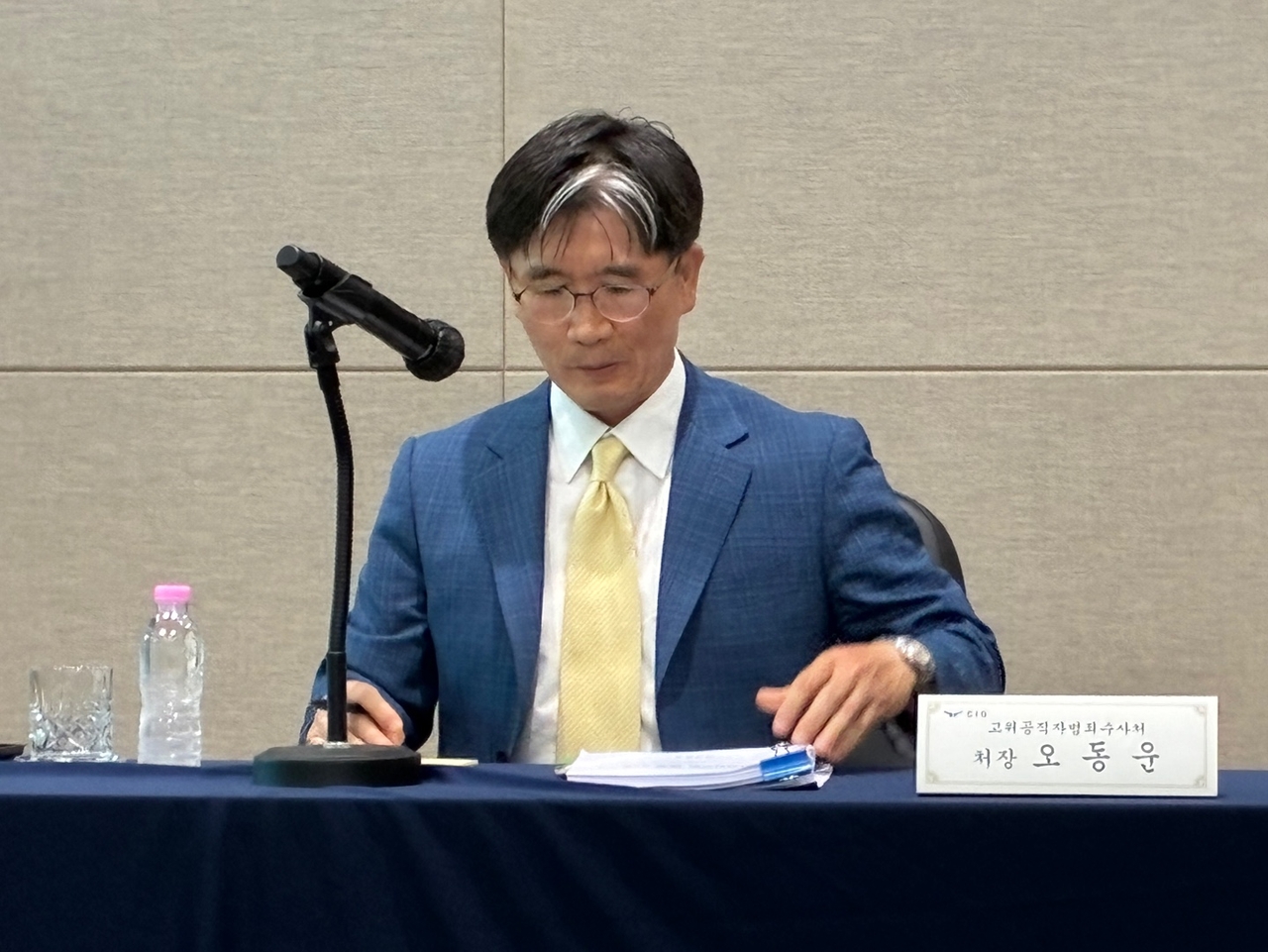
Oh Dong-woon, chief of the Corruption Investigation Office for High-ranking Officials (CIO), said Monday that political appointees at the National Election Commission fall within the agency's investigative jurisdiction and that it is reviewing whether criminal charges can be established in connection with the ballot paper shortage that emerged during the June 3 local elections.
Speaking at a press briefing at the CIO's office in Gwacheon, Gyeonggi Province, to mark his second anniversary in office, Oh said the agency is monitoring the joint investigation task force's probe into the ballot shortage and has received its own case filings on the matter. "NEC political appointees are subject to our investigation, so we are carefully reviewing whether criminal involvement and liability can be established," he said. He added that the agency is focusing on whether any problems arose in how administrative directives were carried out.
Oh also said the CIO has decided to refer to police cases filed solely under the criminal law provision on "law distortion," citing uncertainty over whether the agency holds investigative jurisdiction over such standalone cases. However, he said the CIO can investigate cases in which law distortion charges are combined with allegations of abuse of authority or dereliction of duty.
The law distortion provision took effect in March following a revision to the Criminal Act, making it a criminal offense for judges, prosecutors and others involved in investigations or trials to deliberately misapply the law — despite knowing the applicable legal standards — in a way that influences outcomes. According to the CIO, of the 69 cases filed under the provision as of Monday, 50 involved subjects over whom the agency holds indictment authority and 19 involved those over whom it does not. Of the total, 10 have been referred to other agencies and 10 have been decided against indictment.
The CIO also referred to the Korean National Police Agency's National Investigation Headquarters the case against Supreme Court Chief Justice Jo Hee-de, who was reported to prosecutors in connection with the Supreme Court's en banc ruling that overturned and remanded the conviction of President Lee Jae Myung on charges of violating the Public Official Election Act. Oh said the agency forwarded the case rather than dismissing it outright because it found grounds for investigation.
With the prosecution service set to be abolished in October and replaced by a new serious crimes investigation agency and a separate public prosecution office, Oh said in his opening remarks that the CIO would serve as a stabilizing force during the transformation of the justice system. "Some ask whether the CIO's role will be diminished once the new agency is established, but no other investigative body will hold indictment authority," he said. "We will strive to be an agency that fulfills its critical mission."
While the new agencies are being established on the principle of separating investigation from prosecution, the CIO holds both powers. Oh said the agency would honor its founding purpose as a politically neutral body and work to keep a check on those in power.
The CIO, which launched in 2021, continues to face criticism — particularly from the legal community — over what critics describe as a lack of competence. A recurring concern is that the agency has repeatedly failed to clear even the minimum threshold of persuasion needed to secure detention warrants in major cases.
The CIO sought warrants in two cases in 2021 and three in 2023, all of which were rejected. Of two sought in 2024, only the warrant for former Defense Intelligence Command chief Moon Sang-ho was granted. Last year, only the arrest warrant for former President Yoon Suk Yeol in connection with the Dec. 3 emergency martial law declaration was approved. In March, warrants for a senior judge surnamed A and a lawyer surnamed B — both suspected of trading rulings for money through a high school alumni network — were also rejected.
More recently, the agency drew scrutiny over a failure to maintain a prosecution. In a bribery case involving a senior police official who was indicted in April 2024 and convicted at trial, the CIO neither submitted a written opinion nor sent a prosecutor to a bail hearing for businessman Kim, who faced charges of offering the bribe, during the appeal. The court released Kim last month.
Oh said he had ordered an internal review of the administrative lapse. "We will make sure this does not happen again and will pursue perfection in both investigation and prosecution work," he said.
Oh said the CIO Act must be revised to put the agency on a sound footing. In his opening remarks, he said: "Amending the law to overcome our staffing limitations and structural weaknesses is not about expanding our authority — it is an urgent appeal to sharpen the blade aimed at serious wrongdoing."
"The CIO Act is unique to South Korea, and as a newly created law it has gaps," Oh said. "There are friction points between CIO prosecutors and regular prosecutors, and cases are being delayed as a result. Swift supplementation and legislation are needed."
Oh, a former judge, took office on May 21, 2024, during the Yoon Suk Yeol administration as the CIO's second chief, succeeding founding chief Kim Jin-wook. His term runs through May 2027.
bell@heraldcorp.com