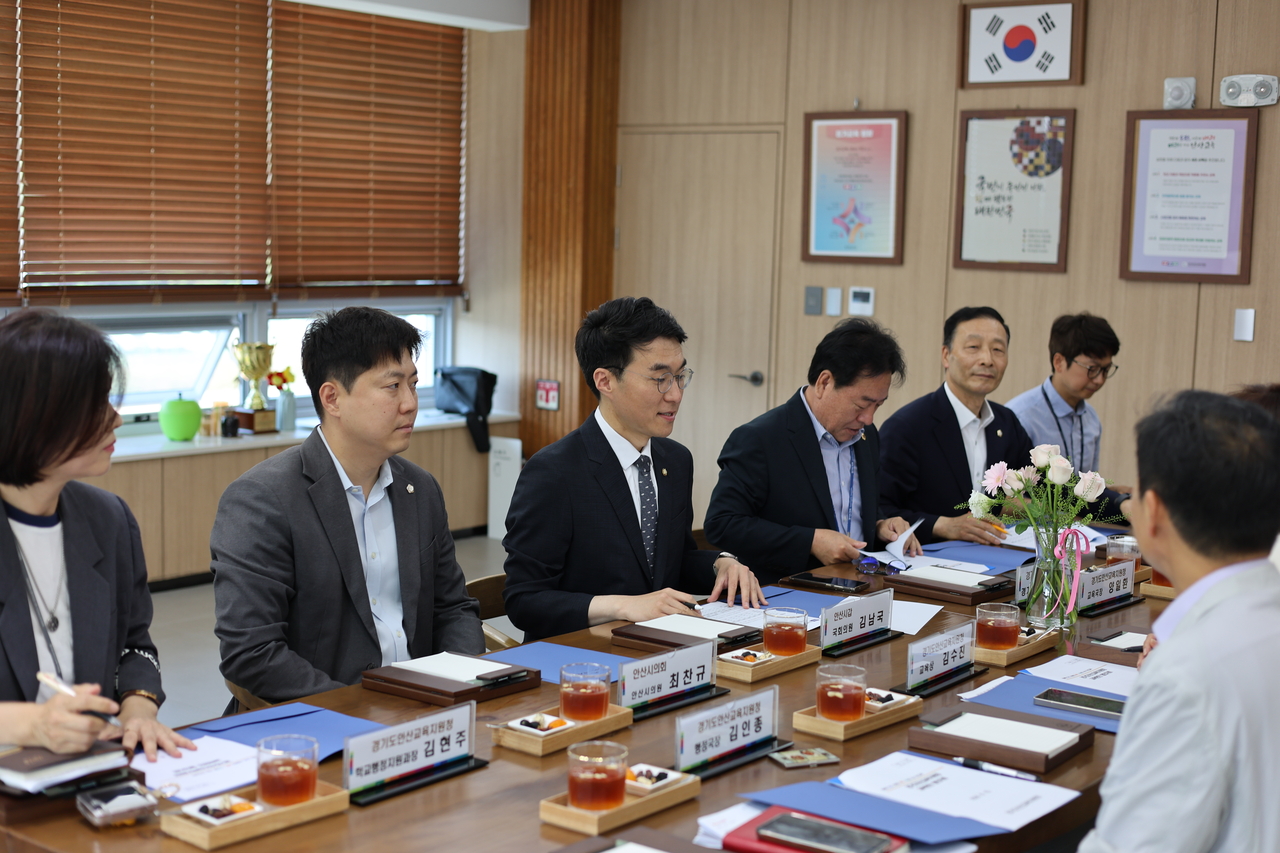
Kim Nam-kuk, a Democratic Party of Korea lawmaker representing Ansan-gap in Gyeonggi Province, visited the Ansan District Office of Education on Monday and held a meeting on two of the area's most pressing education issues: confirming the nullification of a proposed Hwaseong-Ansan school district merger and finding ways to address enrollment imbalances at schools in the Ansan Lake school zone, including Haesol Elementary School and Haeyang Middle School, his office said.
According to Kim, the meeting was convened to carefully address the conflicting concerns and complaints of parents across local schools and to identify practical solutions that would both protect students' right to attend their preferred schools and preserve the existing educational environment.
At the meeting, Kim reconfirmed that the proposed Ansan-Hwaseong school district merger — raised in response to overcrowding at a middle school in neighboring Hwaseong — had been formally closed after the Ansan District Office of Education officially notified the Hwaseong Office of Education that it could not accept the proposal.
Discussion then turned to the problem of Haesol Elementary School graduates exceeding the enrollment capacity at Haesol Middle School. Graduates of Haesol Elementary strongly prefer to continue to the nearby middle school, but the school can accommodate roughly 50 fewer students than are seeking admission, making it urgent to secure a place for those students.
Kim proposed that simply adding classrooms to the existing school was not enough and that a more fundamental solution was needed. "One alternative to easing overcrowding could be to let each school develop its own distinct strengths — Haesol Middle School's advantage of being close by, and Haeyang Middle School's advantage of offering specialized education in a less crowded setting — so that the two schools build differentiated appeal," he said.
Kim also called for a close review of plans to build a new high school in the Haeyang-dong area. The Ansan Office of Education said declining population currently left insufficient demand for a new public high school, but that large-scale development bringing in new residents and students could change that. Kim said the designation of Ansan as a free economic zone and the prospect of attracting major companies would drive population growth and increase demand for schools. He urged the office to proactively explore establishing a specialized high school suited to the character of a free economic zone — such as an AI-focused high school.
Kim also reviewed support measures for multicultural students enrolled at Seokho Middle School and other schools. He noted that while multicultural students struggle in class due to language barriers, there are also complaints from Korean students who feel disadvantaged when lessons are structured around those students. "Systematic support at the national level is needed so that all students can learn together harmoniously," he said.
He added that local governments and district education offices alone may face limits in quickly resolving budget and interagency coordination issues. "Drawing on the expertise and networks I built as a member of the National Assembly's Education Committee, I will communicate directly with the Gyeonggi Provincial Office of Education and the Ministry of Education to make sure these cooperative solutions move forward without a hitch," he said.
"Above all, the voices of residents and parents must come first," Kim said. "Ansan city, the education office and the Assembly member will form a strong team and work together for the long-term future of education in Ansan."
Kim returned to the National Assembly as a two-term lawmaker after winning the Ansan-gap by-election held alongside the June 3 local elections.
bigroot@heraldcorp.com