
Hypercar debut proves global competitiveness
Team crosses finish line 13th in world-class endurance race
Covers 5,068 km at average speed of 220.59 km/h
Car enters race 500 days after Euisun Chung's decision
Race driving data to serve as asset for production vehicle development
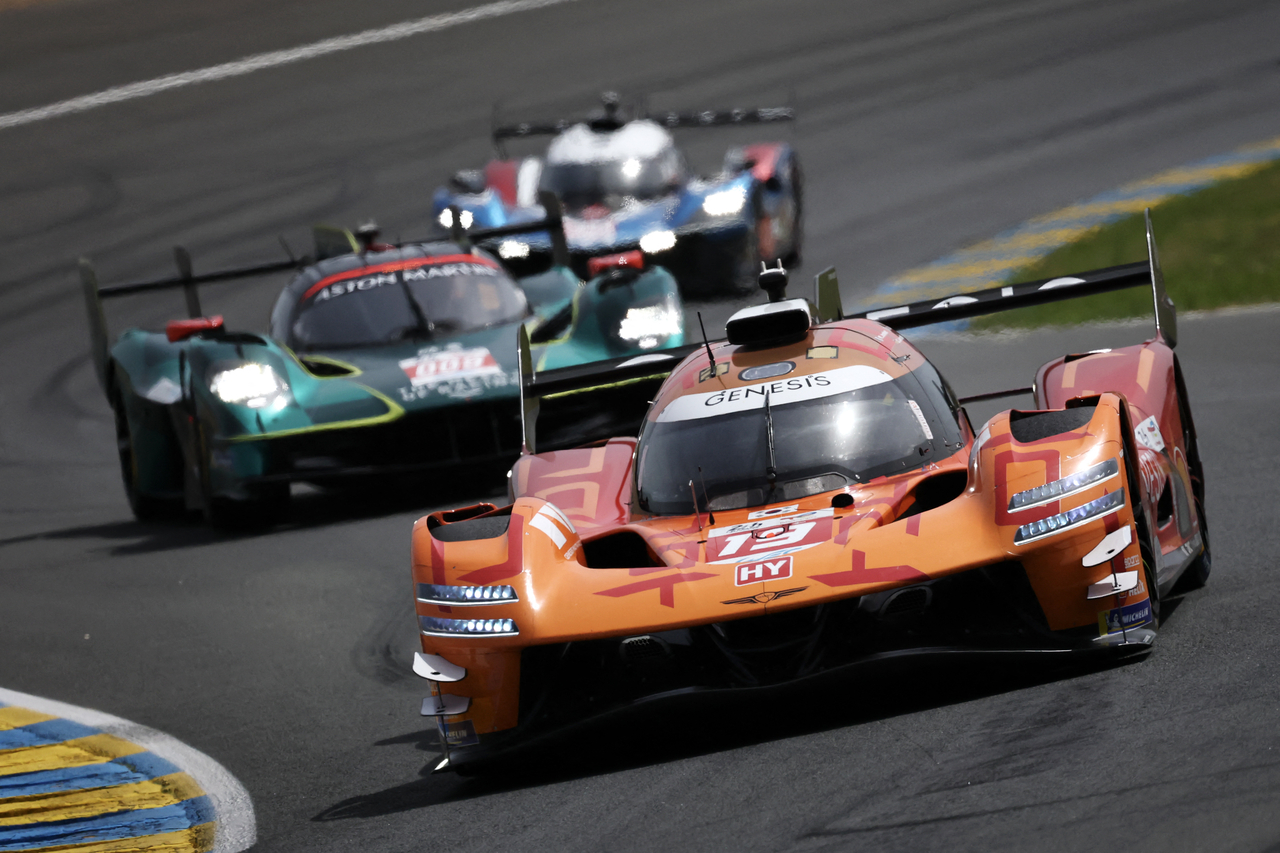
![Genesis Magma Racing's No. 19 GMR-001 hypercar races at the Circuit de la Sarthe in Le Mans, France, during the 24 Hours of Le Mans on Saturday. Below, the car pulls into the pit lane for servicing and refueling. [Reuters·AFP]](https://wimg.heraldcorp.com/news/cms/2026/06/15/rcv.YNA.20260614.PAF20260614209701009_P1.jpg)
Genesis, the luxury brand of Hyundai Motor Group, has set a new milestone in Korean motorsport history by completing its debut race in the Hypercar class at the 24 Hours of Le Mans — the world's most prestigious endurance race. The achievement came on the brand's first outing alongside global manufacturers with decades of racing experience.
Genesis Magma Racing, the brand's official motorsport team, made its Hypercar class debut at the 94th 24 Hours of Le Mans at the Circuit de la Sarthe in Le Mans, France, on Saturday and Sunday, successfully bringing its No. 19 GMR-001 hypercar across the finish line.
The No. 19 car completed 372 laps to finish 13th overall, covering more than 5,068 km over 24 hours and four minutes at an average speed of 220.59 km/h. Its best lap, set on lap 297, was 3 minutes and 27.64 seconds.
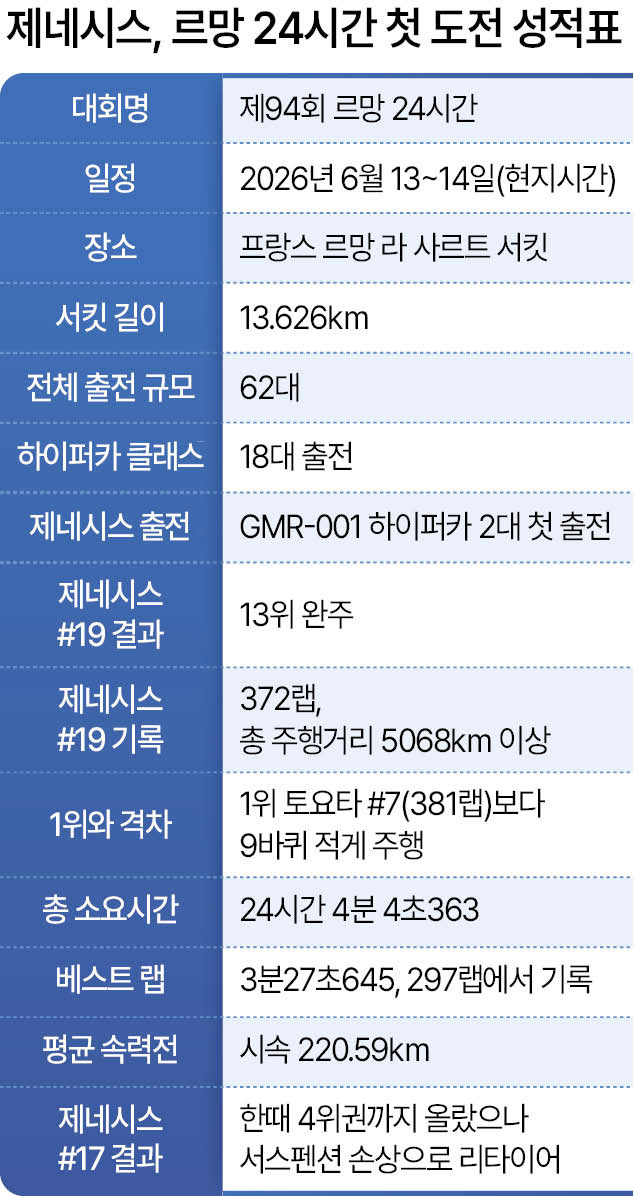
This year's Le Mans drew a total of 62 entries. The top-tier Hypercar class, in which Genesis competed, had 18 cars. Of those, only 14 finished — four retired mid-race: the No. 50 Ferrari, No. 15 BMW, No. 17 Genesis and No. 38 Cadillac.
Genesis's finish drew particular attention given the high barriers to entry in the Hypercar class. The 24 Hours of Le Mans is not simply a test of outright speed — car performance and durability, driver stamina, pit strategy, team management and the ability to respond to unexpected situations are all put to the test. Covering more than 5,000 km without pause over 24 hours means finishing the race is itself considered an achievement and a symbol of technical capability. That is why spectators applauded the drivers and teams who endured the grueling run after the race concluded.
Recent Hypercar class debutants have struggled. BMW returned to the class in 2024 with two cars and both retired. French brand Alpine also entered two cars in its debut that same year, and both were eliminated due to engine problems. First-time finishes are genuinely rare for new entrants.
Genesis, too, did not have a straightforward race. The No. 17 car climbed as high as fourth place midway through, demonstrating strong competitiveness. In Hyperpole qualifying, the No. 19 car placed sixth and the No. 17 ninth, putting both cars inside the top 10.
The No. 17 car, however, was involved in an accident with roughly seven and a half hours remaining. It struck a curb hard while exiting a corner, damaging the suspension, and ultimately retired. The setback was particularly disappointing for the team, as the car had maintained a stable pace and been in contention near the front since early in the race.
The No. 19 car, by contrast, overcame its own crisis to survive to the end. A system fault brought the car to a halt on track, but the driver manually restarted the system and returned to racing. The team then guided the car to the finish through precise pit strategy and steady management.
Industry observers have credited the result to a decisive call by Hyundai Motor Group Chairman Euisun Chung. Motorsport demands enormous development and logistics costs — Volkswagen shuttered its motorsport division in 2020 and withdrew from related activities entirely.
![Hyundai Motor Group Chairman Euisun Chung (right) and Luc Donckerwolke, the group's Chief Design Officer and Chief Creative Officer, tour the Genesis booth in the manufacturer's village at the Circuit de la Sarthe in Le Mans, France, on Saturday. [Joint press corps]](https://wimg.heraldcorp.com/news/cms/2026/06/15/news-p.v1.20260614.ff2e1d92135241549c979283247b964b_P1.jpg)
Chung visited Le Mans in person for the first time this year, encouraging drivers and engineers and watching the race firsthand. His presence underscored a symbolic moment for Genesis as it moves beyond its identity as a luxury brand toward becoming a high-performance one.
Genesis's Le Mans campaign was backed by long-term group-level investment and strategic commitment — not a marketing exercise. The brand reached the Hypercar class starting grid roughly 500 days after the decision to enter motorsport was made.
Luc Donckerwolke, Hyundai Motor Group's Chief Design Officer and Chief Creative Officer, said last year that he had proposed bringing Genesis into motorsport to senior management and received a "let's do it" response within just three days.
The finish carries significance beyond the result alone. A Hyundai Motorsport official said the hypercar is fitted with hundreds of sensors that accumulate 200 to 300 gigabytes of driving data per race, adding that the data would be used by Hyundai Motor's Namyang R&D Center and its AVP division to develop high-performance production vehicles.
The 24 Hours of Le Mans is not a stage where competitiveness is established with a single finish — it demands year-on-year improvements to the car, increasingly refined team operations, and continuous work on driver lineups and race strategy. Developing Korean drivers, competing consistently near the front of the Hypercar class, and building a track record of repeated finishes remain the challenges ahead for Genesis.
Genesis Magma Racing Team Principal Cyril Abiteboul thanked the team and engineers "for achieving a finish on the unforgiving stage of the 24 Hours of Le Mans," adding that while the No. 17 car did not cross the finish line, "it showed strong potential throughout the first half of the race." Genesis's next challenge is the WEC São Paulo 6 Hours in Brazil, scheduled for July 10-12. Building on the experience gained at Le Mans, the brand's high-performance motorsport campaign is now moving into its next phase in earnest.
Meanwhile, overall victory went to the No. 7 Toyota Gazoo Racing car, which completed 381 laps — nine more than Genesis. The No. 20 BMW M Team WRT car finished second and the No. 8 Toyota third, giving Toyota two cars on the podium.
The win marked Toyota's return to the top of Le Mans for the first time in four years. After claiming five consecutive victories from 2018 through 2022, Toyota had ceded three straight titles to Ferrari before reclaiming the trophy this year.
kwater@heraldcorp.com





