Korean space ETF investors thrown into confusion as fund managers miss out on IPO allocation, forced to buy shares at a 20% premium to the offering price; ACE and KODEX ETFs hold roughly 25% SpaceX weighting; six domestic ETFs fell on the first day of listing
![An advertisement for SpaceX-related exchange-traded funds plays on an elevator monitor in a Seoul apartment building on June 14, after Mirae Asset Securities — the domestic underwriter for the US space company's IPO — received no share allocation in the final distribution. [Yonhap]](https://wimg.heraldcorp.com/news/cms/2026/06/15/rcv.YNA.20260614.PYH2026061403480001300_P1.jpg)
SpaceX made a splashy stock market debut, but Korean asset managers who had planned to load the stock into their ETFs at the IPO price were left scrambling. Mirae Asset Securities, which participated in the domestic underwriting syndicate, received no shares in the final allocation, forcing fund managers to buy SpaceX on the open market instead. The pivot came at a cost: with the stock trading nearly 20% above its offering price, the higher entry point has weighed on potential returns.
Space and aerospace ETFs with SpaceX exposure opened Monday's session in the red. As of 10 a.m., KODEX US Space & Aerospace had fallen 9.36% and ACE US Space Tech Active was down 12.03%. TIME Global Space Tech & Defense Active also slipped 1.74%.
Returns diverged, however, depending on each fund's SpaceX weighting and investment strategy. TIGER Global AI Active gained 6.84%, TIME US Nasdaq 100 Active rose 4.29%, and TIME Global AI Active advanced 4.88%.
Market participants attributed the performance gap to differences in how much SpaceX each fund holds and when shares were purchased.
Korean asset managers had originally planned to secure SpaceX IPO shares through Mirae Asset Securities and fold them directly into their ETFs. That plan collapsed when Goldman Sachs, the lead bookrunner, declined to allocate any shares to the domestic underwriting syndicate in the final distribution.
Korea Investment Management was hit hardest. The firm had sought SpaceX IPO shares for its ACE US Space Tech Active ETF and its Korea Investment Global Space Technology & Defense Fund, but received nothing. It ultimately bought shares on the open market on the first day of trading.
"We confirmed that no shares were allocated from our IPO participation and responded by purchasing SpaceX in the market to include it in the ETF," Korea Investment Management said. "Given how high investor expectations were, we are deeply sorry to deliver the news of the failed allocation."
Mirae Asset Global Investments also revised its approach. The firm had considered adding SpaceX to its TIGER US Space Tech ETF on listing day under the fast-entry regime for newly listed stocks, but ultimately decided against it, opting instead to include the stock two trading days after listing as originally planned.
Timefolio Asset Management took a different route, buying SpaceX on the open market on listing day and adding it to three funds: TIME Global Space Tech & Defense Active ETF, TIME US Nasdaq 100 Active ETF, and TIME Global AI Active ETF. The firm said it had chosen the open-market strategy in advance, anticipating uncertainty around IPO allocation.
"We managed the risk of portfolio composition data distortion from speculative allocation estimates while simultaneously building a SpaceX position in the market," said Kim Nam-ho, head of ETF management at Timefolio Asset Management.
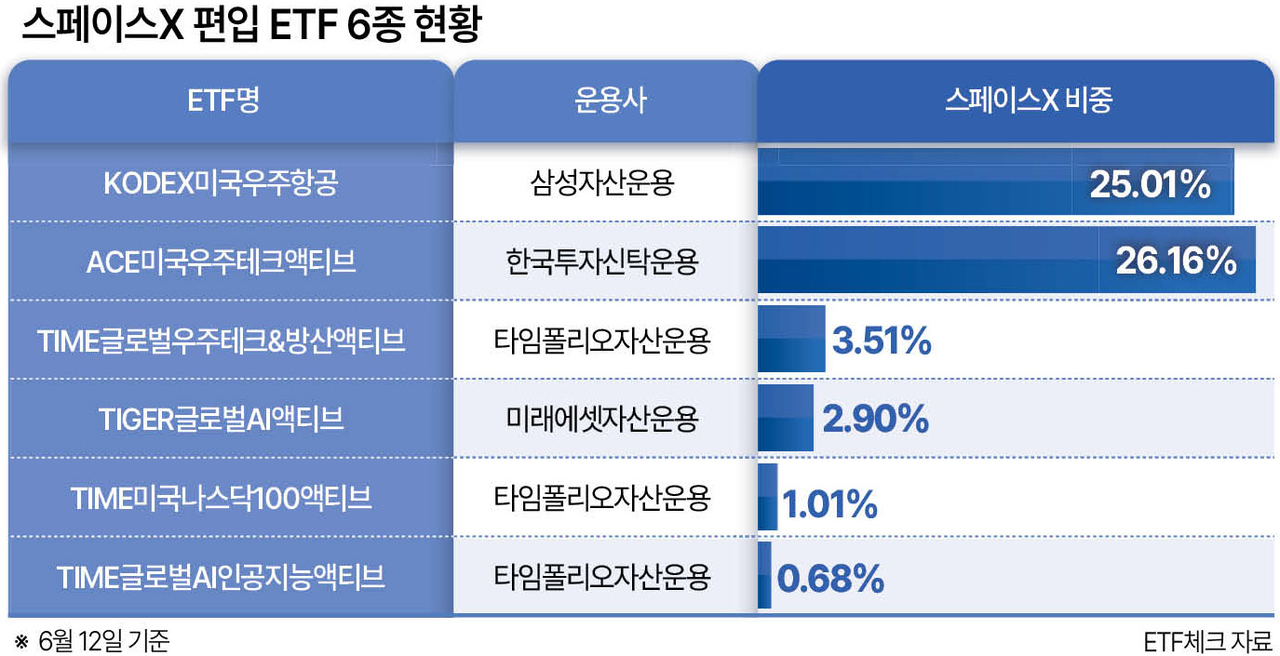
According to ETF Check, six domestic ETFs now hold SpaceX. Korea Investment Management's ACE US Space Tech Active ETF carries the largest weighting at 26.16%, while Samsung Asset Management's KODEX US Space & Aerospace ETF holds SpaceX at a 25.01% weighting.
Timefolio's TIME Global Space Tech & Defense Active ETF holds a 3.51% weighting, and Mirae Asset Global Investments' TIGER Global AI Active ETF holds 2.90%. TIME US Nasdaq 100 Active ETF and TIME Global AI Active ETF hold SpaceX at 1.01% and 0.68%, respectively.
The core problem is that most managers ended up buying SpaceX at market prices rather than the IPO price. SpaceX closed its first day on the Nasdaq on June 12 at $160.95, up 19.22% from its offering price of $135, after surging as high as $176.52 during the session. Fund managers who failed to secure IPO shares had no choice but to buy in after the stock had already spiked.
Market participants say the two variables that will most determine each ETF's future performance are SpaceX's weighting in the portfolio and the actual purchase price. Even funds holding the same stock can produce meaningfully different returns depending on when and at what price shares were acquired.
The fallout continues to ripple through the market. Deposits from domestic professional investors who had applied for IPO shares were refunded in full, and the Financial Supervisory Service has launched an inquiry into the circumstances. Legal disputes are considered unlikely given that the prospectus disclosed the possibility of non-allocation, but the successive strategy reversals by fund managers caused considerable confusion among investors.
Competition among asset managers to gain SpaceX exposure is not letting up. Kiwoom Investment Asset Management plans to list its KIWOOM US Space Data Center Infrastructure ETF on the Korea Exchange on Tuesday. The product is designed to hold SpaceX at up to a 25% weighting from launch, investing in space launch vehicle companies and data center infrastructure firms.
Industry insiders caution that the wave of investor attention drawn by SpaceX's listing could amplify short-term volatility in related ETFs. "SpaceX's listing has concentrated investor attention on the sector, but that does not translate directly into improved earnings across the broader space industry," an official at one asset management firm said. "For stocks where expectations are already priced in, volatility could actually increase."
hajun825@heraldcorp.com