Home mortgage rates hit 7% range, squeezing borrowers
Fixed-rate mortgages seen breaking 8% threshold
Middle East tensions and loan volume caps drive increases
Variable-rate borrowers also face sharp rise in monthly payments
A salaried worker surnamed Park began shopping for a bank mortgage in April to buy a home. At the time, borrowing 300 million won ($194,000) at an annual rate of 6 percent on a 30-year equal-installment repayment plan would have meant monthly payments of about 1.8 million won. But as market rates climbed amid the Middle East conflict, Park decided to wait, hoping conditions would stabilize.
More than a month later, rates have barely moved — and have in fact risen further. Stalled end-of-war negotiations and tightened government household loan regulations have pushed mortgage rates to around 7 percent annually. Under the same borrowing terms, monthly payments would now run about 2 million won. With the Bank of Korea also weighing a benchmark interest rate hike, some analysts say rates could breach 8 percent. Park is now wrestling with whether to take out the loan before conditions worsen.
A borrower surnamed Kim took out a 300 million won variable-rate mortgage at 5 percent annually when buying a home late last year, paying about 1.6 million won a month on a 30-year equal-installment plan. Kim recently received notice from the bank that monthly payments would rise to about 1.8 million won, as the applied rate climbed to 6 percent on the back of rising market rates. Should the variable rate reach 7 percent following a benchmark rate hike, monthly payments could climb to around 2 million won — a prospect Kim finds deeply worrying.
Bank lending rates are rising quickly as inflationary pressure from the prolonged Middle East conflict collides with stricter government caps on household loan volumes. If a rate hike in the second half of the year materializes, fixed-rate mortgage rates — currently in the mid-7 percent range — could exceed 8 percent annually, analysts say.
According to financial industry sources Tuesday, KB Kookmin Bank raised variable rates on its non-face-to-face mortgage products by 0.20 percentage points on Monday. The bank said the move was "a measure to maintain an appropriate portfolio." NH NongHyup Bank had already raised both fixed and variable mortgage rates by 0.20 percentage points each on June 1.
The rate increases are largely attributed to tightened household loan volume regulations imposed by financial authorities.
Regulators lowered the target growth rate for household loans across the financial sector to 1.5 percent this year, down from 1.7 percent last year. Some mutual finance cooperatives and savings banks that exceeded last year's targets were effectively barred from growing their loan balances at all this year — a so-called "zero net increase" penalty. With banks also facing reduced lending capacity, demand spilling over from second-tier lenders has prompted them to preemptively raise their lending thresholds.
Data submitted to the office of Democratic Party of Korea lawmaker Lee In-young by the Financial Supervisory Service showed that outstanding mortgage balances at the five major banks — KB, Shinhan, Hana, Woori and NH NongHyup — fell by between 344.7 billion won and 1.6143 trillion won each compared with the end of last year, as of the end of the first quarter. However, a renewed stock market rally in May drove credit loan balances up by around 2 trillion won, signaling that demand pressures remain.
Other banks are expected to follow with rate increases of their own. When one bank raises its lending rate, borrowers tend to flock to rivals offering lower rates. "Some banks still have room within their loan volume caps, but they have no choice but to adjust rates to prevent demand from concentrating at specific institutions," an official at a major commercial bank said.
With geopolitical uncertainty in the Middle East pushing up market rates and household loan regulations adding further pressure, the upward trend in lending rates is expected to steepen.
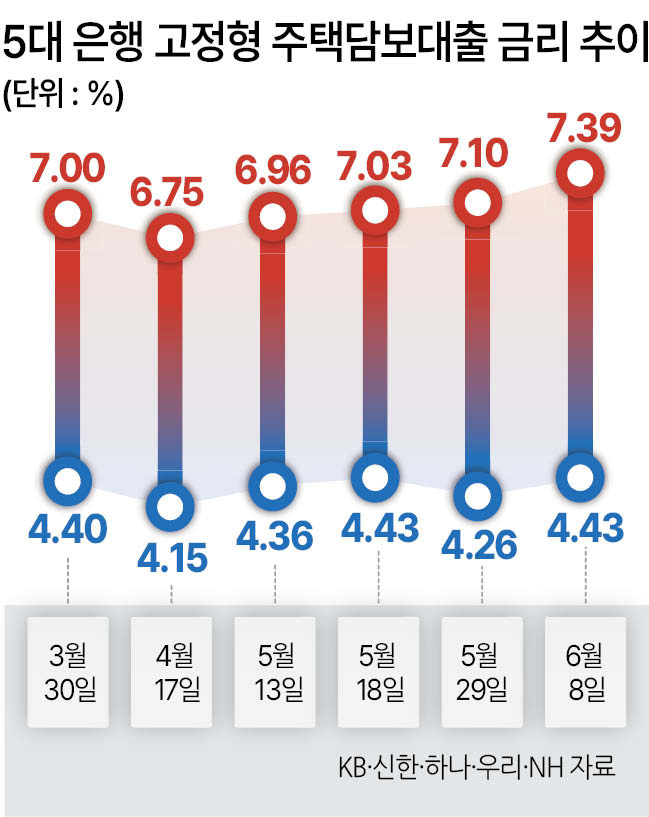
As of Monday, fixed-rate mortgage rates at the five major banks ranged from 4.43 to 7.39 percent annually — up 0.17 percentage points at the lower end and 0.29 percentage points at the upper end compared with May 29, when the range was 4.26 to 7.10 percent. Fixed mortgage rates have risen consistently since hitting a low of 4.15 to 6.75 percent on April 17. If the Bank of Korea raises its benchmark rate in July, the upper end could exceed 8 percent annually.
According to the Korea Financial Investment Association's bond information center, the yield on five-year bank bonds — the benchmark for fixed-rate mortgages — stood at 4.473 percent annually, the highest level in about two years and seven months since Nov. 13, 2023, when it reached 4.489 percent.
Prospective homebuyers taking out new loans face a growing dilemma. Borrowing 300 million won at 5 percent annually on a 30-year equal-installment plan requires monthly payments of about 1.61 million won; if rates rise to 8 percent, that figure swells to 2.2 million won.
Variable-rate borrowers are also facing higher interest costs. As of Monday, variable-rate mortgage rates at the five major banks — based on the new COFIX — ranged from 3.96 to 6.23 percent annually, with the upper end up about 0.40 percentage points from the 3.70 to 5.87 percent range recorded on Dec. 31 last year.
A borrower who took out a 300 million won loan at the end of last year at 5.87 percent annually on a 30-year equal-installment plan will see monthly payments rise from 1.775 million won to 1.846 million won once the 6.23 percent rate is applied. If the variable rate reaches 7 percent following a benchmark rate hike, monthly payments would hit 2 million won.
Access to credit at second-tier lenders — a key source of financing for lower-income households — is also expected to tighten. The yield on three-year credit card company bonds, which serve as the benchmark for card loans, stood at 4.441 percent annually on Monday, matching a two-and-a-half-year high alongside five-year bank bonds. "When lending rates rise, we have to be more selective about borrowers who are more likely to repay, from a risk management perspective," a second-tier financial sector official said. "Screening will inevitably become stricter."
hyuk@heraldcorp.com