Financial Services Commission forms AI Insurance Fraud Prevention Task Force; detected fraud tops 1 trillion won as total losses estimated at 9 trillion won; authorities move to tear down data barriers between public and private insurers
The government has launched a pan-agency response framework to fight AI with AI — tearing down the data barriers that have long separated public and private insurers — after reports highlighted that even insurance companies cannot detect fraudulent medical documents forged using artificial intelligence.
The Financial Services Commission held a meeting of the Insurance Investigation Council on Thursday, chaired by FSC Financial Industry Bureau Director General Kim Jin-hong, and convened the kickoff session of the AI-Based Insurance Fraud Prevention System Task Force. The Insurance Investigation Council is a consultative body established under Article 163 of the Insurance Business Act, bringing together the government and relevant agencies.
Participants included the FSC, the Korean National Police Agency, the Financial Supervisory Service, the Korea Credit Information Services, the Financial Security Institute, the Insurance Development Institute, the National Health Insurance Service, the Health Insurance Review and Assessment Service, the National Pension Service, the Korea Workers' Compensation and Welfare Service, and the life and non-life insurance industry associations.
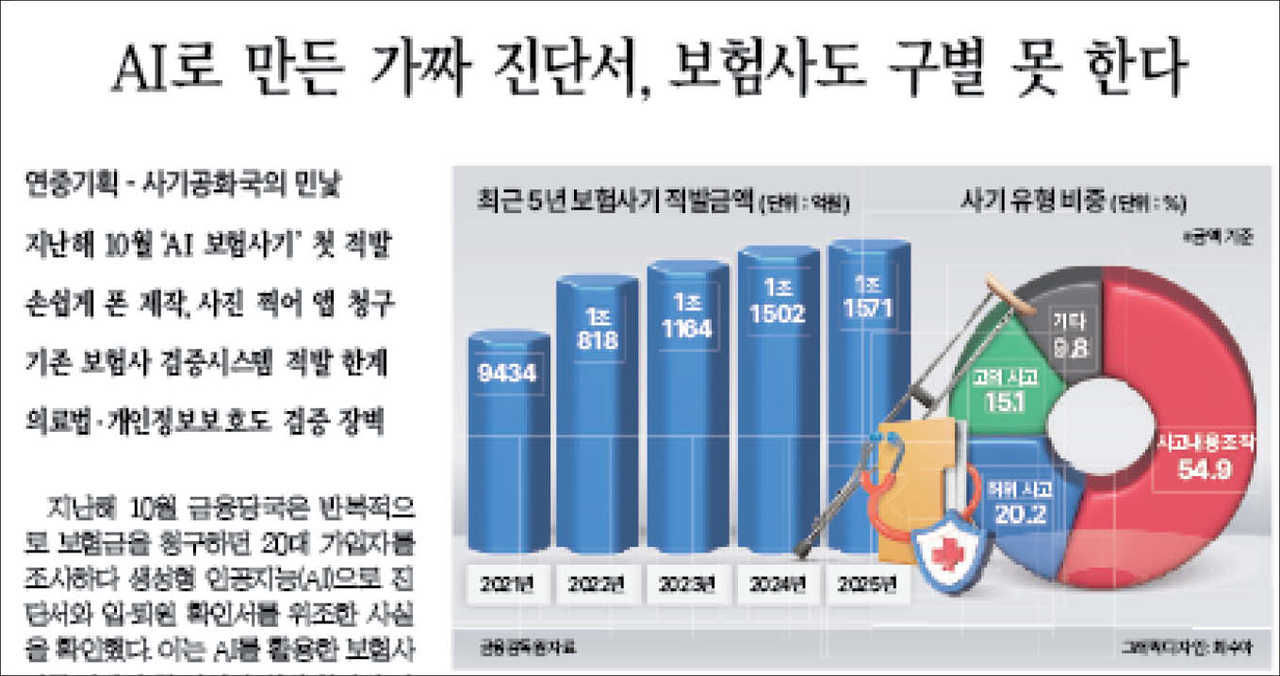
The task force was formed against a backdrop of mounting insurance fraud losses. Detected fraud reached 1.1571 trillion won (about $766 million) last year, surpassing 1 trillion won for the fourth consecutive year. When undetected fraud is factored in, total losses are estimated at around 9 trillion won — a figure derived by applying the growth rate in detected fraud over the past two years to the Insurance Research Institute's 2023 estimate of 8.2 trillion won.
The problem is that fraudsters have acquired a powerful new weapon in AI. In the past, forgeries could be caught through physical clues such as inconsistent fonts or character spacing left behind during the alteration process. Generative AI, however, reconstructs image pixels from scratch, erasing those telltale signs. Once a forged document is printed out, photographed and uploaded to a claims app, current technology offers in effect no way to detect the manipulation. Industry insiders say AI-assisted document forgery has become virtually a perfect crime. In one case, a person in their 20s from Busan began in July last year uploading genuine hospitalization and outpatient certificates to a generative AI tool, extending the recorded hospital stays, and defrauded 11 insurers of 150 million won before being sentenced to two years in prison.
The problem had long been anticipated. Quantifying the scale of AI-assisted insurance fraud is itself difficult, and the biggest obstacle has been the complete blockage of access to medical institution data. Under current medical law, patient records cannot be shared with third parties without the subject's consent, meaning that even when a suspect hospital is identified, requests for records from insurers or the FSS have routinely been refused as unlawful.
Cross-referencing treatment data held by the National Health Insurance Service and the Health Insurance Review and Assessment Service against insurance claim documents could filter out a significant share of forgeries — but that avenue has remained closed.
The barriers exist within the private sector as well. Korea Credit Information Services, the Insurance Development Institute and individual insurers each operate their own AI-based detection systems, but these run in silos with no real-time information sharing between them.
To overcome these limitations, the task force will operate through three working groups: a legislation and systems subcommittee, a data subcommittee and an infrastructure subcommittee. Through this structure, the FSC plans to upgrade Korea Credit Information Services' existing AI-based insurtech platform into an integrated fraud-prevention infrastructure for the entire insurance sector.
The FSC said the approach is to upgrade the existing platform operated by Korea Credit Information Services rather than build a new one from scratch. The task force will take a broad look at the legal basis needed to consolidate, share and use information, as well as the specific data items required and the methods for sharing them. The system is designed for use by insurers, not ordinary consumers, and protecting the rights of policyholders — including personal data privacy — is also part of the plan.
The FSC plans to run the task force for three months and release a blueprint for an AI-based insurance fraud prevention system in September, with legislative amendments and platform upgrades to follow from October.
psj@heraldcorp.com