PPP wins TK, Gyeonggi Pyeongtaek-eul; Han Dong-hoon takes Busan Buk-gu Gap
Democratic Party grows from 152 to 161 seats; PPP from 106 to 110
Pro-government bloc holds 186 seats, ruling majority intact
![Independent candidate Han Dong-hoon greets supporters at his campaign office in Buk-gu, Busan, after his victory in the constituency by-election was confirmed Thursday. [Yonhap]](https://wimg.heraldcorp.com/news/cms/2026/06/04/news-p.v1.20260604.feb319f30cf2444093798f5d8c067a7c_P1.jpg)
In Wednesday's National Assembly by-elections — covering 14 seats and widely described as a "mini general election" — the People Power Party and independent Han Dong-hoon together claimed five seats, a result analysts called a notable achievement for the opposition bloc. The Democratic Party of Korea, which had been defending 13 of the 14 constituencies, ended up losing four seats.
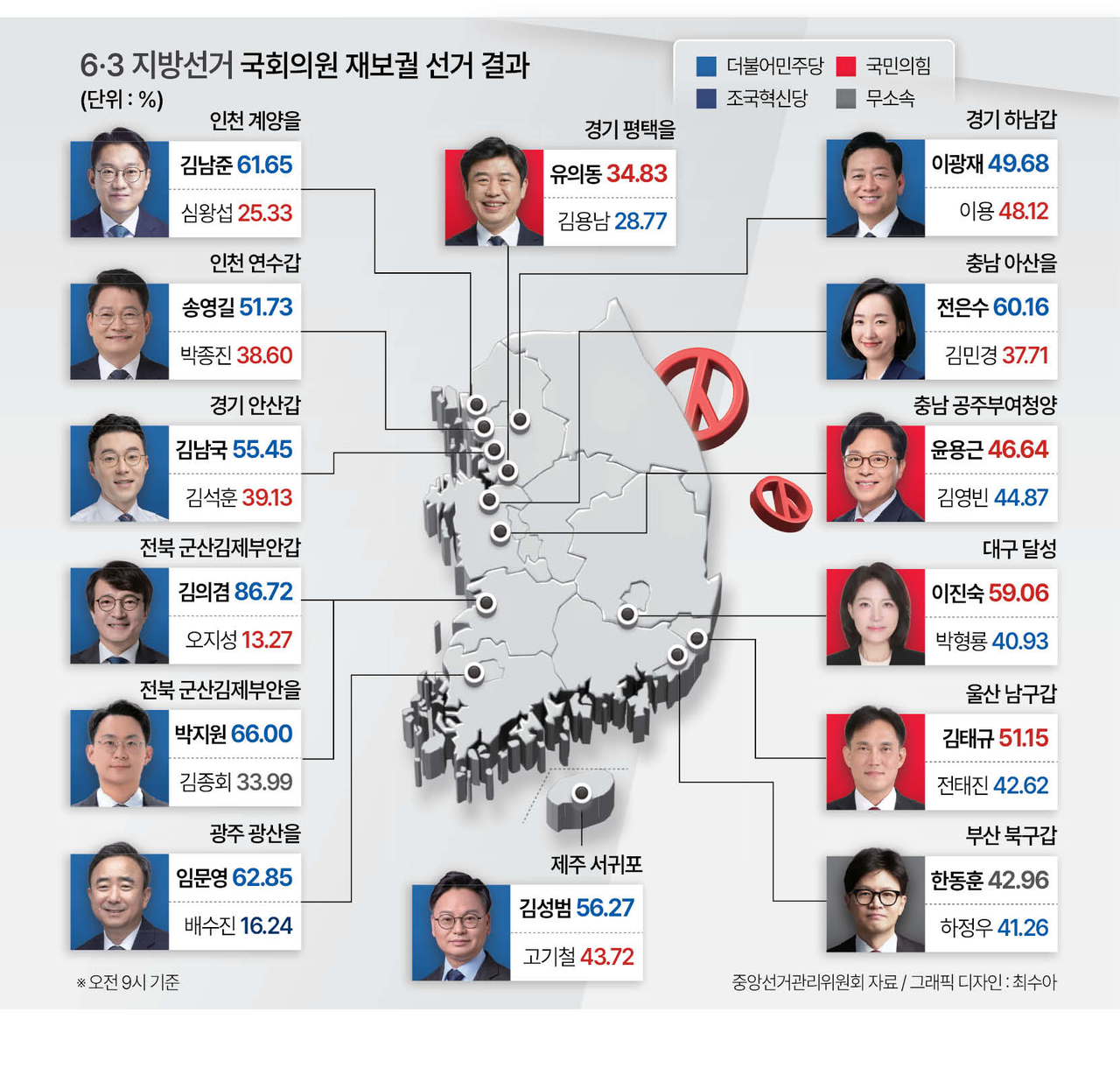
According to the National Election Commission, Democratic Party candidates won nine of the 14 districts, the People Power Party won four, and one seat went to an independent.
The most closely watched race was Busan Buk-gu Gap — the constituency vacated by Busan Mayor-elect Jeon Jae-soo of the Democratic Party — where Han won a dramatic victory over Democratic Party candidate Ha Jung-woo and People Power Party candidate Park Min-sik.
In Gyeonggi Pyeongtaek-eul, another fiercely contested metropolitan-area race triggered after former Democratic Party lawmaker Lee Byeong-jin had his election invalidated on charges of violating the Public Official Election Act, People Power Party candidate Yoo Eui-dong defeated both Democratic Party candidate Kim Yong-nam and Cho Guk Innovation Party candidate Cho Guk, demonstrating the party's resilience.
In two other districts previously held by the Democratic Party — Ulsan Nam-gu and South Chungcheong's Gongju-Buyeo-gun-Cheongyang-gun — People Power Party candidates Kim Tae-gyu and Yun Yong-geun both overcame early deficits to win come-from-behind victories. In Daegu Dalseong-gun, the seat vacated by Daegu Mayor-elect Choo Kyung-ho, People Power Party candidate Lee Jin-suk won comfortably, as widely expected.
The Democratic Party successfully defended nine seats: Incheon Yeonsu Gap (Song Yeong-gil) and Gyeyang-eul (Kim Nam-jun), Gwangju Gwangsan-eul (Im Mun-yeong), Gyeonggi Hanam Gap (Lee Gwang-jae) and Ansan Gap (Kim Nam-kuk), North Jeolla's Gunsan-Gimje-Buan Gap (Kim Eui-gyeom) and Gunsan-Gimje-Buan-eul (Park Ji-won), South Chungcheong Asan-eul (Jeon Eun-su), and Jeju Seogwipo (Kim Seong-beom).
The Hanam Gap race was among the tightest: as of 6:50 a.m. Thursday, winner Lee Gwang-jae had 49.68 percent of the vote, edging out People Power Party candidate Lee Yong at 48.12 percent by a margin of 1,385 votes.
"I will pour every drop of my sweat and passion into Hanam," Lee said in his victory remarks. "Even though I entered the race late, the warm support Hanam residents showed me is something I will never forget."
In Gyeyang-eul — known as President Lee Jae Myung's home constituency — Kim Nam-jun, one of Lee's closest allies, won with 61.65 percent of the vote, well ahead of People Power Party candidate Shim Wang-seop at 25.33 percent and independent Kim Hyeon-tae at 13.01 percent. "I will faithfully uphold President Lee Jae Myung's campaign pledges," Kim said. "I understand the weight of the mandate entrusted to me, and I will take it as a call to work with overwhelming dedication."
As a result of the by-elections, the Democratic Party's seat count rose from 152 to 161, while the People Power Party grew from 106 to 110. Counting the Reform Party's three seats and Han's seat as part of the broader opposition bloc brings that total to 114.
Although the opposition bloc's gain of four seats represents a meaningful shift, it is unlikely to significantly alter the ruling camp's dominant position in the Assembly. Parties aligned with the ruling side — including the Cho Guk Innovation Party, the Progressive Party, the Basic Income Party and the Social Democratic Party — hold a combined 18 seats, and when pro-government independents are included, the broader ruling bloc reaches 186 seats.
Under the current National Assembly Act, a bloc holding 180 seats — three-fifths of the 300-member chamber — can exercise virtually all legislative powers short of constitutional reform, presidential impeachment and expulsion of Assembly members. That threshold is also the minimum needed to designate bills as fast-track items and push through legislation over the ruling party's objections. Crossing 200 seats, or two-thirds of the chamber, would additionally enable constitutional amendments, presidential impeachment motions and the expulsion of lawmakers.
bigroot@heraldcorp.com