"When taxes are right, the nation is right."
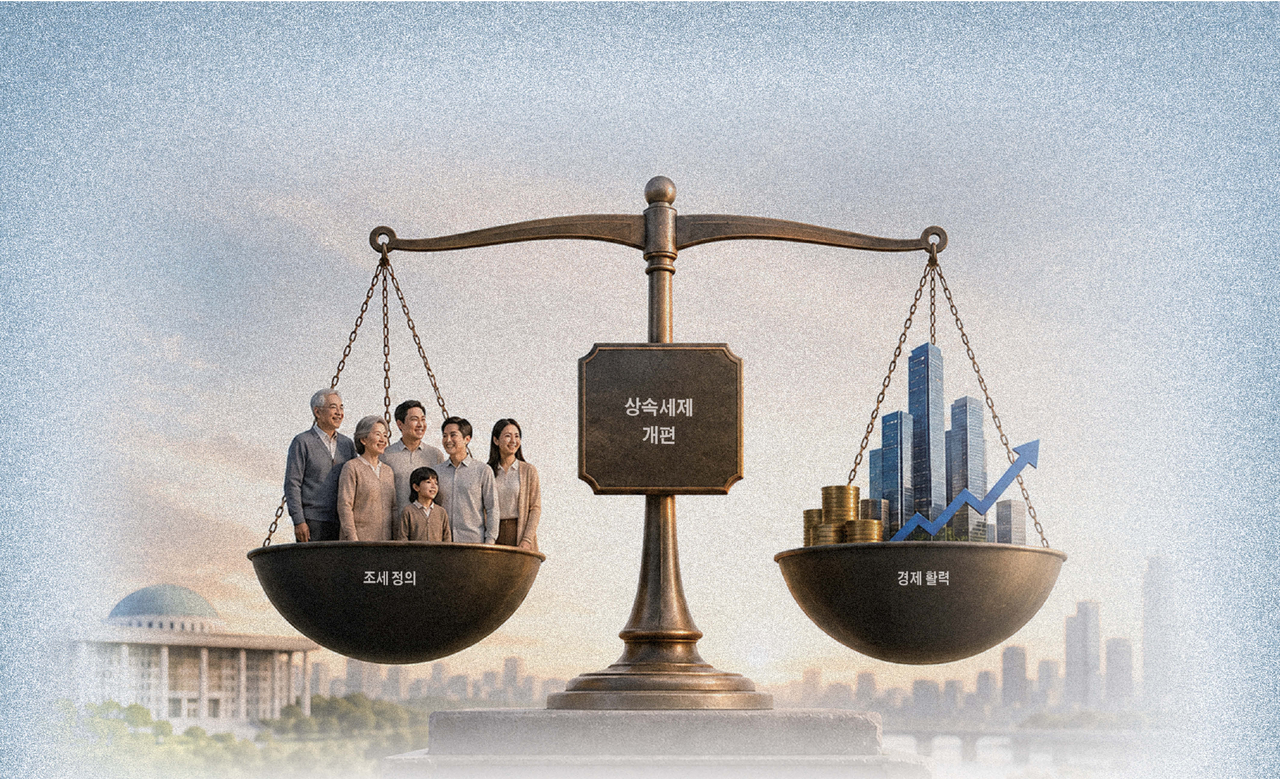
Taxation is more than a tool for funding the state. It is a measure of a civilized society — a reflection of the values a community holds and how it chooses to share its burdens. The debate over inheritance tax reform now unfolding in South Korea is not simply a question of cutting or raising taxes. It is a generational challenge: how to reconcile two core values — fiscal justice and economic vitality.
A heavy inheritance tax burden by international standards
Early this year, reports claimed that 2,400 high-net-worth individuals had left South Korea the previous year because of the inheritance tax burden, sparking public controversy. The underlying statistics were later found to be inaccurate, but the episode served as a reminder that South Korea's inheritance tax burden is high by international standards.
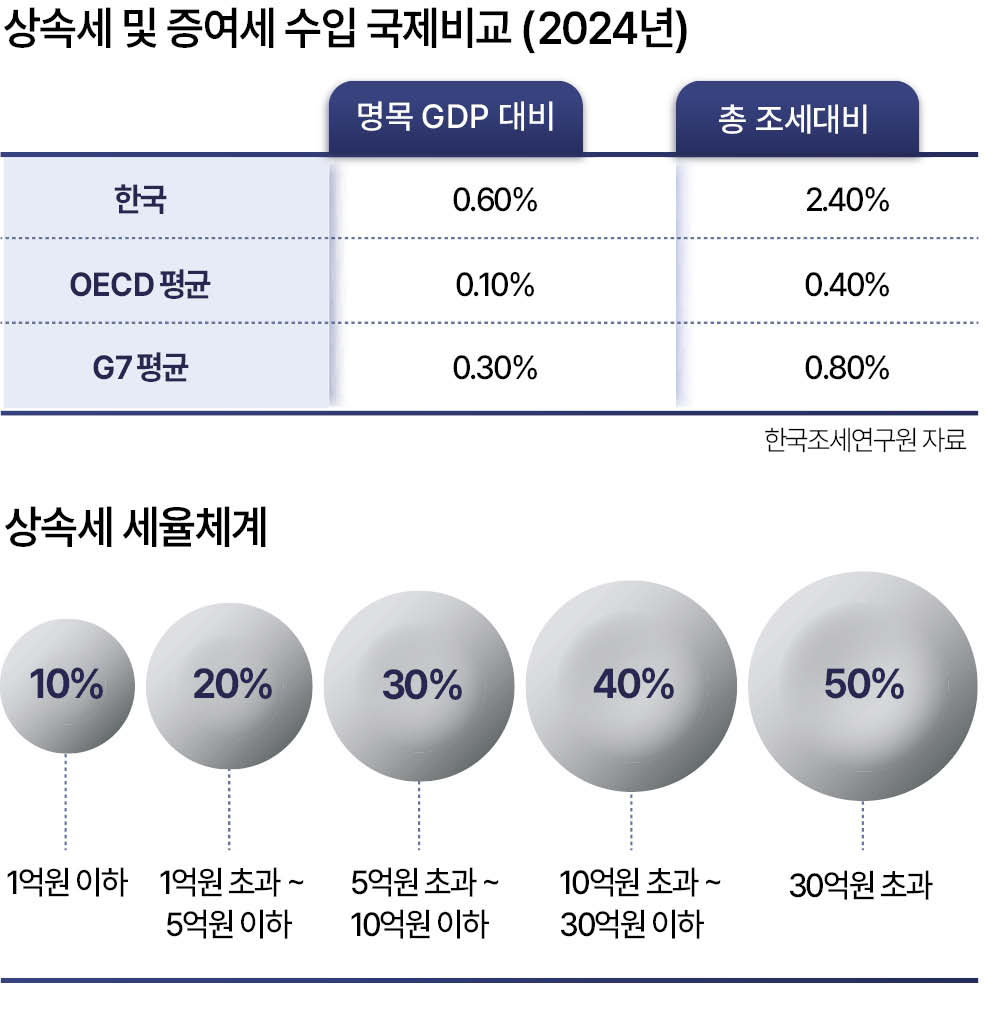
South Korea's top inheritance tax rate stands at 50 percent, the second highest among OECD members after Japan's 55 percent. France's top rate is 45 percent, while the United States and the United Kingdom both sit at 40 percent; the OECD average is around 25 percent. As of 2024, South Korea's combined inheritance and gift tax burden as a share of GDP was 0.6 percent — far above the OECD average of 0.1 percent. Inheritance and gift taxes also account for 2.4 percent of total tax revenue in South Korea, six times the OECD average of 0.4 percent. Critics argue that this heavy burden is perceived as punitive taxation, dampening entrepreneurial spirit and investment appetite while encouraging capital flight abroad.
The answer is 'rational optimization,' not abolition
Some argue that inheritance tax should be abolished entirely, contending that it contributes to the "Korea discount" and makes business succession unnecessarily difficult. But South Korean society today faces structural problems of deepening asset polarization and widening intergenerational inequality. In a reality where the size of a parent's assets increasingly determines a child's starting point in life, abolishing inheritance tax outright would only further erode the foundations of social cohesion. Inheritance tax serves as an institutional mechanism — not merely to raise revenue, but to curb the tax-free transfer of wealth, enhance social mobility and reinforce equality of opportunity.
The direction to pursue, therefore, is not abolition but "rational optimization" — carefully calibrating tax rates, assessment methods and deduction thresholds to reflect changing times and global norms. It is worth noting that even some advanced economies that once abolished or sharply curtailed inheritance taxes are now revisiting the idea of strengthening them, driven by growing concern over widening inequality.
Bringing the top rate down to around 45 percent
The rate structure is the first thing that needs fixing. The current top rate of 50 percent is high by international standards and imposes a significant burden on business succession. Lowering the top rate to 45 percent — in line with the top income tax rate — would improve South Korea's international tax competitiveness. Concerns about tax cuts for the wealthy can be addressed by simultaneously overhauling various tax exemptions and deductions to keep the effective tax rate on large estates at an appropriate level.
The controlling shareholder premium valuation system also needs reform. Some claim the effective top inheritance tax rate reaches 60 percent when the premium applied to controlling shareholders is included, but the statutory top rate remains 50 percent. When shares held by a controlling shareholder are sold in a block, a 20 percent premium is added to the tax base to reflect the control premium. Factoring in a control premium is standard practice in major economies including the United States, Germany and Japan, but the current system's blanket 20 percent surcharge is out of step with reality.
Shifting from an estate tax to an inheritance acquisition tax
South Korea currently levies inheritance tax on the total estate left by the deceased — a system known as an estate tax. Among the 24 OECD countries that impose inheritance taxes, only four — the United States, the United Kingdom, Denmark and South Korea — still use the estate tax model. The remaining 20, including Germany, France and Japan, use an inheritance acquisition tax, which taxes each heir on the assets they actually receive. The estate tax is administratively convenient, but it can result in heirs being taxed on assets transferred to third parties and never actually received. The acquisition tax model better reflects the ability-to-pay principle and is also expected to encourage a broader distribution of wealth.
Updating deduction thresholds that have become a burden on the middle class
Modernizing a deduction system frozen for 30 years is equally urgent. The current flat deduction of 500 million won (about $331,000) and the spousal deduction of at least 500 million won were set in 1996 and no longer reflect a reality in which Seoul apartment prices have more than quadrupled. What was once a tax affecting only the ultra-wealthy has become a genuine financial burden for middle-class families who own a single home in Seoul.
The share of inheritance and gift taxes in total national tax revenue doubled from 2.2 percent in 2016 to 4.4 percent in 2025. The ratio of inheritance taxpayers to total deaths also more than doubled in five years, rising from 2.9 percent in 2020 to 5.9 percent in 2024. The original purpose of inheritance tax is to curb the concentration of wealth through the tax-free transfer of large estates — not to squeeze middle-class homeowners who live in the properties they own. Deduction thresholds must be updated to reflect inflation and rising asset values.
Excluding general corporate succession from family business relief
The family business succession system needs to be restructured in line with its original intent. It is encouraging that the government is reviewing plans to narrow the scope of eligible businesses and tighten post-succession compliance requirements, following President Lee Jae Myung's pointed question: "What kind of family business is a parking lot?"
When the system was introduced in 1997, it was designed to prevent the discontinuation of small, locally rooted businesses and artisan-type technology firms — operations where family succession was the only way to keep the enterprise alive. Over time, however, the system has drifted far from that original purpose. The eligible scope has expanded to include mid-sized companies with annual sales of up to 500 billion won, and the deduction ceiling has ballooned to 60 billion won. This seriously undermines tax fairness relative to salaried workers and other heirs, and the system is increasingly difficult to defend against charges that it facilitates the tax-free hereditary transfer of wealth.
The solution lies in a two-track approach that distinguishes between "family business" succession and "corporate" succession. Small and medium-sized enterprises in traditional manufacturing or locally rooted industries — where family succession is genuinely unavoidable — should continue to receive support so that skills, jobs and institutional knowledge are not lost. For general corporate succession, a tax deferral model is preferable to generous deductions: taxes would be deferred while the business continues to operate, with full payment due when shares are sold or management ends. This balances business continuity with tax equity.
Introducing a Korean-style 'Legacy 10' to foster a culture of giving
The inheritance tax reform debate should also extend to how South Korea can broaden its culture of charitable giving. This column proposes introducing a Korean-style "Legacy 10" program. In the United Kingdom, estates that donate 10 percent or more of their value to public-interest causes qualify for a reduced inheritance tax rate of 36 percent instead of 40 percent — a policy that has significantly expanded the culture of legacy giving. If South Korea were to offer a 10 percent reduction in inheritance tax liability when a portion of an estate is returned to society, a virtuous cycle of "90 percent to the family, 10 percent to society" could take root. Far more money would flow into the public-interest sector than the government would forgo in tax revenue, helping fill welfare gaps the state cannot reach and strengthening social solidarity.
A generational decision for fairness and growth
Inheritance tax carries powerful symbolic weight as a tool for curbing wealth concentration and maintaining social cohesion. But a nation has no future if it sacrifices corporate vitality and the will to invest in the name of fiscal justice alone. Ultimately, the heart of inheritance tax reform is finding the balance between fairness and growth — raising economic dynamism while reducing the sense of social deprivation that comes from inherited advantage, and building a foundation where the next generation is guaranteed a fair chance. That is the essence of the inheritance tax reform South Korea should pursue. It is a question of long-term national strategy that transcends short-term interests. The government and the National Assembly must look beyond partisan interests and ideological divisions, and move swiftly to advance inheritance tax reform with the foresight that the future demands.
bonsang@heraldcorp.com