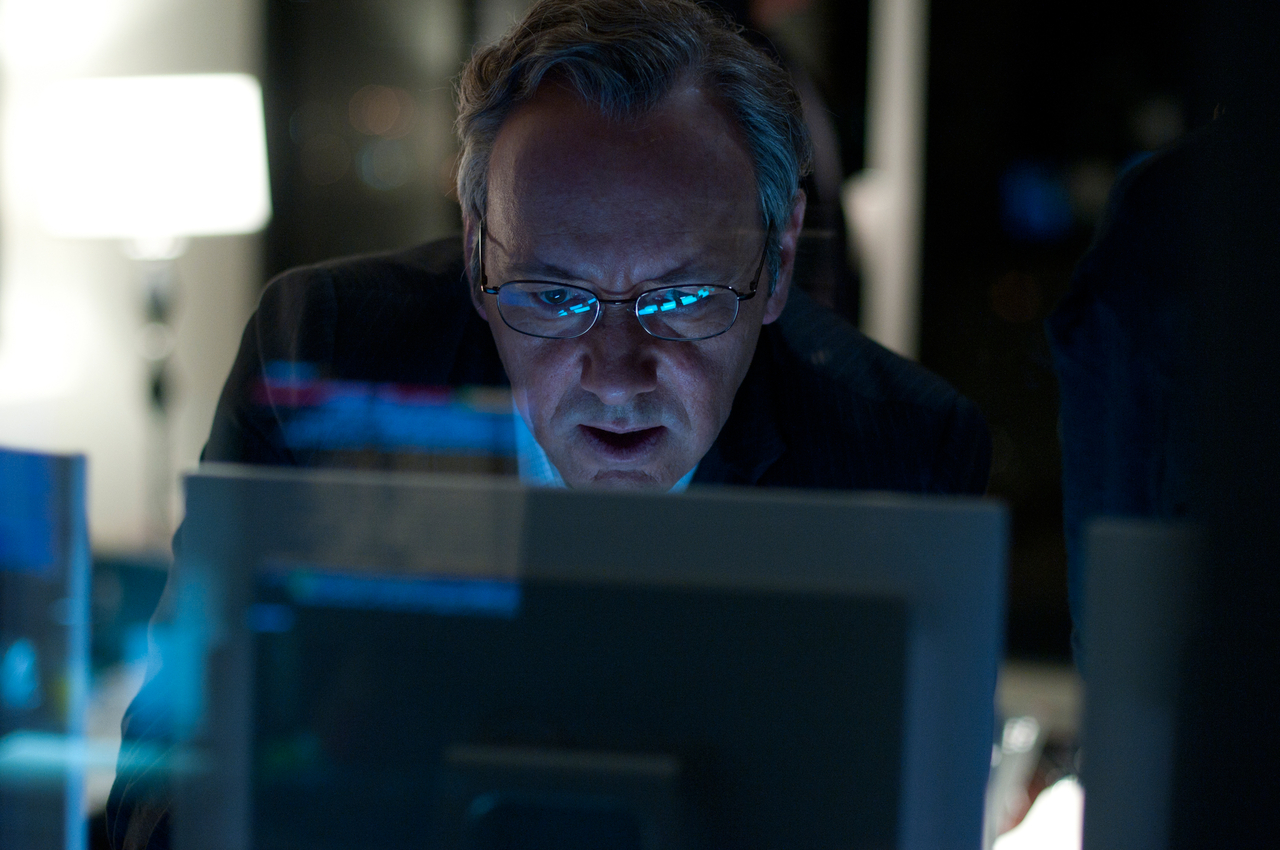

Near the opening of the film Margin Call, investment bank CEO John Tuld distills the cruelest survival rule of capitalist markets into a single line: "There are three ways to make a living in this business — be first, be smarter, or cheat. I don't cheat. And although I'd like to believe we have some smart people here, it's a hell of a lot easier to just be first." The line cuts straight to the mechanism of greed and fear that operates beneath the market's most dazzling surface.
The film opens as Eric Dale, head of risk management at a major Wall Street investment bank, is fired and hands junior analyst Peter Sullivan a USB drive containing a mysterious financial simulation. Working alone through the night, Sullivan discovers that the firm's leverage ratio has already breached its limits — a drop of just a few percent in asset prices would render the company completely insolvent. At an emergency meeting convened at 2 a.m., CEO John Tuld's chosen path was ruthless: the moment markets opened at dawn, the firm would dump its toxic assets in a fire sale before anyone else could move. Whether the partners and retail investors who had trusted the firm were ruined in the process was irrelevant. It was the pure survival instinct of an apex predator sprinting for the exit first.
The ending is bleak. Sam Rogers, the firm's head of risk who had spent more than 30 years at the company, knew the operation would devastate the market — yet he followed Tuld's orders, rallying his traders to offload worthless assets onto clients at a frantic pace. The firm survived by shedding every piece of toxic leverage, but countless investors were wiped out, the market descended into chaos, and the employees who had soiled their hands disposing of the assets were promptly let go. In the film's final scene, Sam Rogers — one of the few survivors, clutching tens of millions of dollars in bonuses — digs a grave for his dead dog in the yard of his ex-wife's home, shoveling in silence. Against the glittering skyline, the film closes with a chilling message: those who sold their conscience to secure capital's survival are left with nothing but a hollow shell.
The fatal boomerang of unchecked intellect and financial engineering
The "betrayal of the mathematical model" that Peter Sullivan confronted in the film maps directly onto the tragic landscape now facing South Korea's asset markets. The most potent catalyst that the domestic financial investment industry has thrown into this market of greed is a set of single-stock leveraged ETFs and ETNs — products designed to deliver twice the daily price movement of individual names such as Samsung Electronics and SK Hynix. These instruments flatly contradict the foundational principle of funds — that diversification offsets volatility and risk — and instead bet an investor's entire fortune on one or two giants. Retail investors, blinded by boundless optimism over the AI semiconductor boom, embraced these instruments without hesitation, and the market rapidly entered the mindless intoxication of a "lemming syndrome," with the crowd charging headlong toward the cliff's edge.
In a rising market, single-stock leverage offers strong returns to investors gripped by FOMO. But structurally, these products carry a fatal poison known as volatility drag — the negative compounding effect. When the underlying share price moves sideways or suffers a sharp drop, the leveraged product's value erodes at twice the speed, inflicting irreversible losses. The moment earnings concerns surface among global technology stocks, Icarus's wax wings melt without fail. Should SK Hynix and Samsung Electronics suffer a sharp intraday plunge, investors holding leveraged products engineered to track twice the downside would face a structural collapse and a catastrophic cascade of forced liquidations in an instant. The price of speculative conviction — piling excessive leverage onto a single engine while intoxicated by the illusion of indicators — is this cold.
The 1,500-won exchange rate threshold that mocks complacent optimism
A time bomb far more macroeconomically destructive than the collapse of individual assets driven by single-stock leverage is ticking in the foreign exchange market. Authorities and market experts had long soothed economic actors with complacent optimism, calling the 1,400-won-per-dollar level a "new normal" reflecting global dollar strength. But as the intraday rate surged into the mid-1,500-won range, skepticism emerged about the defenses of a Korean economy fundamentally dependent on external trade. Not even the national emergency of the martial law crisis produced an exchange-rate shock this destructive. To say that a runaway won-dollar rate — beyond a mere price fluctuation — is the most candid indicator that an irreparable fault line has opened in South Korea's international creditworthiness as assessed by global capital markets is hardly an exaggeration.
In any case, the sustained selling of Korean equities by foreign investors demands vigilance. The fractures in the foreign exchange market mirror the ruthless survival instinct of the apex predators in Margin Call who sprint for the exit first. The moment global capital and overseas investors detect a vulnerability in the Korean economy, they execute an exodus — dumping won and securing dollars — before anyone else, to shield themselves from asset losses. Once that stage is reached, monetary policy is completely cornered. Cutting interest rates to defend against weak domestic demand risks capital flight and a surging exchange rate; pressing the tightening pedal to stabilize the won risks snapping the backbone of a real economy already at its debt limit.
![A bank employee holds a $100 bill in Taipei.
[AFP/Yonhap]](https://wimg.heraldcorp.com/news/cms/2026/06/11/news-p.v1.20260608.58ff65f89e914c259fd3f3b93a91a19a_P1.jpg)
The exodus behind the false crown — and the national pension's dilemma
Even as the Korean stock market boasts outward growth and rising global stature, a silent retreat by foreign investors has been unfolding beneath the surface. Undistracted by the glitter of headline indicators, they have methodically calculated the currency-loss risk from a rising exchange rate and the heavy concentration in certain sectors, taking profits whenever the opportunity arose. It is a dispiriting picture: while foreign predators — like the protagonists of Margin Call — are first out the door, pocketing real gains, ETF-focused retail investors are left absorbing the full weight of that selling pressure.
The future posture of the national pension fund — which this year ranks third in the world by assets on the back of strong index gains — deserves close attention. The fund has grown so large that it appears to have lost the agility to rebalance its portfolio nimbly when markets overheat, and it has been slow to lock in profits. The essence of investing is not merely to inflate the book value of assets, but to secure their safety by crystallizing gains at the right moment. When returns have been made, realizing a portion of those profits is the right course of action.
Yet the national pension fund remains shackled by structural and institutional pressures — including the implicit obligation to prop up the market's downside — and has been unable to press the profit-realization button in time. Foreign investors lock in short-term gains and leave, guided by survival instinct, while the national pension sits with assets frozen at peak prices to maintain a false crown. When the liquidity of a giant fund stiffens, the risk ultimately transfers to the Korean public in the form of lower pension returns — a cruel irony for citizens who already firmly believe the pension will run dry.
The global tightening trap and the prelude to a leverage tragedy
The convulsions in single-stock ETFs and the foreign exchange market are not isolated mutations. The world is currently ensnared in a massive tightening trap — persistent inflationary pressure and the sharp rise in bond yields driven by efforts to contain it. As interest rates, the price and cost of money, have surged, the false muscles of an asset market that once seemed capable of expanding indefinitely on the force of liquidity have begun to buckle all at once. Even bitcoin — once celebrated as a digital safe haven — has lost its support and fallen without end, demonstrating just how savagely leverage can turn into a weapon of mass destruction when asset prices decline.
This catastrophic inflection point aligns precisely with the "bankruptcy of the mathematical model" that junior analyst Peter Sullivan uncovered in Margin Call. The investment bank in the film piled on leverage dozens of times over, based on a complacent risk model that assumed asset prices would rise forever — but when the faintest crack appeared in the macro environment, that lever instantly transformed into a monster that devoured the firm whole.
The current surge in global bond yields and the collapse of the crypto market are a final warning to those who strapped on the thin wax wings of leverage and flew toward the peak of greed. When asset prices move sideways or turn lower, high interest rates become a cost bomb that squeezes the life out of leveraged investors. Ultimately, the cascade of margin call pressure that follows the collapse of underlying assets is forcing the entire real asset market to relive that desperate, cold moment in the film when John Tuld had to dump every toxic asset onto the market just to survive. A mirage built on debt will always evaporate without a trace when confronted with the cold reality of rising rates.
It is true that the current situation is not identical to the dot-com bubble — the two semiconductor giants are generating substantial earnings. Still, can anyone claim to know the future with certainty? That is precisely why the saying goes: the stock market is not a domain of prediction, but of response. The hallucination of AI tokens — the value assigned to factories that produce intelligence — combined with excessive leveraged speculation in asset markets and a runaway exchange rate, leads to an outcome this chilling. The market fractures witnessed this time go beyond a simple short-term price correction. They represent a structural fault line in South Korea's macro-financial environment — vulnerabilities that had been hiding behind the grand narrative of a technological paradigm leap — erupting all at once. No matter how dominant a semiconductor's technological edge, if the macroeconomic foundation and foreign exchange defenses of the country it stands on are unsound, the financial mirage cannot hold.
Confronted with the warning lights of single-stock leverage and the abnormal fracture of a won-dollar rate in the 1,500-won range, we must squarely face the structural contradiction of a Korean financial system that has grown bloated and finds itself wedged in the exit just as foreign capital, following its risk calculus, sprints for the door first. Blind faith in past patterns and premature optimism cannot prevent the coming structural inflation driven by supply-side shocks, the surge in bond yields, or the catastrophe of a collapsing international credit standing. What South Korea needs now is not the outward bulk of a false crown. We must boldly strip away the intoxication of speculation and step onto the cold scale of genuine value — lest the Korean asset market repeat the hollow scene of Sam Rogers in Margin Call: clutching his bonus after turning the financial markets into a wasteland, digging in silence in a barren front yard to bury his dead dog.
It is time to erase the dazzling illusion that indicators project and face the bare reality of the real economy. Only by confronting that essential truth with clear eyes can we halt Icarus's tragic fall and set a genuine course for the South Korean economy once more.
J.C. Chandor
J.C. Chandor (born 1973) is the director of Margin Call. He grew up in New Jersey with a father who spent 40 years at an investment bank — Merrill Lynch — and that upbringing proved a decisive asset in the realistic Wall Street portrayal of his debut feature. Chandor made a celebrated entry into feature filmmaking in 2011 with Margin Call, which he also wrote, earning an Academy Award nomination for Best Original Screenplay.
bonsang@heraldcorp.com