![[Yonhap]](https://wimg.heraldcorp.com/news/cms/2026/06/24/news-p.v1.20260624.3a2ec21f5224471085408abc5f23147e_P1.jpg)
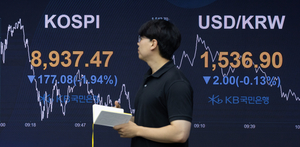
Despite the Kospi triggering a circuit breaker for the fourth time this year and falling nearly 10 percent during trading, analysts say the market's underlying fundamentals remain intact and the selloff presents a buying opportunity. Daishin Securities maintained its third-quarter Kospi target of 11,500 points and forecast a rally in July and August.
"Nothing has changed except investor sentiment and supply-demand dynamics," Lee Gyeong-min, a researcher at Daishin Securities, said in a report Wednesday. "A phased buying strategy with the primary support level at 8,000 and the secondary at 7,700 in mind remains valid," he said.
Daishin Securities identified four factors behind Tuesday's sharp decline: Bank of America's forecast of three interest rate hikes this year, South Korea's failure to be added to MSCI's developed-market watchlist, a delay in approval for SK Hynix's American depositary receipts, and concerns over month-end rebalancing by domestic and foreign pension funds. However, the brokerage said these were short-term variables affecting sentiment and fund flows — not factors that damage corporate earnings or underlying fundamentals.
Lee was also skeptical about the rate-hike outlook. "It is a somewhat excessive forecast," he said. "With oil prices falling and June consumer price index and personal consumption expenditure data expected to come in softer than May, there is no reason to rush into rate hikes." He added that the Federal Reserve's dot plot merely leaves open the possibility of a rate hike in 2026 and does not signal the start of a rate-hike cycle.
On South Korea's failure to be added to the MSCI developed-market watchlist, Lee said the impact on actual capital inflows would be limited even if market sentiment takes a hit. "Whether or not Korea is added to the MSCI developed-market watchlist does not determine whether global liquidity flows in," he said. "It is a psychological setback and a disappointment factor — the direct impact is limited."
Lee also characterized the SK Hynix ADR approval delay as little more than a cycle of short-term hope and disappointment. "The optimism that drove Monday's surge simply turned to disappointment, prompting selling," he said. "The impact on fundamentals is limited — it is a matter of time."
He also cautioned against reading too much into concerns about pension fund selling. "If they are rebalancing at the end of June, they would need to start offloading now," he said. "The presence of potential selling pressure is worth keeping in mind, but reports of a sudden flood of sell orders are overblown."
Daishin Securities said the correction has actually made the Kospi more attractive on a valuation basis. The index's 12-month forward earnings per share has continued to climb to around 1,089 points, while the sharp drop has pushed the forward price-to-earnings ratio down to 7.53 times.
Positive signals are also emerging on the supply-demand front. Foreign investors net purchased 3.3 trillion won ($2.15 billion) in the final minutes of Tuesday's session and in the after-hours futures market, closing the day with net purchases of 2.14 trillion won.
"A similar pattern appeared during the circuit breaker on June 8," Lee said. "Even with short-term fluctuations, it is a signal that the index is approaching a bottom."
He also pointed to the market's swift recoveries following each of the three circuit breakers triggered this year as supporting evidence — after drops of 12.06 percent on March 4, 5.96 percent on March 9, and 8.39 percent on June 8, the Kospi rebounded each time.
"Looking at past cases, sharp drops that occurred without any deterioration in earnings momentum have consistently been followed by strong rebounds," Lee said. "Those recoveries were underpinned by easing geopolitical risk between the US and Iran and improving earnings, which ultimately pushed the Kospi above the 9,000 mark."
He added that Tuesday's circuit breaker, unlike previous ones, was triggered in the absence of major external headwinds such as US-Iran war risk, a spike in global oil prices, or rising US government bond yields. "With the second-quarter pre-earnings season approaching, fundamental momentum is expected to strengthen as earnings forecast upgrades resume," he said.
"Investors with high equity exposure need to hold their positions," Lee said. "Those sitting on cash should consider phased buying of leading stocks in preparation for the Kospi's move into the 10,000-point era." He added that Daishin Securities maintains its forecast of a market rally in July and August and its third-quarter Kospi target of 11,500 points.
Market analysts broadly agree that the latest drop reflects a short-term correction driven by sentiment and fund flows rather than any deterioration in fundamentals. Expectations for earnings improvement — particularly in the semiconductor sector — remain intact, and second-quarter corporate results are being closely watched as the key variable that will determine whether the market rebounds.
The government said South Korea could eventually be included in the MSCI developed-market index if reforms to the foreign exchange and capital markets continue.
rainbow@heraldcorp.com