Government probe finds widespread misuse of meal cards for children at risk of hunger; about 17.1 billion won in loaded funds goes unused annually
![[123RF]](https://wimg.heraldcorp.com/news/cms/2026/06/24/news-p.v1.20260624.002d4916f1c144029be6f70700087dc0_P1.jpg)
Meal cards issued to help feed children from low-income households have been used to buy alcohol and tobacco, and at cafes and PC bangs, a government investigation has found. In some cases, guardians who had abused children and had them placed in care facilities continued using the cards to pay for their own meals.
The Government-Joint Anti-Corruption Task Force under the Office for Government Policy Coordination released the findings Wednesday together with the Ministry of Health and Welfare.
The child meal card is issued by local governments to prevent hunger among children under 18 from vulnerable households — including recipients of basic livelihood benefits and single-parent families. As of last year, 182 local governments were issuing and operating the cards, with about 150,000 children enrolled. The Ministry of Health and Welfare recommends that local governments set a per-meal allowance of at least 10,000 won ($7).
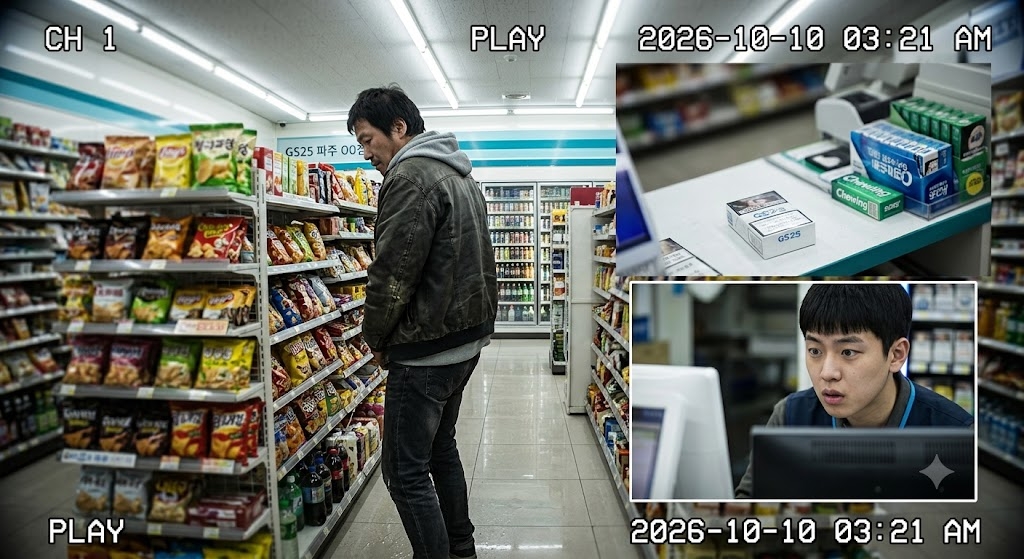
A sample survey of all 17 metropolitan cities and provinces conducted from January through August last year found that 13 of them — all except Seoul, Incheon, Busan and Gwangju — recorded purchases of alcohol and tobacco using the meal cards. Most general supermarkets, unlike convenience stores, lacked payment-blocking systems, making it possible to buy items unrelated to meals.
Investigators also found cases in which parents made fraudulent charges at their own restaurants, or conspired with store owners to purchase household goods such as detergent and tissue paper.
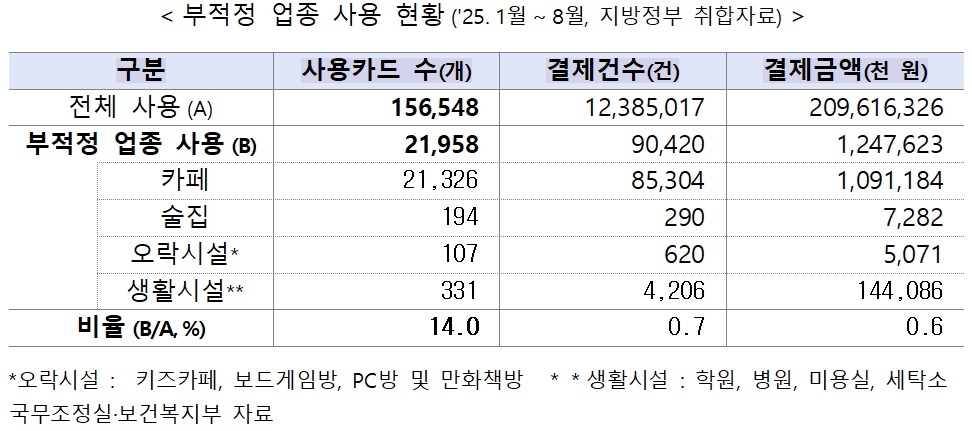
Spending at venues unrelated or inappropriate to the program's purpose was also confirmed. A total of 150 million won (0.1 percent of total spending) was used at cafes (about 1.1 billion won), lifestyle facilities such as hagwon, hospitals and hair salons (about 140 million won), bars (about 7 million won), and entertainment venues such as PC bangs and comic book cafes (about 5 million won).
Poor management by local governments also came to light. Some municipalities managed meal card recipients through separate systems without registering them in Haengbok e-eum, the government welfare information system, and failed to update eligibility records in a timely manner when children entered care facilities, died or graduated. As a result, meal cards were used even after children had been placed in protective facilities or had died.
On the other side of the problem, 17.1 billion won — 7.8 percent of the total 220.7 billion won loaded onto the cards — expired unused. About 4,800 children used less than 10 percent of their loaded balance, in some cases because they did not know how to use the cards or feared the stigma of being seen doing so.
To ensure the cards are used as intended, the government said it will recommend that local governments adopt a set of improvements: upgrading the merchant network and card payment systems; excluding merchants where children have made non-meal purchases; making registration in the Haengbok e-eum system mandatory and strengthening management of card issuance and eligibility changes; and improving guidance on how to use the cards and on unused balances. The government said it will also monitor and support implementation.
Kim Yeong-su, head of the task force, said the investigation confirmed that local governments had focused on issuing the cards while neglecting oversight. "The meal card has its merits, but we also need to consider alternatives that better serve the program's purpose — such as dosirak or banchan delivery," he said.
Hyeon Su-yeop, first vice minister of Health and Welfare, said the ministry would continue expanding the network of merchants that can block payment for inappropriate items at the point of sale. "We will also significantly strengthen user-tailored guidance so that support funds are not left unused simply because children do not know which restaurants accept the card or what their balance is," he said.
thlee@heraldcorp.com